
Profit is an opinion shaped by accounting rules. Cash is a bank balance. The gap between those two ideas is where most founder-led companies get surprised, and the cash flow statement is the report built to close it.

What a Cash Flow Statement Is
A cash flow statement reports the cash that moved into and out of a business during a period, sorted into operating, investing, and financing activities. It starts with the cash you had, adds or subtracts each category, and ends with the cash you actually hold. It measures cash movement over time, not accrual profit.
Anyone who signs payroll, negotiates a credit line, or plans a capital purchase needs to read one. A lender will ask for it. So will a buyer during diligence.
How a Cash Flow Statement Works
The mechanism is arithmetic. It only runs one direction. Beginning cash and cash equivalents, plus net operating cash flow, plus net investing cash flow, plus net financing cash flow, equals ending cash and cash equivalents. The bottom subtotal carries the name net increase or decrease in cash, and it has to tie to the movement in the cash line on your balance sheet. If it doesn’t tie, the statement is wrong. Not the bank.
A few terms you’ll hear from your controller or your CPA:
- Cash and cash equivalents covers cash on hand, bank balances, and qualifying short-term instruments such as money market funds.
- Restricted cash is cash you hold but cannot freely spend, and it gets its own treatment.
- Direct method and indirect method are two ways to present the operating section.
- Noncash investing and financing transactions, like equipment bought entirely with seller financing, never touch the cash totals. They get disclosed separately.
That last point trips people up. A $200,000 debt-for-equity conversion moves liabilities and equity but produces no cash inflow, so it lives in a footnote rather than in the financing section.
Operating, Investing, and Financing Activities
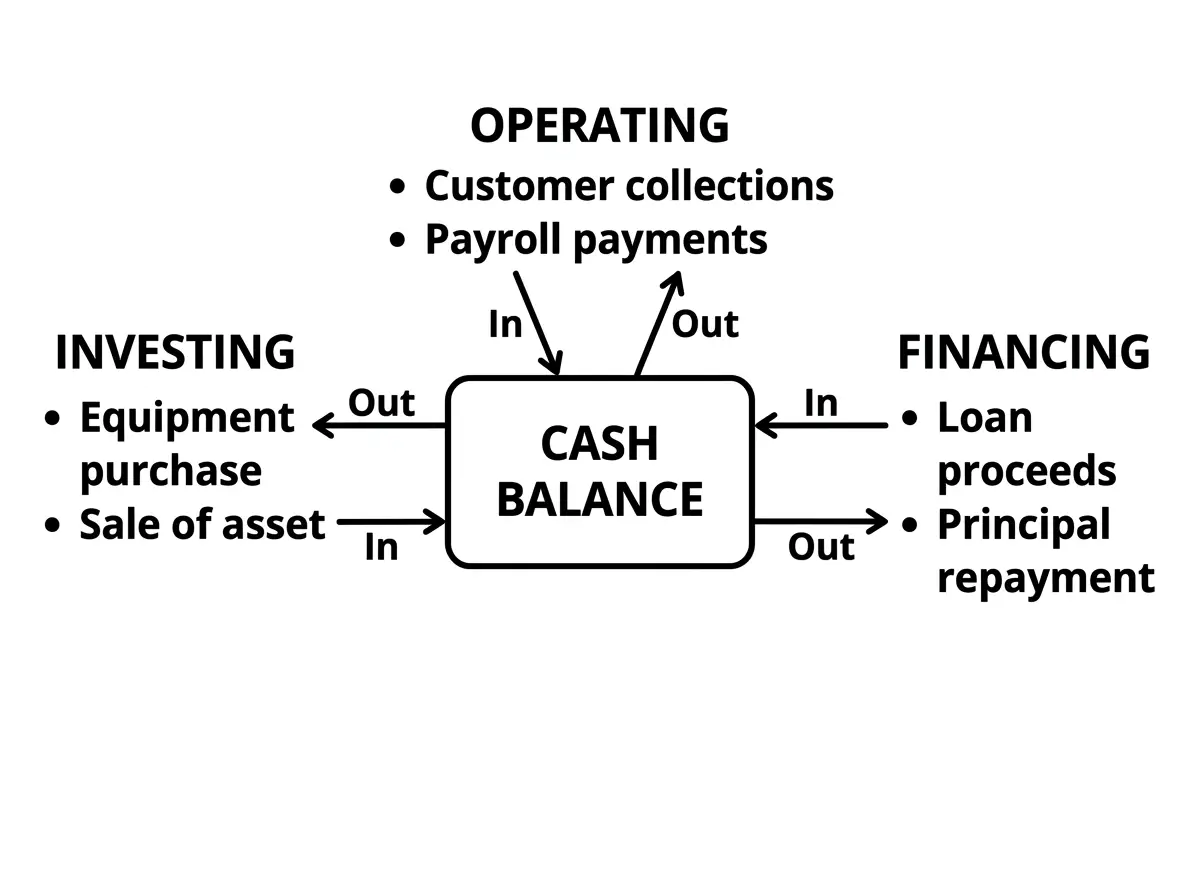
Operating covers the principal revenue-producing activity of the business: cash collected from customers, cash paid to suppliers, employees, and tax authorities. Investing covers the acquisition and disposal of long-term assets and investments that are not cash equivalents. Financing covers transactions with capital providers, the things that change the size and composition of contributed equity and borrowings.
| Activity | What lands here | Typical lines |
|---|---|---|
| Operating | Day-to-day trading cash | Customer collections, supplier and payroll payments, taxes paid, changes in receivables, inventory, payables |
| Investing | Long-term assets and non-equivalent investments | Equipment and software purchases, acquisitions, divestitures, proceeds from selling a building |
| Financing | Capital providers | Loan proceeds, principal repayments, owner contributions, distributions, share repurchases |
One distinction settles a surprising amount of confusion. A $50,000 owner contribution is financing. A $50,000 equipment purchase is investing. A $50,000 purchase of shares in another company is also investing. The word “investment” points in two directions depending on who is handing over the money.
Worth pausing on: classification of interest, dividends, and certain taxes can differ between U.S. GAAP and IFRS. If you are comparing your statement to a competitor’s filing, check which framework produced it before you draw a conclusion.
When It Matters for Real Businesses
You run into the cash flow statement the moment profit and bank balance stop agreeing. That happens more often than founders expect. Each cause changes a different line.
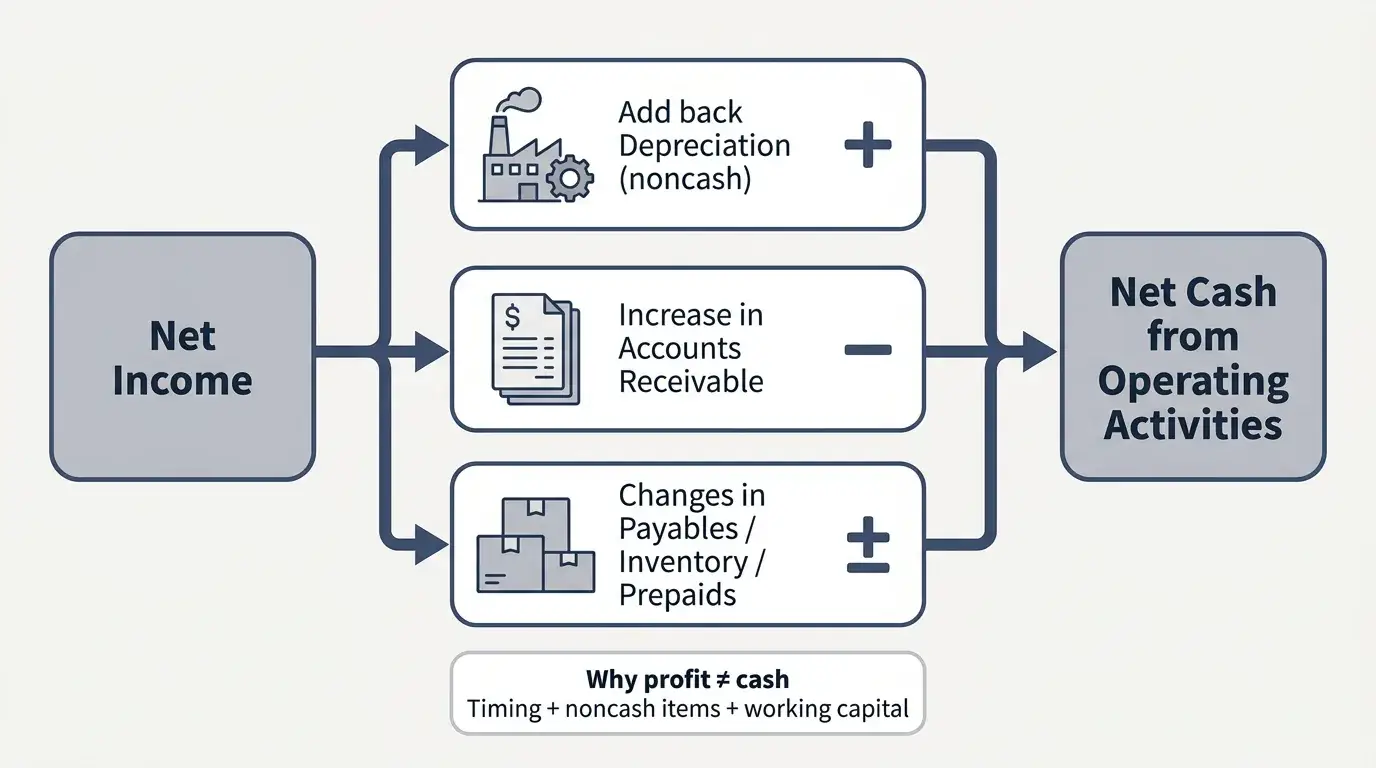
- Profit without cash. A credit sale raises revenue and net income while raising accounts receivable. Operating cash flow absorbs the hit as a negative working-capital change until the customer pays.
- Growth that eats cash. Hiring ahead of revenue, stocking inventory, and funding longer receivable cycles all pull from operating cash flow. A distributor adding a product line often grows profit and shrinks cash in the same quarter.
- Debt service. Interest usually sits in operating under U.S. GAAP. Principal repayment sits in financing and never appears on the income statement at all, which is why a company can post profit and still lose ground on cash every month.
- Asset purchases. A $100,000 machine hits investing once, in full. It then returns to the income statement as depreciation over several years, which is why depreciation gets added back in the operating section. The cash already left.
- Working-capital swings. Receivables up, cash down. Inventory up, cash down. Payables up, cash up, because you are holding someone else’s money a little longer.
Positive total cash flow proves nothing on its own. Borrow $2 million and your cash flow looks fine while operations bleed. Negative total cash flow proves nothing either. A company generating $2 million from operations and spending $1 million on productive assets is in a stronger position than one funding negative operations with fresh debt. The diagnostic question is whether the core business produces sustainable operating cash flow and whether that cash covers capital spending and debt service. The full treatment of recurring liquidity failures is in “cash flow problems”.
If you cannot answer what cash looks like 90 days out in about 30 seconds, that’s a reporting gap. Not a discipline problem. A 15-minute call is usually enough to tell whether the fix is a reporting change or something deeper.
Cash Flow Statement vs. Income Statement
The income statement recognizes revenue and expense when the economic activity happens, whether or not cash moved. The cash flow statement records only cash that moved. The balance sheet is different from both. It shows position at a single date, while the cash flow statement explains what happened between two dates.
Free cash flow is a separate, non-uniform analytical measure generally derived from operating cash flow less capital expenditures. It is not a subtotal on the statement itself. That comparison is covered in “free cash flow”. The step-by-step calculation of the operating section lives in “operating cash flow formula“.
Direct Method and Indirect Method
These are presentation choices. Not different measurements. Both produce the same net cash from operating activities. A cash flow statement direct method presentation lists gross cash receipts and gross cash payments: cash collected from customers, cash paid to suppliers, cash paid to employees. The indirect method starts with net income and reconciles to the same number by adding back noncash items and adjusting for changes in operating assets and liabilities.
When the two appear to disagree, the cause is almost always one of three things: a noncash item captured in one presentation and missed in the other, a balance-sheet movement excluded from the reconciliation, or a reversed sign on a working-capital change. The totals must match. The lines in between never will, and they were never supposed to.
A Small Example of Profit Without Cash
Here is a cash flow statement example with solution, drawn from a marketing agency’s quarter.
Example: agency with $180,000 of profit and $35,000 less cash
| Line | Amount |
|---|---|
| Net income | $180,000 |
| Add back depreciation | $22,000 |
| Increase in accounts receivable | ($165,000) |
| Increase in prepaid media | ($48,000) |
| Decrease in accounts payable | ($24,000) |
| Net cash from operating activities | ($35,000) |
| Purchase of production equipment (investing) | ($40,000) |
| Draw on line of credit (financing) | $75,000 |
| Net change in cash | $0 |
The agency won three large retainers. Revenue and net income both jumped. Those clients pay on 60-day terms, so $165,000 of that profit sat in receivables at quarter end. Media was prepaid ahead of the campaigns. A vendor tightened terms, so payables fell by $24,000 instead of rising. Depreciation of $22,000 reduced profit without touching the bank.
Result: $180,000 of profit, negative $35,000 of operating cash, and a line-of-credit draw covering the equipment purchase. The business is not failing. It is financing its own growth on a revolver, which works until the revolver is full. The cash flow statement purpose, in one line, is to make that visible before the covenant test does.
What to Do Next
The next question depends on what you found. If your statement will not tie, start by walking every balance-sheet account except cash and confirming the period movement appears somewhere in the statement. A single $10,000 reversed sign shows up as a $20,000 gap.
If the issue is forward visibility rather than history, the 13-week view is the tool. That comparison sits in “13 week cash flow”. If working capital is what’s consuming the cash, the hub article “working capital” carries the fuller treatment, and “cash flow forecast” covers whether a forecast is worth building for a company your size.
In my own work, the first 90 days follow a set rhythm: weeks 1 and 2 review cash, reporting, and processes. Weeks 3 through 6 build the forward plan. Weeks 7 through 12 fix the top profit or cash leak and set a review rhythm. That sequence exists because reading the statement is the easy part. Acting on what it shows is where the money is.
If you’re running a founder-led company between $5 million and $50 million without a full-time CFO, and a real decision on cash, margin, or financing is sitting in front of you, start with a short conversation about the decision.

Frequently Asked Questions
What are three types of cash flow statements?
There are three sections, not three statements: operating, investing, and financing. There are, however, two presentation methods for the operating section, direct and indirect, and most private companies use the indirect method because it starts from net income already in the books.
What is cash flow in simple terms?
Cash flow is the movement of money in and out of your bank accounts over a period. Revenue is what you billed. Cash flow is what cleared. A company can bill $500,000 in a month and collect $180,000 of it.
What are five rules of cash flow?
Five that hold up in practice: the statement must tie to the change in cash on the balance sheet. Classify by the nature of the transaction, not the account name. Noncash transactions get disclosed, never counted. Principal repayment is financing even though it feels like an expense. Operating cash flow, not net income, is the number lenders stress-test.
What is the difference between the balance sheet and the cash flow statement?
The balance sheet is a photograph at one date. The cash flow statement is the film between two dates, explaining how the cash line on the earlier balance sheet became the cash line on the later one.
Is depreciation an operating cash flow or a noncash adjustment?
It is a noncash adjustment. Under the indirect method, depreciation is added back to net income in the operating section because it reduced profit without moving cash. The cash left earlier, in the investing section, when you bought the asset.
Are loan proceeds and loan repayments operating or financing cash flows?
Both are financing, because they change the size of borrowings. Interest paid is generally operating under U.S. GAAP, which means a $50,000 quarterly debt payment can split across two sections of the same statement.
Why are noncash investing and financing transactions disclosed separately?
Because including them would break the arithmetic. Equipment acquired with seller financing changes assets and liabilities without any cash leaving the account, so it appears in a supplemental disclosure where a reader can see the economic event without distorting the cash totals.
What’s the best cash flow management software?
The reporting tool matters less than the mapping behind it. Most wrong cash flow statements from accounting software trace to account mapping, a misstated opening cash balance, undeposited funds, or bank transfers double-counted. Fix the mapping before you change platforms.