
A cash flow problem almost never has one cause. It has a dominant cause and two or three passengers, and the fix depends entirely on which one is driving. Late customers, thin margin, inventory, growth, and debt service all drain the same bank account. The symptom looks identical from the outside. The work is sorting them in the right order, fast, before a timing gap turns into a solvency question.
What follows is the triage sequence I run with founder-led companies: match the symptom, judge the urgency, confirm the cause with a report you already have, then fix it.

Quick diagnosis: what symptom matches your cash flow problem?
Start by matching what you are seeing in the bank account to the cause that produces it most often. The table below ranks the common causes of cash flow problems in business by how frequently they show up in a $5M to $50M company and how much damage they do if ignored.
| Symptom | Most likely cause | Urgency | Next step |
|---|---|---|---|
| P&L shows profit, balance keeps falling | Receivables and inventory absorbing cash | Medium | DIY diagnosis, pro if it repeats |
| Receivables aging past 60 days, sales flat | Slow collections, disputed invoices | Medium | DIY |
| Revenue up, cash down | Growth funding itself out of the bank | Medium to high | Pro |
| Gross margin fine, still short every month | Fixed costs above recurring gross profit | High | Pro |
| Line of credit never comes off the ceiling | Borrowing covering operating losses | High | Pro |
| Supplier moves you to cash on delivery | Creditor confidence dropping | High | Pro |
| Payroll or withheld payroll taxes at risk | Liquidity failure | Act today | Pro |
Three checks tell you most of what you need before anyone opens a spreadsheet:
- Trailing 12-month operating cash flow. Negative means the problem is structural, not timing.
- Aged receivables total versus one month of operating outflow. If receivables exceed it and the balance is still falling, cash is trapped, not lost.
- Weekly outflow run rate. Divide available cash plus confirmed receipts by it. That gives you runway in weeks.
Is this urgent, or can it wait until next week?
Normal cash strain looks like a tight Friday followed by a comfortable Tuesday, with the whole cycle visible in advance. Urgent looks like an obligation you cannot fund and cannot reschedule. business.gov.au reports that a reduced cash flow puts a business at risk of not being able to pay debts or cover day-to-day operating costs, and the signals below say that risk has already arrived.
Warning: act today if any of these are true
- Payroll runs this week and the funds are not there or not certain.
- Withheld payroll taxes or sales tax collected from customers were spent on operations.
- A payment was dishonoured, or a check was held back to avoid one.
- A key supplier has cut terms, stopped credit, or demanded cash on delivery.
- The revolving facility has sat at its ceiling for more than 30 days and the lender has declined an increase.
- A statutory demand, collection notice, judgment, or attorney letter has arrived. That is a legal deadline, not an invoice.
- You are counting on one large customer payment or one pending contract to make it through the month.
Anything on that list means a weekly cash view and a conversation with your lender before you default. Not after. A single late invoice from a reliable customer, a seasonal dip you forecasted, or a one-time equipment purchase can wait until next week’s review.
Why is my business profitable, but there’s no cash in the bank?
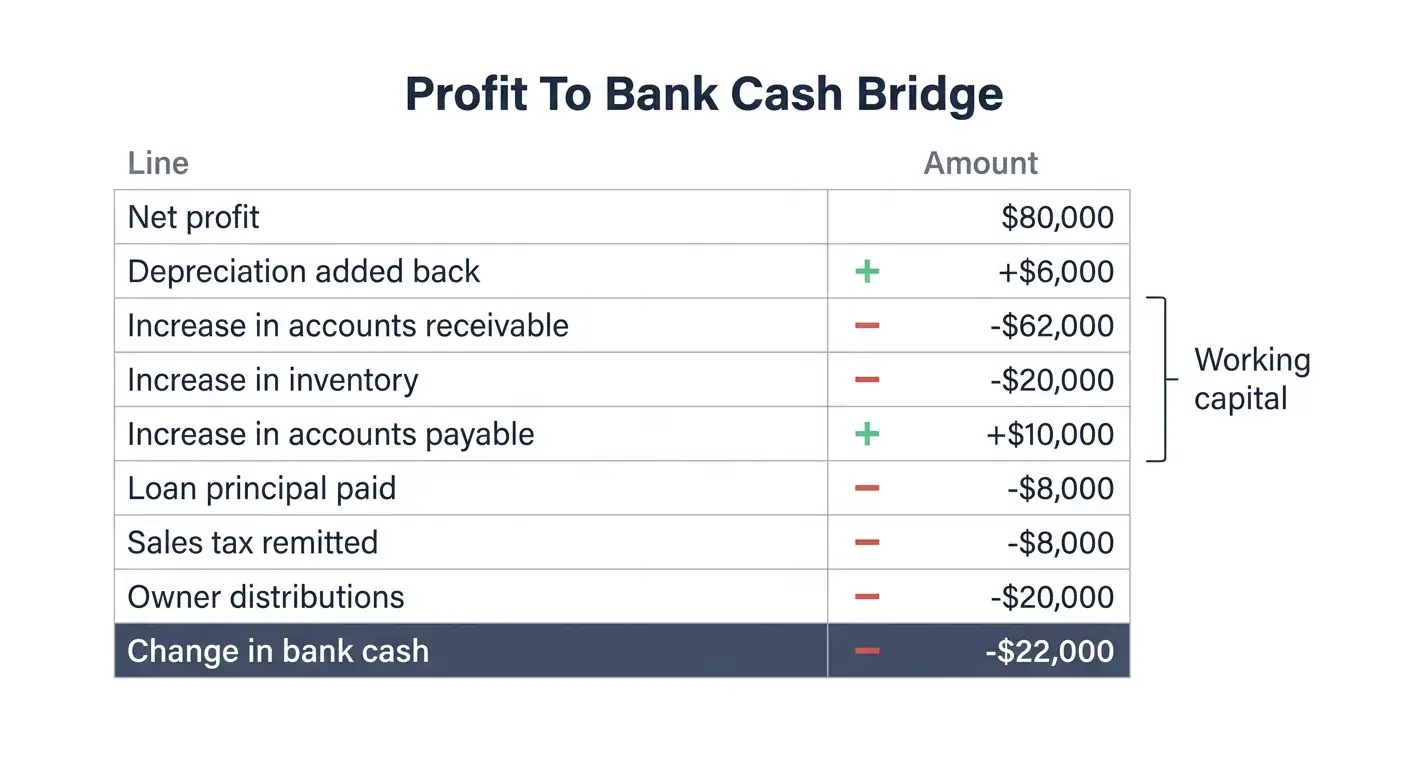
Profit is an accounting result. Cash is a timing result. Here is a real reconciliation shape from a distributor with a good month on paper and a worse month in the bank.
| Line | Amount |
|---|---|
| Net profit | $80,000 |
| Depreciation added back | +$6,000 |
| Increase in accounts receivable | -$62,000 |
| Increase in inventory | -$20,000 |
| Increase in accounts payable | +$10,000 |
| Loan principal paid | -$8,000 |
| Sales tax remitted | -$8,000 |
| Owner distributions | -$20,000 |
| Change in bank cash | -$22,000 |
Now trace one invoice through it. The company bought and paid for the goods in February. It shipped on March 3 and invoiced $48,000 on net 45 terms, so March books the revenue and the margin. The customer pays on day 62, which lands in mid-May. Profit hits in March, cash left in February, and cash returns in May. Repeat that across a growing order book and a profitable company runs its balance down every month while the P&L keeps saying yes.
The permanent fix is a forward view rather than a backward one. A 13-week cash and working-capital view is one of the deliverables I build in a CFO Decision Diagnostic, and it answers what cash looks like in 90 days in about 30 seconds. For how the statement itself separates operating, investing, and financing movement, the full explanation lives in “What Is a Cash Flow Statement? A Simple Guide.”
Late customer payments
Confirm this cause before you accept it. Pull the aged receivables report, calculate days sales outstanding against your stated terms, then split the overdue column into three buckets: invoices the customer disputes, invoices stuck in their approval process, and invoices they simply have not paid. Customers often paying late is a recognized sign of a cash flow problem, because it leaves the business without enough cash to cover costs it has already incurred.
The fix, in order:
- Call the five largest overdue accounts personally this week. Not email.
- Clear every disputed invoice, even at a partial credit, because a disputed invoice collects nothing at all.
- Fix your own bottleneck first. Invoices issued five days after delivery are five days of free credit you gave away.
- Move new work to deposits, milestone billing, ACH autopay, or card on file.
- Set a credit limit and a stop-work threshold, then enforce both.
The wrong fix: discounting to get paid faster, across the board. A 2% discount for net 10 on a 20% gross margin job gives up a tenth of your margin to accelerate cash by about 20 days. Do that on every account and you have converted a collections problem into a margin problem.
If left alone: receivables keep aging, the oldest balances become uncollectible, and you end up financing customers who already decided not to pay on time.
Expenses are outrunning receipts
Timing problems and burn problems look the same in a bank balance. They look completely different on a weekly grid. Lay out 13 weeks with confirmed receipts, probable receipts, and every outflow, then look at the pattern. If the weekly deficits alternate with surpluses and the closing balance trends flat, you have timing. If the closing balance steps down every single week regardless of collections, you have a structural burn.
At Morgan Fractional CFO I run a Quarterly Profit Focus with clients: one leak measured and fixed each quarter, whether that is workers comp, card fees, inventory or fleet, turnover and overtime, or media spend. One leak, measured, closed, then the next. That beats a broad cost-cutting sweep for a simple reason.
Cut too far and the savings reverse on you. Pulling maintenance, quality control, insurance, or the people who deliver the work creates rework, churn, and claims that cost more than the line item saved. Sales and collections headcount are the two places where cutting reliably makes cash worse. Start instead with recurring contracts nobody has renegotiated in three years, unused software seats, and customers or SKUs sitting below your contribution margin threshold.
Growth is consuming cash
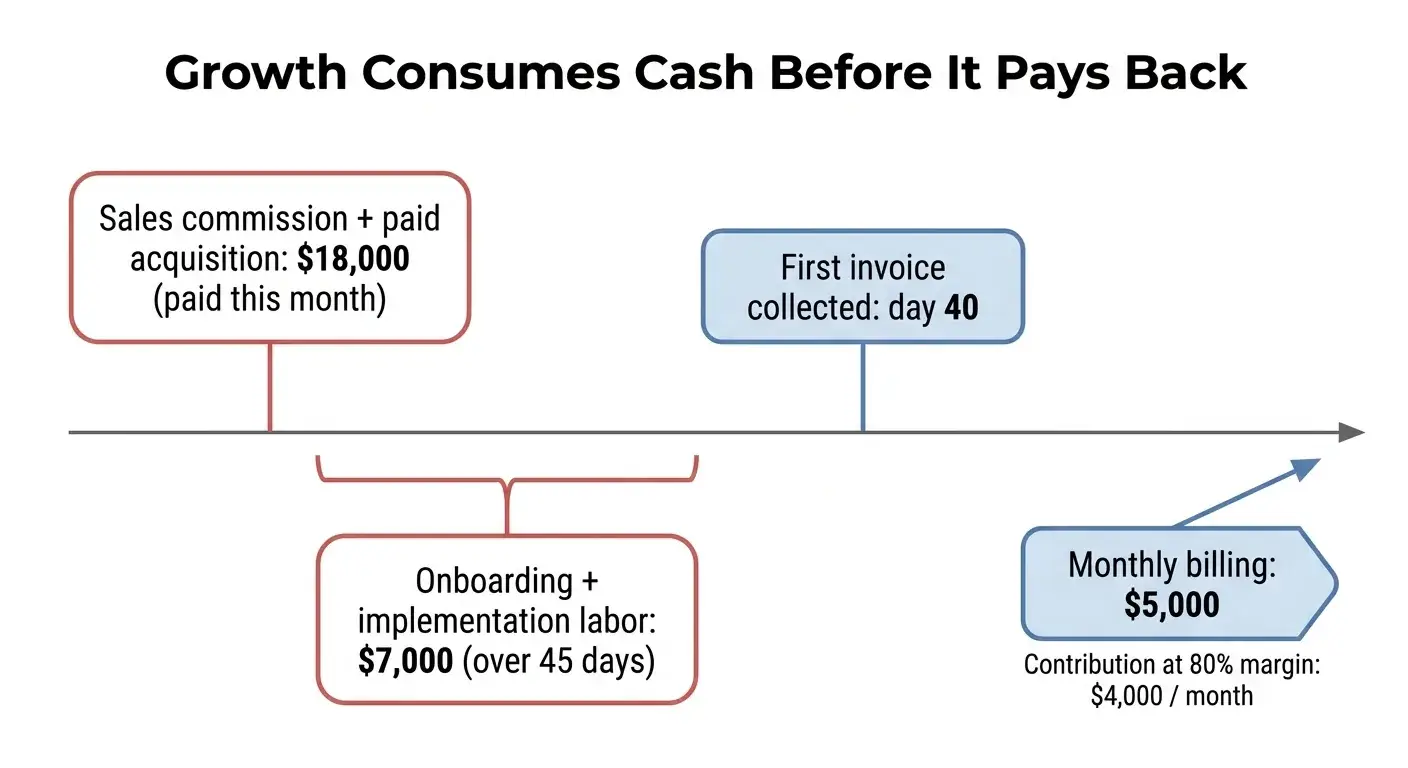
Growth makes cash flow worse because you pay for the customer before the customer pays you. Every new unit of revenue carries an upfront cost, and the gap between that cost and the first collected dollar is funded out of your bank account. Like trying to drive faster while the tank is emptying.
Take a SaaS company adding a $60,000 ARR customer billed monthly:
- Sales commission and paid acquisition: $18,000, paid this month
- Onboarding and implementation labor: $7,000, spent over 45 days
- Monthly billing: $5,000, at 80% gross margin, so $4,000 of contribution per month
- First invoice collected on day 40
That single customer is $25,000 out the door against $4,000 a month coming back. CAC payback lands past six months once you count onboarding. Sign ten of them in a quarter and you have committed $250,000 of cash to earn $480,000 of contribution over the following year. The deal economics are good. The cash timing will still break the company if the facility is already tight.
An e-commerce retailer hits the same wall through inventory: the season’s buy is paid on deposit plus balance at shipping, sitting in a warehouse for 90 days before it sells. Both cases need the same answer, which is a funded growth plan rather than a slower one. If you want a second set of eyes on what your next 12 months of growth will actually consume, a 15-minute call is usually enough to tell whether the gap is fundable.
Borrowing is masking the real problem
Before any financing conversation, answer one question: is the cash gap temporary or structural? Temporary means trailing 12-month operating cash flow is positive, contribution margin is healthy, and the shortfall is caused by receivables, inventory, or a seasonal trough that reverses on a date you can name. Structural means the business loses money at current volume and pricing. Debt fixes the first and accelerates the second.
Signs that borrowing will only delay the pain:
- The facility has been fully drawn for two or more consecutive quarters with no paydown month.
- New borrowing funds payroll rather than inventory, receivables, or equipment.
- You cannot show a repayment source with a date attached.
- Debt service consumes more than your average monthly operating cash flow over the last year.
- Each round of financing is more expensive and shorter than the last.
Match the instrument to the asset. Receivables finance against receivables, a revolver against a working-capital cycle, term debt against equipment. Funding a recurring operating loss with a merchant advance stacks an effective rate on top of a problem the rate makes harder to escape. For the side-by-side comparison of facility types, collateral, and what each one costs, that work belongs in “Working Capital Guide: Costs, Options and When to Hire.”
What bills should I pay first when cash is tight?
When you cannot pay everyone in the same cycle, pay in this order and document the reasoning as you go.
- Net payroll. Employees have the strongest legal claim and the shortest fuse. As Washington State L&I notes, Washington employers must pay employees at least once per month on a regular, scheduled payday.
- Withheld payroll taxes and sales tax collected from customers. This money was never yours. Spending it invites penalties, enforcement, and personal exposure for officers.
- Insurance and the utilities that keep operations running. A lapsed policy or a shut-off converts a cash problem into an uninsured one.
- Single-source and critical suppliers. Protect the two or three vendors whose stop-credit would halt delivery. Call before the due date with a schedule you can hold.
- Secured lenders. Missing a payment can trigger default and covenant consequences far beyond the payment amount.
- Remaining taxes, under a formal arrangement. Request the plan rather than going quiet.
- Everything discretionary. Subscriptions, travel, non-essential projects, and any spend that can restart in 60 days without damage.
Three payment choices create real risk. Paying the loudest creditor in full while payroll and trust-fund taxes go unfunded exposes officers directly. Round-number payments that match no invoice look like creditor triage in hindsight and complicate any later insolvency review. Paying a related party or an owner loan ahead of trade creditors is the one that draws the most attention of all.
If you are already sequencing payments, the diagnosis phase is over and you need a forward cash view and a lender conversation this week. That is the point where a founder should stop working it alone. Book a 15-minute call and describe the decision in front of you, and I will tell you straight whether this is a 13-week problem or a restructuring one.
Frequently Asked Questions
What financial reports confirm the cause of a business cash-flow crisis?
Five, in this order: the aged receivables ledger, the aged payables ledger, a 13-week weekly cash view, gross margin by customer or product for the trailing 12 months, and the debt maturity and covenant schedule. Receivables and payables aging together tell you whether the problem is collection speed or creditor pressure. Margin by customer tells you whether volume is even worth collecting.
Is a business insolvent if it cannot pay suppliers but still has assets?
Possibly, because the cash-flow test looks at whether you can pay debts as they fall due, not at what the balance sheet says you own. Assets may be pledged to a lender, obsolete, or impossible to sell in the 30 days you have. Positive net assets and an empty bank account can exist at the same time, and insolvency definitions vary by state and by circumstance, so get qualified legal advice rather than relying on a ratio.
What does it mean when suppliers switch a business to cash-on-delivery terms?
It means their credit team saw something, usually your payment history, a credit-bureau change, or a trade reference. Treat it as an operational emergency because COD can stop production or fulfillment before your bank balance reaches zero. Call the supplier the same day with a specific payment schedule and hold to it exactly, since a missed promise usually leads to shorter terms, not longer.
How much cash should I keep in reserve, instead of the vague three-to-six-month rule?
Build it from your own numbers: take your fixed weekly outflow, multiply by your worst-case collection delay in weeks, then add one full payroll cycle and the next quarterly tax payment. A distributor with $120,000 of weekly fixed outflow and a six-week worst case needs roughly $720,000 plus payroll and tax, not a generic percentage. Businesses with concentrated customers or seasonal buying need the high end. Recurring-revenue companies collecting by autopay can hold less.
Will asking customers for deposits or shorter terms actually fix the crunch?
For project and custom work, yes, and it is usually the fastest legitimate cash improvement available. A 30% to 50% deposit on new work plus milestone billing at defined delivery points can pull weeks of funding out of the cycle without touching price. Apply it to new contracts and renewals rather than renegotiating existing agreements, where you risk the relationship for a one-time gain.
What urgent fixes can improve cash flow within 30 days?
Invoice everything shipped or delivered but not yet billed, which is often the single largest untapped pool. Then collect the five biggest overdue accounts by phone, halt all non-committed purchase orders, liquidate obsolete inventory, and move renewals to deposits or autopay. Each of those is reversible and none of them costs margin.
How do I forecast cash when customers pay late and revenue is unpredictable?
Forecast by probable collection date, never by invoice due date. Assign each open invoice a date based on that customer’s actual payment history, then run base, downside, and severe downside cases where the downside pushes every collection out by two weeks. Reconcile forecast to actual every Monday, and the model is usually accurate within a few percent by the third week.
Why does a call center or agency see this pattern so clearly?
Because labor is paid weekly or biweekly while clients pay on 30 to 60 day terms, so the cash gap is structural rather than occasional. At 800 Travel Systems we ran daily KPIs on staffing versus schedule, call-abandon, conversion, and gross profit by agent, and adding travel insurance on every ticket lifted close rates from 10% to 12%. Daily operating metrics close the gap between what the floor did today and what the bank shows in six weeks.