
Fractional CFO for PEO and payroll companies: leadership for the obligations behind workforce-service growth
I help PEO, payroll, and workforce-service leaders connect client pricing, insurance exposure, payroll and benefit obligations, receivables, and liquidity to better growth decisions. I’ve run this exact finance function - as CFO of a $285M PEO moving $3.5B of client payroll a year.
30+ years
as a CFO
MBA
in Marketing
CPA
Georgia State Board of Accountancy License #CPA012637 (inact)
Trusted by leaders at








A healthy P&L can hide a fragile operating position
In workforce services, timing and risk matter as much as the accounting result:
Payroll must be funded.
Taxes and benefits must be remitted.
Workers’ compensation exposure can change.
A fast-growing client may consume cash or carry economics that are not visible in company-level reporting.
You need a financial view that reflects those realities - and a finance leader the banks and regulators trust.
Questions the finance function should answer
01
Which clients and worksites produce acceptable risk-adjusted margin?
Understand service fees, payroll volume, claims experience, benefits, support effort, collections, and contract economics at the right level of detail.
02
How much liquidity does the operating model require?
Forecast the timing of client receipts against payroll, taxes, benefits, insurance, and other obligations. Identify concentration and timing risk before it becomes urgent.
03
Are pricing and contracts keeping pace with cost and exposure?
Evaluate renewal economics, fee structures, minimums, and pass-through assumptions. A price that hasn’t moved in years is a decision, whether or not anyone made it deliberately.
04
Where is growth creating control risk?
Connect sales growth to implementation capacity, reporting quality, reconciliations, receivables, funding requirements, and management accountability.
05
What should owners, lenders, and regulators see each month?
Create a concise reporting package that separates operating performance, liquidity, obligations, exposure, and leading indicators - in the language banks and regulators actually respond to.
What I can support
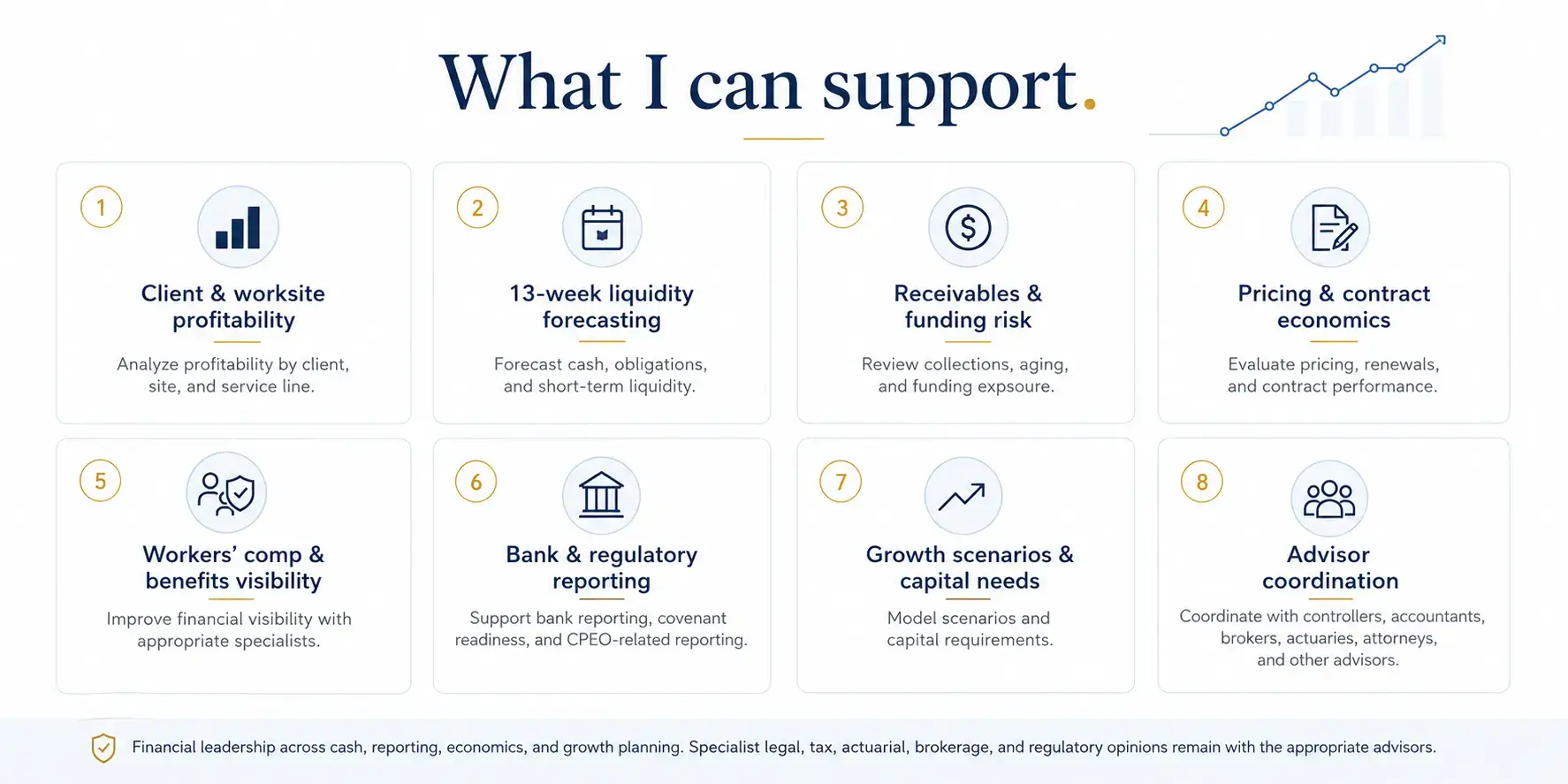
Client and worksite profitability analysis.
13-week liquidity and obligation forecasting.
Receivables and funding-risk review.
Pricing, renewal, and contract economics.
Workers’ compensation and benefits financial visibility, in coordination with appropriate specialists.
Bank reporting, covenant readiness, and regulatory reporting (including CPEO requirements).
Growth scenarios and capital requirements.
Coordination with controllers, accountants, brokers, actuaries, attorneys, and other advisors.
I provide financial leadership. I don’t provide legal, actuarial, insurance-brokerage, tax, or regulatory opinions - those specialists remain responsible for their disciplines.
Recommended starting point
PEO/Payroll CFO Decision Diagnostic
The diagnostic focuses on the decision that prompted the engagement and can include:
1
A 13-week liquidity and obligation view.
2
A client, worksite, or service-line profitability map, subject to data availability.
3
A 90-day action plan for reporting, pricing, receivables, risk visibility, and financial accountability.
Planning investment: $3,000-$5,000, confirmed after a fit call.
From negative EBITDA to Vensure’s largest acquisition to that point
I was recruited as CFO of CertiPay, a $285M PEO, ASO, and HR software business moving about $3.5B of client payroll a year for roughly 90,000 worksite employees - eight operating entities across seven locations.
The business had outgrown its prior finance leadership: the two CFOs who had split the entities between them departed within two weeks of my arrival, eight sets of books were unreconciled, EBITDA was negative, and the banks and regulators had lost confidence.
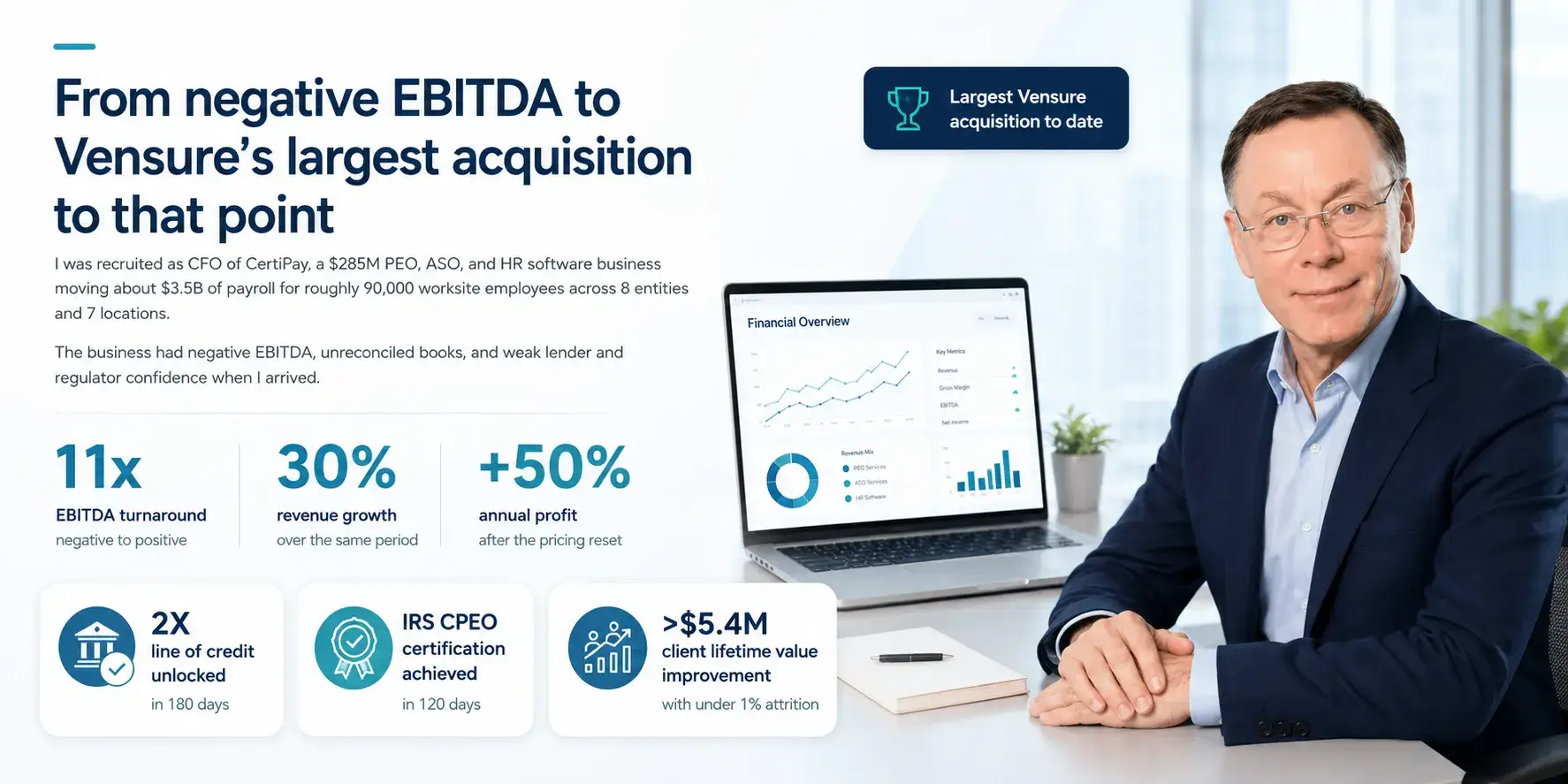
11x
EBITDA turnaround, negative to positive
30%
revenue growth over the same period
+50%
annual profit after the pricing reset
What I led
Rebuilt the team
Consolidated two CFO roles into one, reorganized finance by function instead of by entity, recruited five financial managers within about 60 days, and rebuilt the payroll-tax operations team from the ground up. Over 6 to 12 months we reconciled and corrected all eight sets of books.
Restored the confidence of the banks and regulators
Within 180 days I met the bank’s reporting requirements, unlocking a 2X line of credit and positive working capital. Within 120 days I met our regulatory obligations and earned CertiPay its first-ever IRS CPEO certification - something it had chased without success for two years.
Reset a decade-old pricing model with numbers, not gut
Legacy clients had gone 10 years without a price adjustment. I stood up a Power BI driven FP&A capability and designed a new strategy: 24 months of price protection for every client, then a fair-adjustment review every 12 months. Annual profit rose 50%, with under 1% client attrition and more than $5.4M of improvement in client lifetime value.
Rebuilt the plumbing and controls
New bank-file automation and treasury controls cut funding errors 25%; a platform modernization cut labor costs 17% and delivered the company’s first-ever customer-profitability reporting.
Steadied the ship through COVID
When revenue fell 20 to 30%, I raised $2.8M to bridge it with zero layoffs.
The result: EBITDA swung from negative to positive - an 11x turnaround - on 30% revenue growth. In 2022 the PEO, ASO, and software core sold to Vensure, backed by Stone Point Capital: the largest and most complex acquisition Vensure had done to that point.
This describes Bob’s role as CFO of CertiPay (2017-2023), not a Fractional CFO client engagement.
Best-fit companies
Established PEO, payroll, staffing, or workforce-service company.
Approximately $5 million to $50 million in revenue.
No full-time CFO, or a temporary gap in senior finance leadership.
Reliable accounting records and access to client-level operating data.
A defined trigger involving liquidity, pricing, claims and exposure visibility, growth, financing, acquisition, or exit.
Frequently asked questions
Bring liquidity, client economics, and risk into the same decision
Or text me directly at (727) 455-9905.