
Operating cash flow is the number that tells you whether the profit on your income statement actually showed up in the bank. Most owners I work with can recite last month’s net income. Far fewer can tell me the cash their operations produced, because the two figures rarely match. This guide walks the calculation the way a preparer sequences it, in order, with the sign rules that cause most of the errors.

Quick answer: what the operating cash flow formula takes and what decides success
Operating cash flow is the cash your regular operating activities generated in the period, once the accrual entries are stripped out. There are two formulas, and both must land on the same number. The direct method is cash receipts from customers + other operating receipts – cash paid to suppliers – cash paid to employees – other operating payments – cash interest paid, if operating – cash income taxes paid. The indirect method is net income + noncash expenses – nonoperating gains + nonoperating losses ± changes in operating working capital.
Published formulas differ because direct versus indirect and IFRS versus U.S. GAAP can classify interest and taxes differently. That’s the part most pages blur.
Plan on an hour once your schedules are pulled. Success comes down to clean classification: keep operating cash apart from investing and financing items, the rest is arithmetic.
Before you start: the inputs, checks, and when this method fits
You need the income statement, both balance sheets and the schedules behind them. Working from the income statement alone is where people stall. Half the answer sits on the balance sheet.
Pull these before you calculate anything:
- Income statement for the period, with depreciation, amortization and impairment shown separately
- Balance sheet at the current and prior period end, gross rather than net
- Accounts receivable aging and inventory subledger
- Accounts payable, accrued liability and wages payable schedules
- Prepaid expense rollforward
- Income-tax payable, deferred-tax, interest expense and interest payable detail
- Fixed-asset additions and disposals, with proceeds and book value
- Deferred revenue or contract liability balances
As Texas Comptroller training notes, the increase or decrease in receivables you report in the reconciliation has to tie to the difference in gross accounts receivable between the prior fiscal year and the current fiscal year.
When this method fits: you’re preparing or reviewing operating cash flow under U.S. GAAP or IFRS, or rebuilding it for a lender, a board, or diligence. When it doesn’t: this isn’t free cash flow, not EBITDA, and not a bank-statement summary. Free cash flow subtracts capital spending after operating cash flow is settled. The silo article “free cash flow” covers that work and what it typically runs.
Step 1: Choose the reporting framework and method first
Decide indirect versus direct, and U.S. GAAP versus IFRS, before you touch a number. The indirect method starts from a profit measure and the direct method from gross cash movements. The framework you pick drives where interest and taxes land.
| Decision | Indirect method | Direct method |
|---|---|---|
| Starting point | Net income (U.S. GAAP) or operating profit (IAS 7) | Gross cash receipts |
| Data needed | Two balance sheets plus noncash detail | Cash receipts and payments mapped by activity |
| Effort | Lower, most reporters use it | Higher, and U.S. GAAP still wants the reconciliation |
| Best for | Statement preparation, analyst review | Owner-level cash understanding |
The mistake to avoid here: mixing an IFRS interest classification into a GAAP statement. Pick one framework and stay in it for every line. That error survives all the way to the auditor.
Step 2: Calculate operating cash flow with the direct method
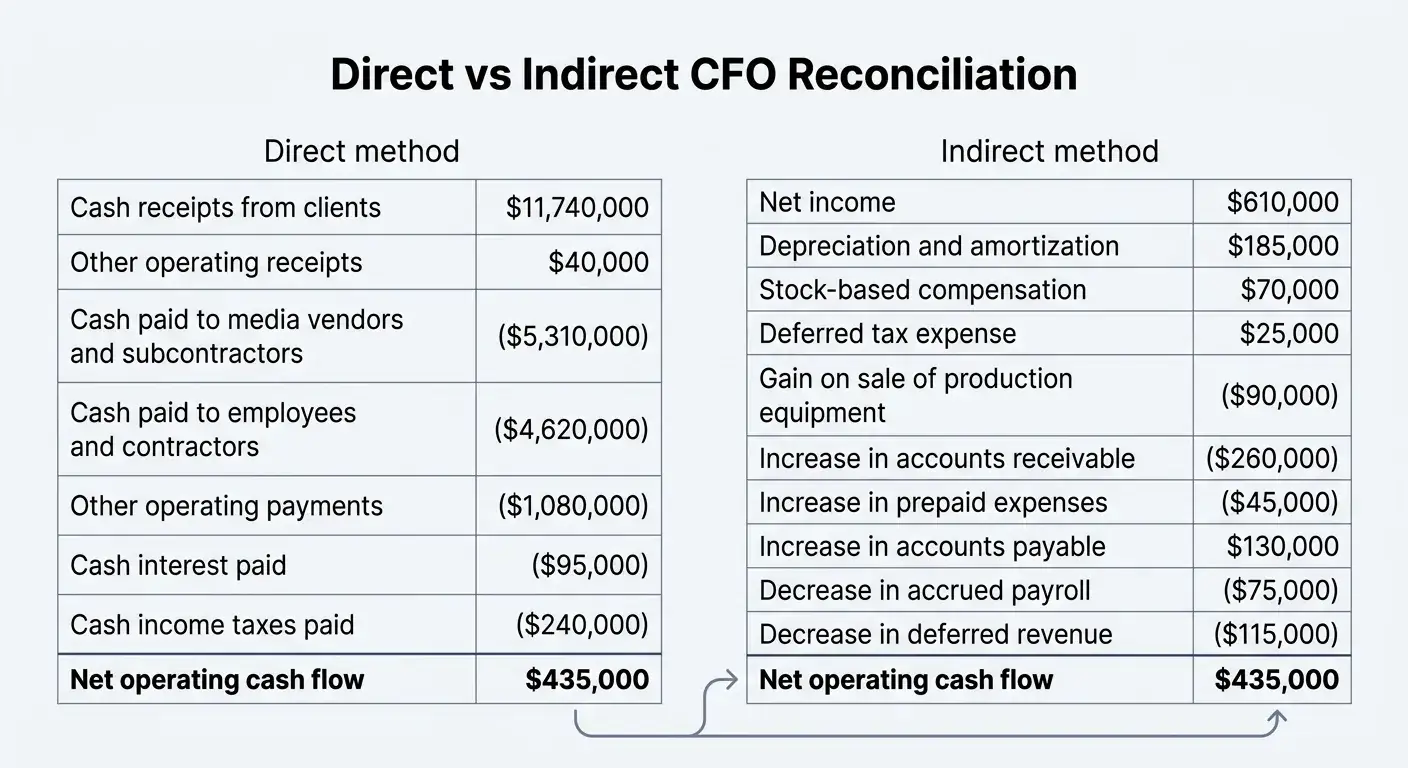
The direct method adds the gross cash that came in and subtracts the gross cash that went out, in the order money moves. Almost nobody shows it with numbers, because it needs a chart of accounts mapped by activity. Here it is, using a marketing agency at roughly $12 million in revenue.
| Direct-method line (gross cash receipts and payments) | Amount |
|---|---|
| Cash receipts from clients | $11,740,000 |
| Other operating receipts (rebates, interest received) | $40,000 |
| Cash paid to media vendors and subcontractors | ($5,310,000) |
| Cash paid to employees and contractors | ($4,620,000) |
| Other operating payments (rent, software, insurance) | ($1,080,000) |
| Cash interest paid | ($95,000) |
| Cash income taxes paid | ($240,000) |
| Net operating cash flow | $435,000 |
Client receipts run $260,000 below the $12,000,000 of recognized revenue. That gap is the receivables movement. Step 4 works it through.
The mistake to avoid here: building the direct method from bank activity. A bank feed will classify a loan draw as an operating receipt and an equipment purchase as an operating payment. Map accounts by activity first.
Step 3: Reconcile operating cash flow with the indirect method
Now rebuild the same $435,000 from the income statement. According to the SEC filing, ASC 230 requires the indirect method to report net cash flow from operating activities by adjusting net income to reconcile it to that figure. The method exists to remove the effects of all deferrals and accruals of expected future operating receipts and payments, along with every item in net income that never touched operating cash.
The short form of the indirect method is net income + depreciation and amortization – change in net working capital. That version holds only when nothing else is material, so here’s the short form and the expanded form side by side.
Work this checklist before the table, not depreciation alone. Noncash charges: depreciation, amortization, stock-based compensation, deferred tax, impairment, provisions. Nonoperating items: gains on disposal (subtract) and losses on disposal (add back). Operating working capital: receivables, inventory, prepaids, payables, accrued expenses, deferred revenue.
| Indirect reconciliation | Amount |
|---|---|
| Net income | $610,000 |
| Depreciation and amortization | $185,000 |
| Stock-based compensation | $70,000 |
| Deferred tax expense | $25,000 |
| Gain on sale of production equipment | ($90,000) |
| Increase in accounts receivable | ($260,000) |
| Increase in prepaid expenses | ($45,000) |
| Increase in accounts payable | $130,000 |
| Decrease in accrued payroll | ($75,000) |
| Decrease in deferred revenue | ($115,000) |
| Net operating cash flow | $435,000 |
A profitable agency that grew billings 20 percent shows this pattern every time. Real profit, thinner cash, receivables holding the difference.
Pro tip: the two methods must reconcile to the same number. If the totals disagree, check the working-capital signs first, then nonoperating items left inside operating profit, then omitted noncash charges, tax or interest accruals treated as cash, and cash-equivalent classification.
Step 4: Work the changes in receivables, inventory, payables, and accruals
Operating working capital here means receivables, inventory, prepaids, payables, accrued expenses and deferred revenue. Inventory and prepaids are operating current assets, so an increase in inventory is a cash outflow and a decrease is a source of cash. A rise in prepaids comes off because cash left before the expense was recognized. Accrued expenses and deferred revenue are operating current liabilities, so an increase in either is added and a decrease is subtracted. It doesn’t mean the net working capital figure off your balance sheet, which usually carries cash, revolver balances and marketable securities that belong in other sections.
The sign rule is one sentence. An increase in an operating current asset is a subtraction; an increase in an operating current liability is an addition. Reverse both for decreases, compute every change as ending balance minus beginning balance.
Trace one cycle through the agency. A client is invoiced $260,000 on March 28 with 45-day terms, so March profit rises and March cash doesn’t. Receivables increased $260,000 and the reconciliation subtracts it. The same month the agency books a $130,000 media invoice and pays it in April. Payables increased $130,000 and the reconciliation adds it. Accrued payroll fell $75,000 when a prior bonus accrual was paid, so cash paid exceeded expense recognized and that comes off.
To rebuild the gross lines from accrual data, three conversions do most of the work:
- Cash collected from customers = revenue – change in accounts receivable
- Cash paid to suppliers = COGS + change in inventory – change in accounts payable
- Cash paid to employees = wages expense – change in wages payable
The middle one prevents the error I see most often in distribution books: treating COGS as cash paid for purchases. A distributor that builds $400,000 of inventory ahead of a season spent that cash and COGS won’t show it.
A 13-week cash view is a rolling picture of money in and out. Once someone owns it, an owner answers “what does cash look like in 90 days?” in about 30 seconds. If that layer has no owner in your company, a short conversation about your specific constraint is the fastest way to find out what it would take.
Step 5: Put interest, taxes, gains, and capital spending in the right place
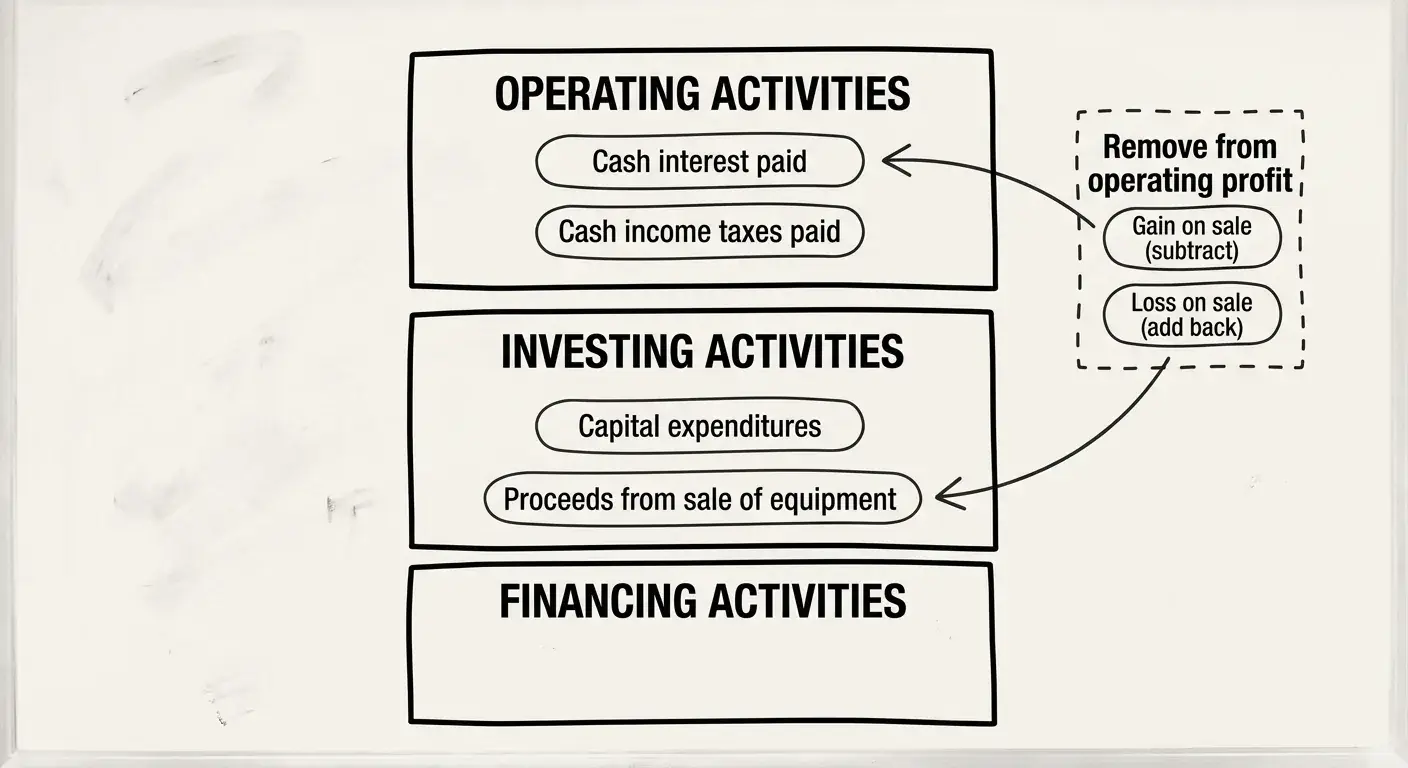
Capital expenditures stay in investing activities under both U.S. GAAP and IFRS. They only come off later, when you calculate free cash flow, never inside CFO. Interest and taxes can sit inside operating cash flow, but only at cash amounts and only where your framework puts them. Under U.S. GAAP, interest paid and income taxes paid run through operating activities and both get disclosed separately. Under IAS 7, interest paid may be classified as operating or financing, and taxes paid are operating unless the tax ties directly to an investing or financing item.
Taxes. Cash taxes paid = income-tax expense – change in income-tax payable. Tax expense alone overstates or understates CFO whenever tax payable, deferred tax or a settlement moved. In the example above, $265,000 of expense became $240,000 of cash because payable rose $25,000.
Interest. Cash interest paid = interest expense – change in interest payable. Use the framework you picked in Step 1 rather than copying a template.
Gains and losses. Subtract a gain on the sale of equipment and add back a loss, because the whole cash effect of that sale sits in investing activities, the proceeds. Leaving the $90,000 gain in operating profit counts the same economics twice.
Step 6: Check whether the result makes sense
Three checks tell you the work is finished and the number is believable.
- The two methods agree. Direct total equals indirect total, to the dollar.
- Every working-capital sign has a story. You can name the account that moved and why, in one sentence each.
- The ratio passes a sanity test. Operating cash flow divided by current liabilities tells you how much of your near-term obligations a year of operations covers. Below roughly 0.4 on a business with steady revenue, I look hard at collections and payment terms rather than at the income statement. Smell test, not a verdict.
Negative CFO isn’t automatically bad. The diagnosis is the same either way: name the account that absorbed the cash. Working-capital drag looks like the marketing agency that wins a large retainer, staffs up in month one, invoices in month two and collects in month four. Profit looks excellent, CFO goes negative for a quarter, it resolves when the collection cycle catches up. Structural burn looks different: negative CFO with flat receivables and rising payables, which means suppliers are financing the business. That’s borrowed time rather than performance. Persistent negative cash sits in the silo’s article “cash flow problems.”
When to call a pro instead
Call someone when the calculation stops being arithmetic and starts being judgment. That line arrives with multiple jurisdictions, acquisitions, foreign-currency operations, complex leases, derivatives, structured financing, noncash acquisition consideration, material deferred-tax balances, or an audit or filing deadline. It also arrives when your two totals won’t reconcile after you’ve worked the pro-tip list, because at that point the problem is in the chart of accounts rather than the spreadsheet.
The other trigger isn’t technical. Your controller reports backward and your CPA handles tax, so the forward-looking layer often has no owner. My first 90 days run in three blocks: weeks one and two reviewing cash, reporting and processes; weeks three to six building the forward plan; weeks seven to twelve fixing the top profit or cash leak and setting a review rhythm. Every ongoing engagement carries a guarantee of at least $50,000 in profit opportunities in the first 30 days, or the work is free.
If your operating cash flow does not tie or does not make sense, book a 15-minute call and name the decision you are stuck on.

Frequently Asked Questions
How to go from OCF to FCF?
Free cash flow is operating cash flow minus capital expenditures. The capex comes off after CFO is settled rather than inside it, exactly as Step 5 describes. The silo article “free cash flow” carries the full treatment.
What is a good operating cash flow ratio?
A ratio of 1.0 or better means one year of operations covers current liabilities outright. 0.4 to 1.0 is common in service businesses with fast payroll cycles. Step 6 covers where I treat the number as a warning rather than a verdict.
What does a high OCF indicate?
It indicates that recognized profit is converting to cash and that working capital isn’t absorbing the gain. High CFO relative to net income, say 1.2 times or better, usually means deferred revenue or disciplined collections are working in your favor. Check that it’s not coming from stretched payables, which inflates the number for a quarter or two and then reverses.
Is operating cash flow the same as EBIT?
No. EBIT is an accrual profit measure that still includes depreciation, amortization and every receivable you haven’t collected. CFO removes noncash charges, adjusts for working-capital movement, and includes cash taxes and, under U.S. GAAP, cash interest paid. Two companies can post identical EBIT and differ by seven figures in CFO.
Is operating cash flow the same as cash flow from operations or cash generated from operations?
Operating cash flow, cash flow from operations, CFO, and net cash provided by operating activities all mean the same subtotal. “Cash generated from operations” is the narrower one to watch: under IAS 7 presentations it often appears before interest and tax payments, with those shown as separate lines beneath it. Check whether the label sits above or below the tax line before you compare two companies.
Does positive net income always mean positive operating cash flow?
No. The gap is routine in growing companies. A business can post $610,000 of net income and still run negative CFO when receivables and inventory grow faster than profit. Step 6 separates that working-capital drag from structural burn.
Do I need both methods if I only file one?
Under U.S. GAAP, an entity using the direct method still has to determine and report the same net operating cash flow figure indirectly by adjusting net income. That makes the direct method more labor-intensive, not less. Most reporters run the indirect reconciliation as the system of record and present the direct method internally, where owners find it easier to read.