
What Free Cash Flow Is
Free cash flow is the cash a business generates from operations after it pays for the long-lived assets it buys during the same period. The standard free cash flow formula is operating cash flow minus capital expenditures. What’s left is the cash genuinely available for debt repayment, distributions, acquisitions or the bank account.
If you run a company, take on debt, or plan to sell one day, this is the number your lender and your buyer will look at first.
How Free Cash Flow Works
Yes, ordinary free cash flow is operating cash flow minus capital expenditures. Operating cash flow, which you’ll hear called OCF or CFO or cash flow from operating activities, is the top line of the calculation. It measures cash produced or consumed by the normal business: collections from customers, payroll, rent, supplier payments, taxes, and the swings in receivables, inventory and payables that come with them. Harvard Business School Online describes cash flow as the net balance of cash moving into and out of a business at a specific point in time.
Capital expenditures, CapEx, are the cash you spend on assets that last longer than a year. Trucks, warehouse racking, servers, leasehold improvements, capitalized software development. Those purchases sit in investing activities on the cash flow statement, not in operating activities. That’s exactly why operating cash flow can look healthy while the bank balance shrinks.
Professionals split CapEx two ways:
- Maintenance CapEx keeps existing capacity running. Replacing a five-year-old forklift. Refreshing laptops on cycle.
- Growth CapEx adds capacity you didn’t have. A second facility. A new production line.
Plain FCF subtracts total CapEx. Analysts estimating distributable cash often subtract only maintenance CapEx. Since most companies never disclose the split, that version is a judgment call rather than a fact. You’ll also meet FCFF (free cash flow to the firm, cash available to debt and equity holders, discounted at WACC against enterprise value) and FCFE (free cash flow to equity, after interest and debt movements, discounted at cost of equity against equity value). Mixing the numerator from one with the denominator from the other is the most common valuation error I see.
How to Read the Formula in a Filing
Start in the cash flow statement, never on a finance website. Here is the workflow I use. Takes about ten minutes on a clean set of books:
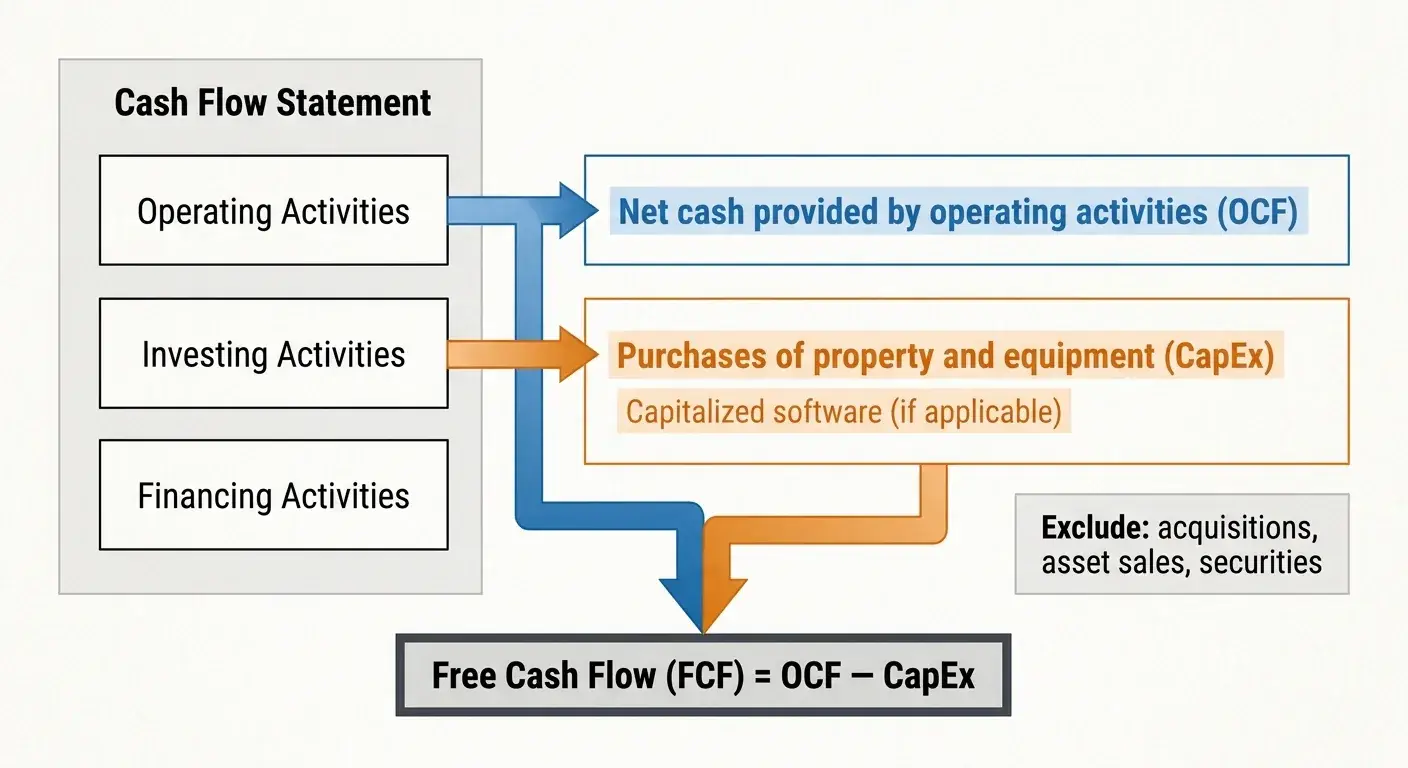
- Find the operating section subtotal, usually labeled net cash provided by operating activities. That is your OCF. Note whether an unusual working-capital release, a big inventory drawdown or a receivables collection sprint, is doing the heavy lifting.
- Move to investing activities. Pull purchases of property and equipment, plus capitalized software if the company capitalizes development cost. Those are CapEx.
- Decide, in writing, what you are excluding. Acquisitions, asset sale proceeds and purchases of securities sit in investing too, and they are not CapEx. If you include them, label the result something other than free cash flow.
- Subtract and compare against any company-reported “adjusted free cash flow.” If the two don’t tie, find the reconciling items. Stock-based compensation add-backs, lease payments and one-time settlements are the usual suspects.
That step four is the reason two websites publish two different FCF numbers for the same company. Each one made a different exclusion decision and neither showed its work. As the SEC notes, the SEC has warned that a non-GAAP measure excluding normal, recurring, cash operating expenses needed to run the business can be misleading under Rule 100(b) of Regulation G, guidance last updated December 13, 2022.
When Free Cash Flow Matters
Use FCF instead of OCF whenever the question involves money leaving the business after operations: valuation, debt service, distributions, or funding growth without new capital. Use OCF when you want to judge the operating engine itself before management’s investment choices enter the picture.
The situations where the distinction changes the answer:
- Valuation and exit. Buyers and their quality of earnings teams price cash after sustaining investment. Strong EBITDA with thin free cash flow invites a lower multiple.
- Debt capacity and covenants. Credit agreements frequently define “Free Cash Flow” contractually, with their own add-backs. Read the agreement. Your investor version doesn’t govern the test.
- Dividends and buybacks. FCF sets the ceiling on what you can take out without borrowing.
- Funding growth internally. Negative FCF during a deliberate build is a plan. Negative FCF that repeats every year with no capacity gain is a structural problem.
- Comparing capital-light to capital-intensive. A software business and a distributor with identical OCF are not equivalent businesses.
Example box: a distributor with good OCF and nothing left over
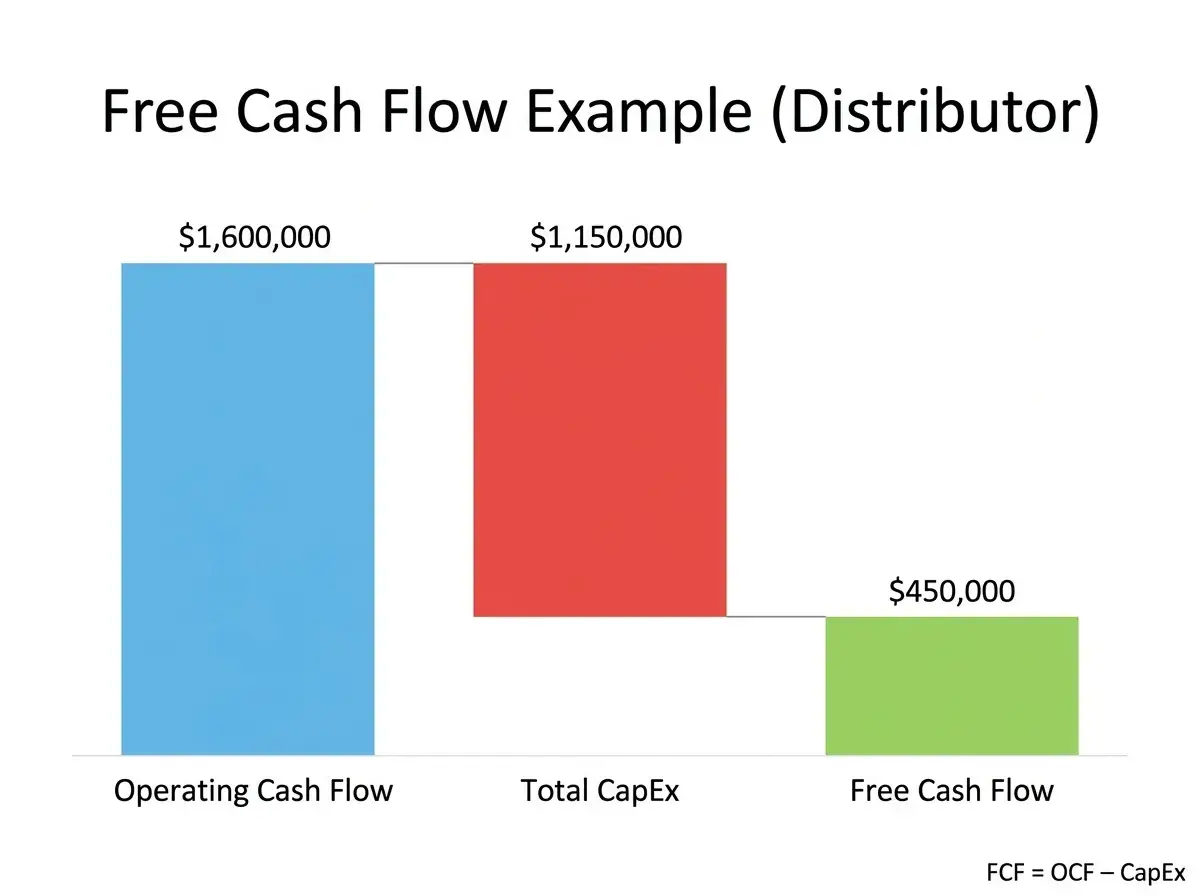
A $22 million parts distributor finishes the year with $1.6 million in operating cash flow. Decent collections, inventory held flat. During the same year it spends $900,000 on a replacement fleet and racking for a second warehouse, and $250,000 on a new WMS that gets capitalized.
FCF = $1,600,000 – $1,150,000 = $450,000.
The owner had been planning a $600,000 distribution and an added sales hire off the strength of that $1.6 million. The racking was growth CapEx, roughly $400,000, and won’t repeat. The fleet is a five-year cycle, so maintenance CapEx runs about $500,000 a year on average, not $900,000. Normalized free cash flow is closer to $850,000, which funds either the distribution or the hire, and not both in the same twelve months. One year’s number told the wrong story in two directions at once.
Working-capital timing does the same thing on a quarterly view. A seasonal inventory build can push FCF negative in Q3 and positive in Q1 with no change in the underlying economics. That’s why a trailing-twelve-month view beats any single quarter. Margin work usually matters more than the CapEx line here. In the diagnostic I deliver a margin map by customer, project, product or channel alongside a 13-week cash and working-capital view, because the cash question and the margin question are almost always the same question. If you want that view on your own numbers, a 15-minute call is enough to tell whether it applies.
Common Confusions About Free Cash Flow
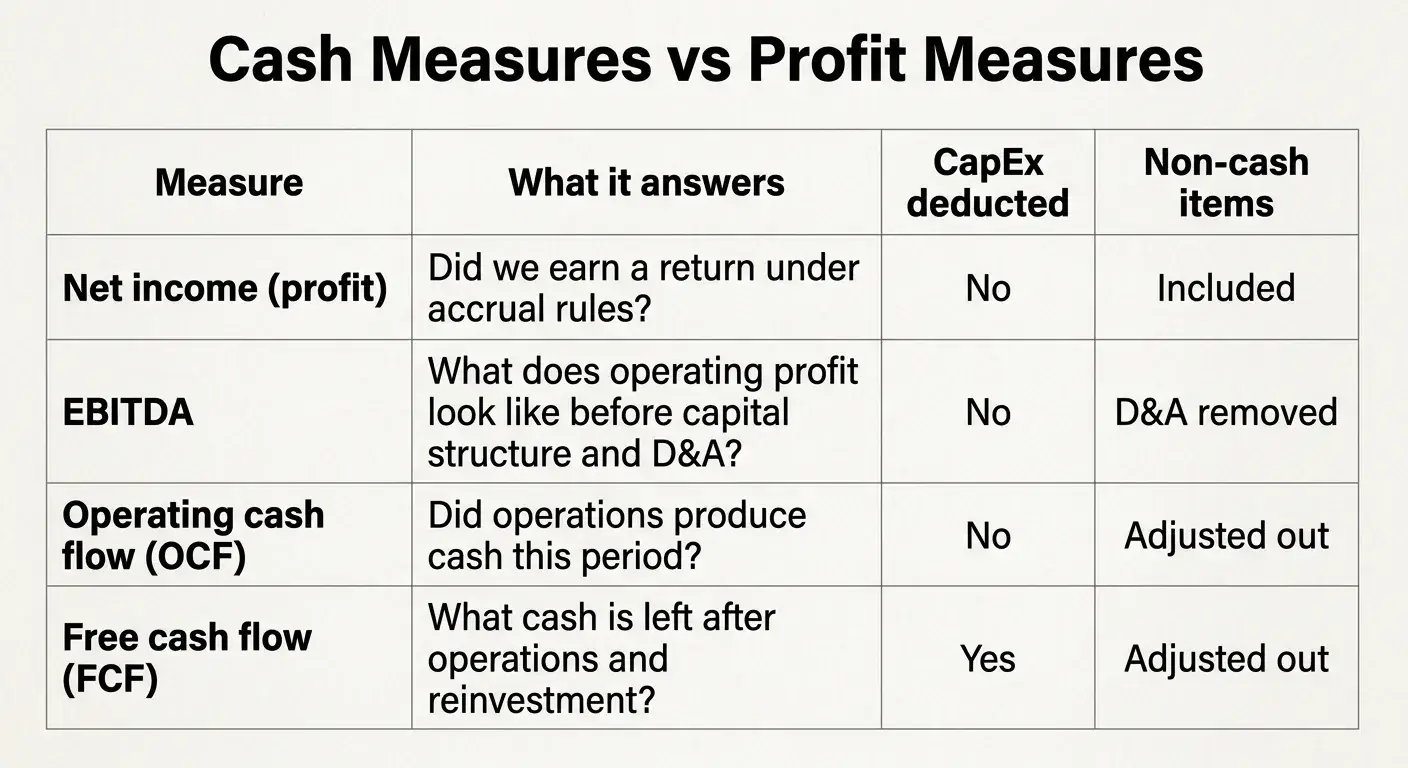
Free cash flow, operating cash flow, EBITDA and net income each answer a different question. They are not interchangeable. EBITDA is an operating-profit proxy that deducts no capital spending and no working-capital investment. Profit is accrual accounting, so it includes revenue you haven’t collected and excludes cash you’ve already spent on assets. Free cash flow vs net income is the clearest of the three gaps: net income spreads a $10 million machine across five years of depreciation, while free cash flow takes the full $10 million hit in the year you write the check.
| Measure | What it answers | CapEx deducted | Non-cash items |
|---|---|---|---|
| Net income (profit) | Did we earn a return under accrual rules? | No, only depreciation | Included |
| EBITDA | What does operating profit look like before capital structure and D&A? | No | D&A removed |
| Operating cash flow (OCF) | Did operations produce cash this period? | No | Adjusted out |
| Free cash flow (FCF) | What cash is left after operations and reinvestment? | Yes | Adjusted out |
Three fast tests to keep them straight. First, if the number can be positive while your bank balance falls, it isn’t a cash measure. Second, if a new warehouse doesn’t change the figure, CapEx isn’t in it. Third, free cash flow is a flow over a period, and your cash balance is a stock at a point in time, so a strong FCF year and a tight December are perfectly compatible.
One more distinction worth naming: FCF is not automatically distributable cash. Debt maturities, lease obligations, minimum liquidity requirements and tax payments can all sit between the FCF line and anything you could actually take out. SEC guidance also cautions that shifting the basis of accounting from accrual GAAP to a cash basis in a non-GAAP measure may be misleading, in guidance updated December 13, 2022.
The full mechanics of how operating, investing and financing activities fit together are covered in “What Is a Cash Flow Statement? A Simple Guide,” so I won’t repeat that structure here.
What to Do Next
Pick the next question you actually need answered. If you’re still wrestling with the top of the calculation, the sister article “operating cash flow formula” walks through how OCF is built. If you want the statement mechanics underneath it, read “What Is a Cash Flow Statement? A Simple Guide.” For the broader cash planning question, including financing options and the cost of getting help, “Working Capital Guide: Costs, Options and When to Hire” is the hub article for this topic and where cost detail lives.
If the real question is whether your company can afford the next hire, which customers actually carry acceptable margin, or how much cash your growth plan will consume over the next 90 days, that is CFO work rather than a formula. I work with founder-led companies between $5 million and $50 million in revenue that have usable books and no full-time CFO, across marketing and media agencies, call centers and BPO, PEO and workforce services, SaaS, distribution, and e-commerce. In one PEO engagement, pricing that had been frozen for a decade was reset to 24 months of protection followed by 12-month reviews: profit up 50 percent, attrition under 1 percent, inside an 11x EBITDA turnaround.
Tell me the decision you’re facing and I’ll tell you straight whether a CFO Decision Diagnostic, a 10-business-day engagement, would answer it.
Frequently Asked Questions
Is EBITDA the same as free cash flow?
No. EBITDA removes interest, taxes, depreciation and amortization from operating profit, and it deducts nothing for capital expenditures or working-capital investment. A distributor with $3 million of EBITDA and $2 million of annual fleet and facility CapEx has nowhere near $3 million of cash available. EBITDA is a profit proxy. Free cash flow is a cash measure.
Is profit the same as free cash flow?
No, and the gap is usually large in either direction. Profit follows accrual rules, so it counts revenue you invoiced but haven’t collected and spreads asset purchases across years of depreciation. Free cash flow counts cash actually received and takes the full asset purchase in the year you pay for it. That’s why a profitable company can post negative free cash flow.
Why can a company have positive operating cash flow but negative free cash flow?
Because CapEx exceeded operating cash flow in that period. A company generating $1.6 million from operations that spends $2.1 million on a new facility posts negative $500,000 in free cash flow while the operating engine is running fine. The follow-up questions are whether the spending is maintenance or growth, whether it recurs, and how it’s financed.
Should maintenance CapEx or total CapEx be subtracted when calculating free cash flow?
Plain FCF subtracts total CapEx. That’s the version you should use for period-to-period comparisons and for any externally reported figure. Subtract only maintenance CapEx when you’re estimating sustainable distributable cash, and note the assumption in writing. Most filings don’t disclose the split, so a replacement-cycle estimate, such as a five-year fleet cycle, is usually the honest approach.
What is the difference between free cash flow, FCFF, and FCFE?
FCFF is cash available to all capital providers, debt and equity, before financing flows. It pairs with WACC and enterprise value. FCFE is cash available to equity holders after interest, debt repayment and new borrowing. It pairs with cost of equity and equity value. Plain FCF, operating cash flow minus CapEx, sits closest to FCFE in spirit but skips the debt adjustments, so don’t substitute one for another in a valuation model.
How do working-capital changes affect operating cash flow and free cash flow?
They move both, dollar for dollar, because working-capital swings sit inside operating cash flow. Collecting $400,000 of aged receivables lifts OCF and FCF in that quarter without changing profitability at all. Stretching supplier payments does the same thing and reverses later. That’s why a trailing-twelve-month view is more reliable than any single quarter.
What is a free cash flow ratio and what does it tell me?
A free cash flow ratio compares free cash flow to another figure, most often revenue or operating cash flow, to show conversion quality. FCF divided by revenue at 8 percent tells you eight cents of every sales dollar survives operations and reinvestment. Track it across three years rather than one, because a single year of growth CapEx will distort it.
How do you calculate FCF?
Take net cash provided by operating activities from the cash flow statement and subtract purchases of property and equipment, plus capitalized software if applicable. The full formula walkthrough, including the operating cash flow build underneath it, belongs to the article “operating cash flow formula.”