
Two finance roles get mixed up more than any others. The controller owns whether the numbers are right. The CFO owns what you do with them. When a founder tells me the books are late and nobody can explain last month’s margin, the gap is almost always controller-level. Hiring a CFO on top of unreliable records only puts a better analyst in front of worse data.

What a controller is
Definition: A financial controller is the senior accounting leader who oversees a company’s day-to-day financial operations. The controller owns the general ledger, the month-end close, financial statements, tax and statutory reporting, payroll oversight and internal controls. The controller reviews and approves the work of the accounting staff, and is accountable for whether reported results can be trusted.
Owners, CEOs, finance leads, anyone sizing up the job title needs that definition. “Controller” appears on org charts at very different levels of scope and authority.
The standard duty list: monthly management reports and annual or statutory financial statements, GAAP reporting and tax reporting, budgets and forecasts with variance explanations, cash-flow monitoring, debt administration and collections, payroll oversight, coordination with the external auditors, and supervision of the accounting staff. EDC Paris reports that a financial controller is also responsible for analyzing the company’s financial health, not only recording it. The controller usually reports to a CFO or finance director. In smaller companies, directly to the CEO or owner. In a 15-person company the controller may post journal entries personally. In a 1,500-person company the controller may manage division controllers, consolidation and technical accounting policy, and never touch a transaction.
How a controller works inside the finance team
A controller sits between the people who record transactions and the people who make decisions on them. Transactions flow in continuously, billing, payroll, purchasing and the bank. The controller turns that flow into statements management can rely on through recording, reconciliation, close and review, then reporting and variance analysis. The controller is the operational head of accounting, normally one layer below the CFO or finance director. The controller owns reporting integrity, controls and compliance. The CFO owns financing, capital allocation and what the company does with the results.
Here are the terms a professional will use:
- General ledger and chart of accounts. The ledger is the system of record. The controller decides how transactions get classified so the reports mean the same thing in June as they did in January.
- Reconciliations. Bank, credit card, payroll, inventory, deferred revenue and intercompany accounts tie back to independent evidence. The controller reviews rather than prepares, which is the point.
- Internal controls and segregation of duties. Authorization, custody, recording and reconciliation live with different people. As University of Illinois Business & Finance policy notes, large institutions formalize this, and University of Illinois System employees may not combine certain role access unless the unit obtains an approved Exception Request.
- Audit trail. Documentation showing how a number entered the books and who reviewed it.
- External audit coordination. The controller is the primary contact for the outside auditors, assembles the requested schedules and answers the technical accounting questions.
- Staff supervision. Accounting staff, AP and AR, and payroll administration sit under the controller, who decides who prepares a task and who reviews it.
Controllers also develop budgets and control expenses with profitability in mind. That’s where the role starts touching management decisions rather than records alone.
Example: one month at a $14M ARR SaaS company Invoices go out from the billing platform on the 1st, mostly annual prepaid contracts. The staff accountant posts cash receipts and the payroll file. The controller does four things nobody else does. First, reviews the deferred revenue rollforward so prepaid contracts release into revenue over the correct term instead of landing in the month cash arrived. Second, reconciles the merchant processor clearing account, where fees and chargebacks hide. Third, accrues commissions and the AWS bill that arrives on the 9th. Fourth, flags that gross margin fell 2 points because hosting costs grew with usage while list prices did not. The CEO gets a statement on business day 7 and an explanation of the margin move in the same email. Without the controller, the CEO gets a trial balance on day 20 and a guess.
What a controller does day to day
Most of a controller’s week is review work and repetitive processing, not strategy. The honest split in a $5M to $50M company runs roughly 60 percent close, reconciliation and compliance mechanics, 25 percent reporting and review, and 15 percent analysis or project work. The analysis is the part people hire for. The mechanics are the part that makes the analysis true.
A normal non-close week: approve the payment run against supporting documents, review the aged receivable list and set collection priorities, approve new vendors and bank changes, answer the sales team on contract terms with revenue consequences, update the cash forecast, and spot-check entries posted by the accounting staff.
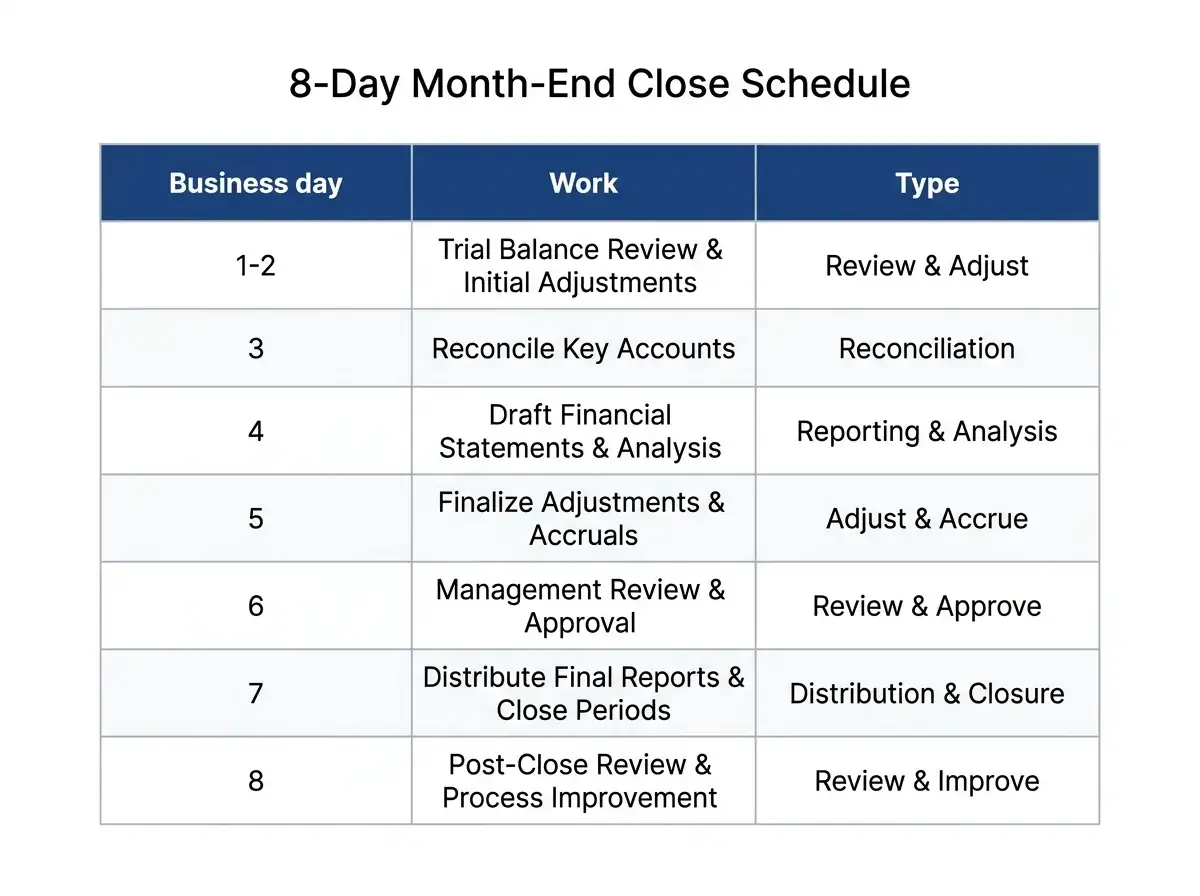
Close week is a different job. Here’s a sample eight-day schedule:
| Business day | Work | Type |
|---|---|---|
| 1-2 | AP and AR cutoff, accrue unbilled vendor invoices, post payroll and commission accruals | Repetitive |
| 3 | Bank, credit card, merchant and payroll clearing reconciliations prepared by staff | Repetitive |
| 4 | Controller reviews reconciliations, challenges aged reconciling items, approves adjusting entries | Review |
| 5 | Inventory or deferred revenue schedules, prepaid and fixed asset rollforwards, intercompany tie-out | Review |
| 6 | Draft statements, variance analysis against budget and prior month, written explanations | Reporting |
| 7 | Management reporting package issued, margin by customer or product, cash and working capital view | Reporting |
| 8 | Readout with the CEO, open items list, process fixes carried into next month | Management |
If you want the task-level version of that eight-day schedule, the full breakdown is in “month end close checklist.”
When a business needs a controller
The trigger is almost never revenue. It’s the moment accounting work stops being recording and starts being judgment, review and defense of the numbers to someone outside the company. A controller can be needed even when a CFO already sits in the seat, because no CFO can run reliable strategy on books that close late and reconcile badly. Watch for these:
- The close takes more than 15 business days, or finishes only after the owner personally fixes entries.
- Reconciliations are stale, or the person preparing them is also the person approving payments.
- Cash on hand and cash available next month are two different mysteries.
- A second entity, a second location, a second currency, an inventory stream, project-based revenue or a new contract structure arrives.
- A lender wants covenant calculations, a buyer wants quality of earnings support, or a first audit is scheduled.
- Headcount in accounting reaches three or more and nobody supervises the work.
Example: a $28M regional distributor. Books closed on day 22. Inventory was counted quarterly, so cost of goods sold was a plug. The bank asked for a covenant certificate inside ten days and the team missed it twice. A controller came in, moved to monthly cycle counts, built a landed-cost standard so freight stopped distorting product margin, and reconciled the inventory subledger to the ledger every month.
Before the hire: a day 22 close, a covenant certificate the bank had to chase, and an owner acting as the last line of review. After: close on day 8, a reporting package issued on a fixed date, reconciliations reviewed by someone who did not prepare them, and margin by customer as a report instead of an argument. That report showed two of the top ten accounts lost money after freight and returns.
That stability is what lets the forward-looking work start. On ongoing engagements I run a Quarterly Profit Focus, one leak measured and fixed each quarter: workers comp, card fees, inventory or fleet, turnover and overtime, or media spend. None of that works on books you can’t trust. If you are weighing whether the gap in your company is accounting or decision support, a short conversation will usually settle it faster than another month of waiting.
Controller vs accountant, CFO, and finance manager
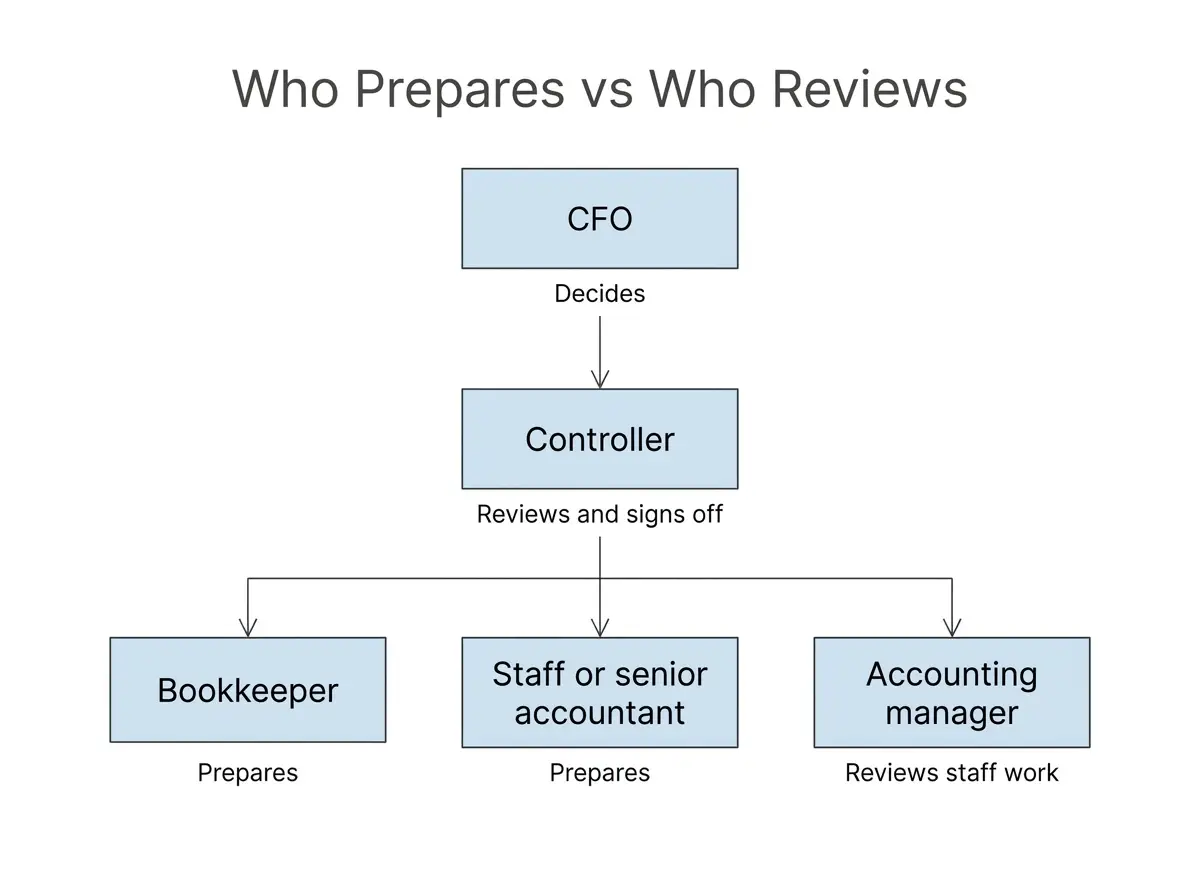
The distinction is scope and authority, not seniority alone. An accountant prepares. A controller reviews, approves and owns the process. A CFO decides what the company does with the capital.
| Role | Core scope in one sentence | Prepares or reviews | Approves | Reports to |
|---|---|---|---|---|
| Bookkeeper | Records transactions and keeps AP and AR current. | Prepares | Nothing beyond data entry | Controller or owner |
| Staff or senior accountant | Posts journal entries, builds schedules and prepares reconciliations. | Prepares | Nothing outside assigned entries | Accounting manager or controller |
| Accounting manager | Runs the transaction cycle and assigns close tasks. | Reviews staff work | Routine entries and small payments | Controller |
| Controller | Owns the ledger, the close, reporting integrity, controls and the audit. | Reviews and signs off | Adjusting entries, payment runs within limits, accounting policy | CFO, or the CEO and owner when there is no CFO |
| FP&A manager | Builds the budget, the forecast and the models behind decisions. | Prepares the plan | Nothing in the ledger | CFO or controller |
| CFO | Owns capital, financing, margin strategy and the lender, board and buyer relationships. | Reviews the full picture | Budgets, capital spend, financing terms | CEO or board |
Final decisions split cleanly. Accounting treatment, close timing and what gets reported are the controller’s call. What to fund, finance, price or sell is the CFO’s call, or the owner’s when there is no CFO.
Two distinctions people get wrong:
- Is a controller higher than an accountant? Yes. The accountant is right about an entry. The controller is accountable for the whole set of statements.
- Is a comptroller the same as a controller? Usually the same function under a different label, common in government and nonprofit organizations. Read the duties, not the title.
What to do next
Four options, in the order the symptoms usually point to.
- A better accountant when transactions are recorded late or miscoded but someone competent already reviews the close.
- A controller when nobody owns the close, reconciliations go stale, or a lender, buyer or auditor is about to inspect the records.
- A fractional controller when the review and sign-off work is real but does not fill a full seat, often a few days a month in a company with steady transaction volume.
- A CFO when the records are reliable and the open question is cash, margin, financing or an exit.
Diagnose the close first. Strategy built on a late or unreliable close is a guess with better formatting.
My own work starts at the last of those four: founder-led companies at $5M to $50M with no full-time CFO, usable books, and a real decision on cash, margin, growth, financing or exit. I do not provide stand-alone bookkeeping or tax-return preparation, so when the books are incomplete the controller-level work comes first. If your books are usable and the question is what the numbers mean for the next 90 days, book a 15-minute call.
Frequently Asked Questions
What internal controls should a financial controller establish?
Start with spending limits and documented invoice approval, so nothing leaves the bank without a second pair of eyes against supporting documents. Add reconciliation review by someone who did not prepare the reconciliation, system access rights that match job duties, and separation of authorization, custody and recording. In a three-person accounting team the practical minimum is that whoever sets up a vendor cannot also release the payment run.
Do controllers need a CPA?
A CPA is common and often preferred for audited or multi-entity companies, but it’s not universally required. The baseline is an accounting degree plus 7 to 10 years of progressive experience including close ownership. Employers weigh ERP experience, team management and technical areas such as revenue recognition or inventory costing just as heavily.
What is the difference between a financial controller and a business controller?
A financial controller runs accounting operations: ledger, close, statutory and tax reporting, controls and audit coordination. A business controller leans toward operational cost, pricing support and unit economics inside a division or product line. Title variants follow the same split, with corporate controller at the parent entity, division or plant controller at a site, and assistant controller owning selected areas under the controller. Pay follows scope rather than the word on the card, with many US controller roles reported near $90,000 to $150,000 and corporate-controller benchmarks above $200,000.
Can a controller approve payments and change budgets?
Yes, within limits someone else sets. A controller normally approves adjusting journal entries, the payment run and accounting policy, with a dollar threshold above which the CFO, CEO or board signs. Budget authority works differently: the controller enforces the approved budget and explains the variances, while changing the budget itself is a CFO or owner decision.
Can a fractional controller replace a full-time controller?
For many companies under roughly $20M in revenue with a clean transaction volume, yes. A fractional controller typically works set days per month covering review, close sign-off and reporting while in-house staff handle daily processing. The model breaks down when the company needs same-day decisions, heavy on-site inventory work, or constant supervision of a large team.
How stressful is controller work, and when do the long hours happen?
Workload is cyclical. Non-close weeks are usually standard hours. The first 5 to 8 business days of each month, audit fieldwork, and the annual budget cycle are where the overtime concentrates. The pressure comes from fixed external deadlines such as covenant certificates, tax filings and board packages.
What performance metrics should be used to evaluate a controller?
Close duration in business days, number and age of unreconciled items, audit adjustments and findings, restatements or reissued reports, cash forecast variance against actual, and on-time delivery of the monthly reporting package. Set a target for each. Close by business day 8 with zero reconciling items older than 60 days, for instance, and review them quarterly.