
Most closes that run long aren’t short on accounting talent. They’re short on sequence. The order of the work, who owns each task, the evidence a reviewer will accept, and the written rule for what happens when an account doesn’t tie are what separate a three-day close from a twenty-day one. Top-performing finance teams close in about five business days, while the median sits around eight to ten. The gap between those two numbers is almost always process design, not effort.

What a month-end close checklist is and who needs one
A month-end close checklist is the standing sequence of tasks that turns a month of raw activity into a reviewed, locked set of financial statements. It assigns each task an owner, a due date, a dependency, required evidence, and a rule for escalation when something doesn’t reconcile. A task list alone is a to-do. A checklist with ownership, evidence, and escalation is a control.
The correct order rarely changes, no matter the size of the company:
- Pre-close (days -7 to -1): publish the close calendar, communicate cutoff dates, prepare recurring entries, clear prior-month open items.
- Capture and post (business days 1 to 2): bank feeds, AP, AR, payroll, expense reports, billing, inventory movements.
- Reconcile (days 2 to 4): cash, cards, payment processors, subledgers to the general ledger, payroll and clearing accounts.
- Adjust (days 3 to 5): accruals, prepaids, deferrals, depreciation, reclasses, with support attached.
- Consolidate and review (days 4 to 6): intercompany eliminations, currency remeasurement, flux analysis, reviewer sign-off.
- Report and lock (days 5 to 7): issue the package, document open items, lock the period.
Every business with a general ledger needs some version of this. The shape changes by model. Service firms and agencies live and die on unbilled work and payroll accruals. E-commerce retailers carry a processor reconciliation branch that has nothing to do with the bank. SaaS and subscription companies add deferred revenue and usage billing. Distributors add inventory and vendor rebates. Multi-entity groups add intercompany, eliminations, and sometimes a second currency. Same spine, different branches.
How to decide which month-end close path you need
You shorten a close by moving work earlier. You don’t cut review steps. Publish cutoffs before the month ends, standardize recurring entries, clear reconciling items in the first week of the new month, and sequence tasks so nothing gets reconciled before its source data is complete. Controls weaken when you skip the reviewer, not when you compress the calendar.
Pick your path by four variables: transaction volume, number of legal entities, reporting urgency, and control maturity.
- One entity, low volume, no inventory, internal reporting only. You need a lightweight close. See the section below.
- One or two entities, AP and AR subledgers, deferred revenue or inventory, a board or lender reading the numbers. You need a standard close with real sign-off.
- Two or more entities, intercompany activity, foreign currency, usage-based billing, or an audit, raise, or sale in the next twelve months. You need the consolidation and revenue sections further down, and probably a controller who owns the calendar.
- Any size, but the close depends on one person’s memory. Fix ownership first. A month-end close process flowchart with named owners and backups does more for you in month one than any software purchase.
Decision gate: can you name the owner, the reviewer, and the required evidence for every account above your materiality threshold? Yes: your problem is timing. Move cutoffs earlier and attack dependency order. No: your problem is design. Adding days or software to an undefined process produces faster wrong answers.
When a lightweight close is enough
A lightweight close works when the business runs under roughly 300 transactions a month, operates one legal entity, carries no inventory, bills on a simple cash or invoice cycle, and has no outside party reading the statements on a deadline. That close takes three to six hours of work spread across two business days, done by one bookkeeper with the owner as reviewer.
The capacity math matters more than the task count. One person reconciling two bank accounts, one card program, and an AR subledger can finish by day two. The same person handling three processors, a 60-line AP aging, and a payroll accrual cannot. Pretending otherwise is how closes slip to day fifteen.
Even a lightweight close keeps four controls: cash and cards tied to external statements, payroll accrued through the last day of the period, a reviewer who didn’t prepare the entries, and a written log of anything left open. Drop those and you no longer have a close. You have a bookkeeping backup.
When a standard close is the right fit
A standard close fits companies running roughly 300 to 3,000 transactions a month with AP and AR subledgers, deferred revenue or inventory, and a lender, board, or investor expecting statements by a fixed date. Before reconciliations begin, every source feed has to be posted through the cutoff date. Reconciling an incomplete subledger produces a difference you’ll chase twice.
Budget 25 to 45 hours per close across a bookkeeper, a staff accountant, and a controller-level reviewer, finishing in five to eight business days. The marker that you’ve outgrown the lightweight version is usually a repeat offender: the same clearing account carries a difference three months running, or the P&L moves after management has already seen it.
What happens before month-end so the close doesn’t start late
The close doesn’t start on the first of the month. Roughly a third of the work belongs to the seven business days before period end. Teams that skip it spend days one through four of the new month collecting data instead of producing numbers.
Here’s the pre-close calendar I use with clients:
- Day -7: publish the close calendar with owners, reviewers, and due dates. Send cutoff notices to AP, sales, operations, and anyone who submits expense reports.
- Day -5: confirm vendor invoice cutoff. Anything not received by the stated date gets accrued from the purchase order or the prior-month run rate, not chased into day six.
- Day -3: check bank and card feeds for gaps, duplicate imports, and broken connections. A feed that stopped on the 11th is cheap to fix now and expensive to find on day three.
- Day -2: review the prior month’s open-items log. Each line gets an owner, an age, a dollar amount, and a resolution date. Anything carried for a third consecutive month goes to the controller.
- Day -1: stage recurring journal entries, depreciation schedules, and prepaid amortization so they post from a template rather than from memory.
Cutoff communication is the piece most teams underweight. Give contributors at least a week of notice and the submissions arrive. Give them two days and you’ll build accruals for items that were sitting in someone’s inbox.
How to gather source data and post routine transactions first
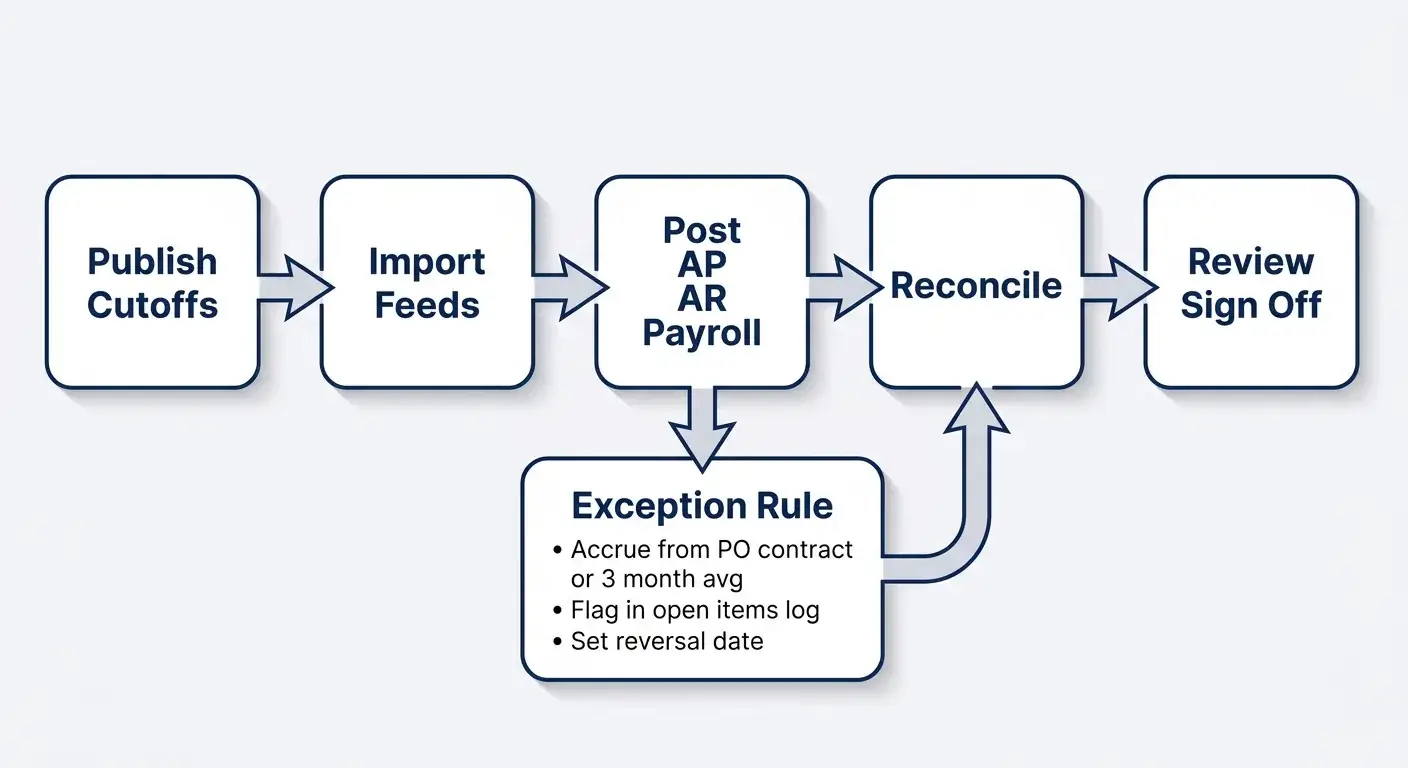
Nothing gets reconciled until its source feed is complete. That means bank and card transactions imported through the last calendar day, approved expense reports posted, vendor invoices entered, customer invoices issued, payroll journals recorded (including the accrued stub period), and billing or subscription data pushed to the ledger.
The risk of reconciling early isn’t wasted effort. It’s false completion. An AP reconciliation marked done on day one, before eleven late invoices post on day three, tells the reviewer the account is clean when liabilities are understated. The checklist looks green and the balance sheet is wrong.
Missing documents should never hold the whole close. Set an exception rule in writing: if support hasn’t arrived by the stated escalation deadline, accrue the item using the purchase order, the contract rate, or a three-month average, flag it on the open-items log, and move on. A documented estimate with a reversal date beats an empty line waiting on a receipt.
How to reconcile bank, card, AP, AR, payroll, and clearing accounts
Every account that holds cash, moves cash, or records a third-party obligation gets reconciled: operating and payroll bank accounts, corporate cards, payment processors, AP and AR subledgers to the general ledger, payroll and benefit liabilities, sales and payroll tax payable, loans, intercompany, inventory, and every clearing or suspense account. A reconciliation is complete when the balance ties to an authoritative outside source, each reconciling item carries an amount, an age, a cause, and an owner, the support is attached, and a reviewer who didn’t prepare it has signed and dated it.
When the subledger doesn’t tie to the GL, classify the difference before you fix it. The usual causes are timing, a coding error, a transaction posted directly to the control account, a missing or duplicated entry, currency remeasurement, a system sync failure, or, occasionally, something that deserves a harder look. The classification tells you whether it’s a one-month correction or a process defect. Isolated differences get cleared in the close. Differences that repeat get root-cause work, a system change, or a new owner.
Give unresolved items a shelf life. As Cornell University Division of Financial Services notes, errors and discrepancies should be detected, investigated, and resolved in a timely fashion, for example within 30 to 60 days. Past that window, an item is no longer a reconciling item. It’s an unrecorded gain or loss waiting to be found by someone else.
An e-commerce example shows why the generic checklist fails. A retailer running two processors can’t reconcile cash alone. Gross sales, processor fees, refunds, chargebacks, rolling reserves, and settlement timing each hit a different account, and the deposit that lands on the 2nd belongs to the prior period. That’s five reconciling questions inside what the checklist calls one bank reconciliation. Build the branch or carry an unexplained difference every month.
If your reconciliations technically exist but nobody can explain what’s in them, that’s the point to bring in outside eyes. A 15-minute call is usually enough to tell whether you have a cleanup problem or a design problem.
How to handle accruals, prepaids, deferrals, depreciation, and reclasses
Use an accrual when the economic event happened in the period and the paperwork didn’t. Defer or amortize when the cash moved in the period and the economic event hasn’t. That single test resolves most period-end judgment calls (including the ones people argue about): the commission earned on a December deal invoiced in January, the annual insurance premium paid on the 15th, the vendor deposit, the signing bonus.
The second question is whether the entry reverses or amortizes. Estimates that will be replaced by actual documents reverse on the first of the next month: accrued vendor invoices, payroll stub accruals, estimated utilities. Entries that spread a known cost over a known period amortize on a schedule: prepaid insurance, depreciation, capitalized implementation costs, deferred commissions. Reversing an amortizing item double-counts expense. Amortizing a reversing item buries an error for six months.
Routine and non-standard entries deserve different treatment. Recurring entries run from an approved template with the calculation stored once and the schedule attached. Non-standard entries, anything material, anything that moves margin, anything that touches a covenant calculation, need a written explanation, a source document, and controller approval before posting. According to UNC Research, cash advances for domestic use must be reconciled within 60 days after receipt of the advance. Set your own limit and enforce it, because an advance that sits for a year is a receivable nobody owns.
How multi-entity, intercompany, and revenue-recognition close work differs
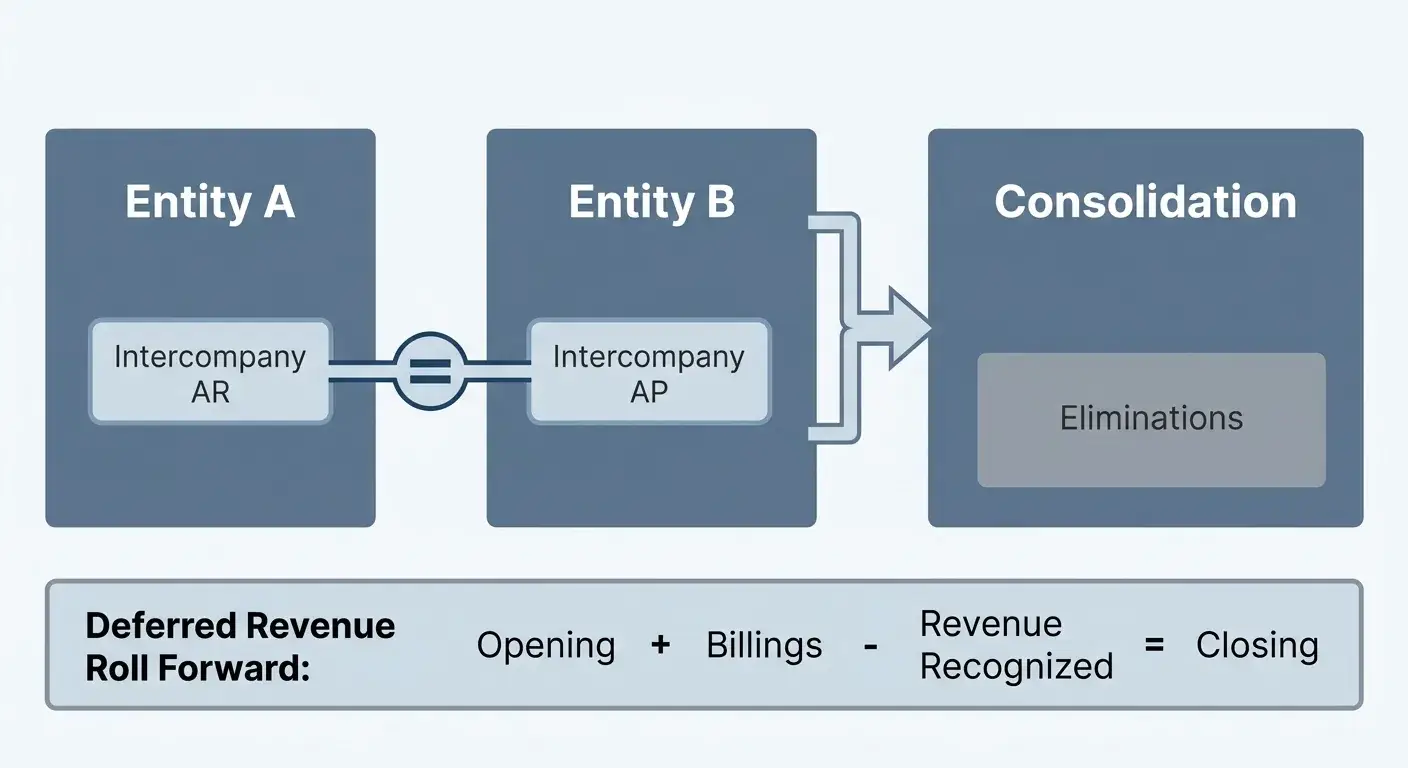
Multiple entities add a whole layer after the individual ledgers are done. Each entity closes on its own calendar. Then intercompany balances have to agree pair by pair before anything consolidates. Receivable in Entity A must equal payable in Entity B to the dollar. Management fees and shared payroll allocations need a written basis. Eliminations post at the consolidation level rather than inside either entity, and foreign subsidiaries need remeasurement with the translation difference landing where it belongs. Groups that skip the pairwise agreement step discover the mismatch at the consolidated level, where it’s far harder to trace.
Revenue recognition adds its own branch. Subscription and usage-based businesses have to prove that the deferred revenue roll-forward moves correctly: opening balance, plus new billings, less revenue recognized, equals closing balance, with the detail agreeing to the billing system rather than to a spreadsheet. Contract modifications, mid-term upgrades, credits, and multi-year prepayments each break the simple version. Usage billing adds a data dependency, since the consumption file from the product has to arrive before revenue can be calculated at all.
Set the applicability test in advance so these don’t sit on the checklist as permanent “if applicable” lines. Intercompany becomes a required step the day a second entity transacts. Deferred revenue becomes a required reconciliation the day prepayments exceed your materiality threshold. Inventory and WIP become required the day you hold stock or run jobs across period ends. Writing the trigger down keeps the step from being skipped for two years and then discovered during diligence.
What a month-end reporting package and review should include
The package decision-makers actually need contains the income statement, balance sheet, cash flow (or at minimum a cash and working capital view), the key account reconciliations, written explanations for material variances, a short KPI set, and a disclosure of unresolved items with owners and resolution dates. Review happens before issuance, not after, and the final reviewer should hold financial authority and should not have performed the work being reviewed. Northwestern University reports that reviewing the period’s expense and encumbrance detail at month close to confirm accuracy is a standard control in larger institutions, and it belongs in a $20 million company too.
Flux analysis is where the close earns its keep. Compare actuals to budget, forecast, prior month, and prior year. Require a written explanation for every movement above the threshold you set. “Payroll up 9 percent” isn’t an explanation. “Payroll up 9 percent on two senior hires starting the 6th plus the extra pay period” is. If the reviewer can’t explain a variance, the close isn’t finished even if every box is ticked.
The package should also answer the questions owners ask between the lines: margin by customer, contribution margin by service line, and where cash is going. In one engagement at CertiPay, a platform modernization cut labor cost 17 percent and produced the company’s first customer-profitability reporting, which changed how pricing conversations went from that month forward. For a clear view of who owns the preparation side of all this versus the review side, see “what does a controller do.”
Lock the period only after approvals, reconciliations, exception documentation, and the reporting review are complete. Record the lock date and define, in writing, who can authorize a post-close adjustment and how it gets documented. A lock with no adjustment protocol pushes people toward quiet spreadsheet edits. That’s the end of your audit trail.
Before you issue:
- Every material account reconciled, supported, and signed by someone other than the preparer.
- Variance explanations written, not verbal.
- Open items listed with amount, age, owner, and resolution date.
- Lock date recorded and post-close adjustment rules stated.
What the month-end close costs
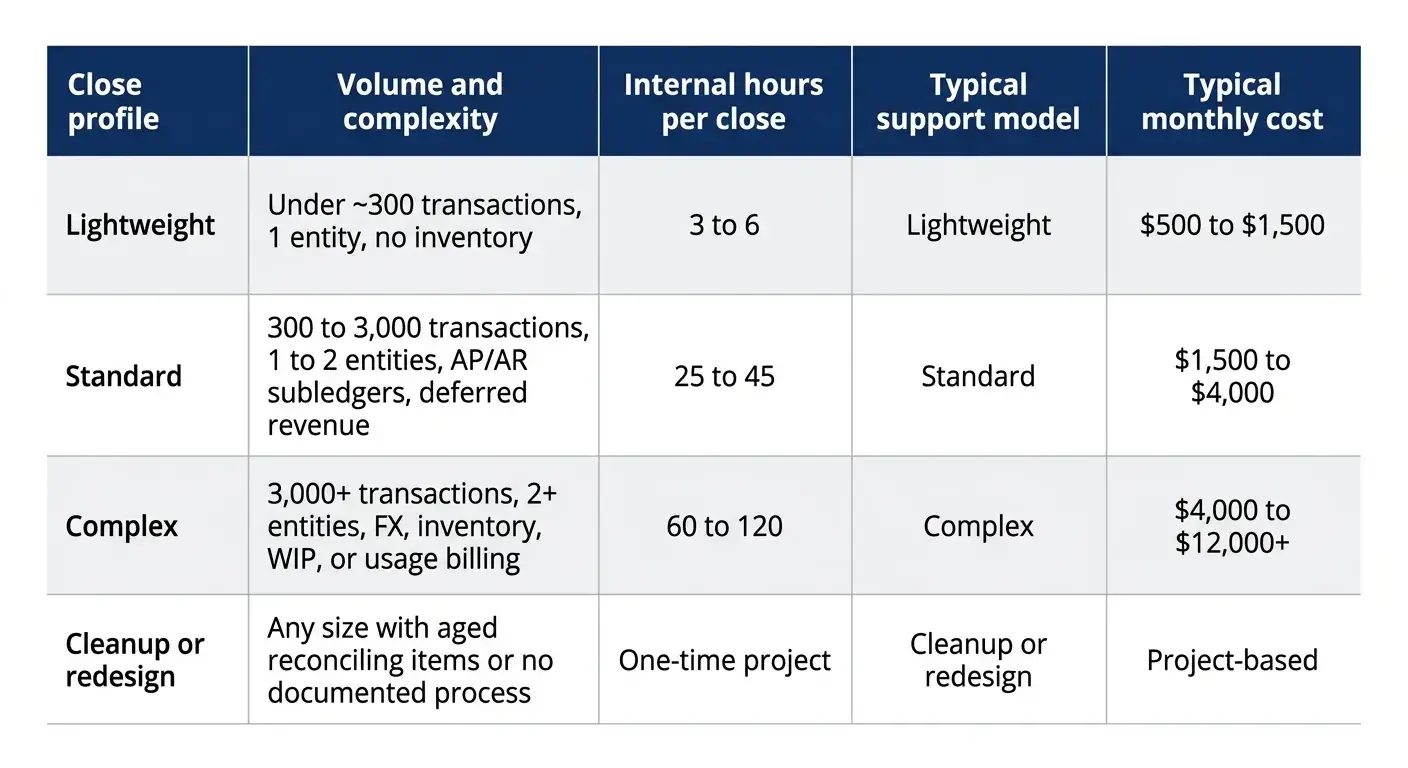
Move from spreadsheets to close-management software when the cost of running the checklist exceeds the cost of the tool. In practice that means two or more entities, more than two reviewers, or a team that is re-copying a workbook, re-dating it, and losing the audit history every month. Before that point, a controlled shared template with locked formulas and a visible sign-off column does the same job. What drives total cost is volume, entity count, model complexity, and who performs the work.
| Close profile | Volume and complexity | Internal hours per close | Typical support model | Typical monthly cost |
|---|---|---|---|---|
| Lightweight | Under ~300 transactions, 1 entity, no inventory | 3 to 6 | Bookkeeper, owner reviews | $500 to $1,500 |
| Standard | 300 to 3,000 transactions, 1 to 2 entities, AP/AR subledgers, deferred revenue | 25 to 45 | Bookkeeper plus part-time controller | $1,500 to $4,000 |
| Complex | 3,000+ transactions, 2+ entities, FX, inventory, WIP, or usage billing | 60 to 120 | Staff accountant, controller, close software | $4,000 to $12,000+ |
| Cleanup or redesign | Any size with aged reconciling items or no documented process | One-time project | Outsourced controller or CFO-led redesign | Project-based |
Outsourced small-business bookkeeping that includes a monthly close generally costs in the low hundreds to a few thousand dollars per month depending on transaction volume. On my side, the CFO Decision Diagnostic carries a $3,000 to $5,000 planning range confirmed after a fit and scope call. Ongoing engagements run $3,000 to $10,000 a month depending on plan, scope, and the condition of the finance function. Software subscriptions sit on top of whichever staffing model you choose. They reduce hours rather than replace judgment.
When to hire a pro for month-end close help
Hire outside help when the close has a structural problem rather than a busy month. Patching works for a slow week. It doesn’t work for any of these:
- Aged reconciling items. Differences older than two months, with no owner and no explanation, especially in clearing, suspense, intercompany, or processor accounts.
- Single-person dependency. One employee knows the sequence, the workarounds, and the passwords, and the close stops when that person is out.
- Multi-entity or multi-currency reporting with no consolidation process or eliminations done by hand in a workbook.
- Material judgment areas. Revenue recognition, inventory valuation, WIP, leases, tax provisions, or deferred commissions large enough to move the statements.
- An event on the calendar. An audit, a refinancing, a covenant review, a raise, or a sale inside twelve months. Diligence finds what the close hides.
- Reports that arrive too late to use. Numbers on day twenty-five answer questions nobody is still asking.
- Suspected fraud or weak separation of duties, including unexplained cash movement or one person with both posting and payment authority.
What to ask before you engage anyone: who will own the close calendar, what the target close day is and by when, which reconciliations they’ll perform versus review, what evidence standard they’ll enforce, how exceptions escalate, and what happens to the process if they leave. If the answer to the last one is a workbook on someone’s desktop, keep looking. Hiring sequence matters too, and if you’re weighing a controller against senior financial leadership, “what does a controller do” lays out where that line sits.
I work with founder-led and CEO-led companies between $5 million and $50 million in revenue that have usable books and no full-time CFO, usually alongside an existing bookkeeper, controller, and CPA. If your close is late, your margins are unclear, or you cannot see what cash looks like 90 days out, tell me the decision you are trying to make and I will tell you whether this is a cleanup, a redesign, or a staffing question.
Frequently Asked Questions
How long should a month-end close take?
Low-volume single-entity businesses can finish in two days with three to six hours of work. If you’re past day fifteen, look at dependency order and cutoff timing before you look at headcount.
What do accountants do for month-end close?
They post remaining transactions, reconcile balance sheet accounts to outside sources, prepare accruals and amortization entries with support, investigate variances, assemble the reporting package, and document anything unresolved. The split that matters is preparer versus reviewer. The person who books the entry shouldn’t be the person who approves it.
What is the difference between a month-end close checklist and a close calendar?
The checklist says what gets done and what evidence proves it. The calendar says when each task is due, who owns it, and what it depends on. You need both, and the calendar should be published at least seven days before period end so contributors can hit the cutoffs.
How do you decide whether a reconciling item is material enough to correct before closing?
Set a dollar threshold in advance, commonly tied to a small percentage of pre-tax income or total assets, and apply it consistently. Below the threshold, document the decision and track the item. Correct it regardless of size if it recurs monthly, affects a covenant calculation, or suggests a control failure.
When should a business lock the accounting period?
Lock after all required reconciliations are reviewed and signed, variance explanations are written, and the reporting package has been approved, typically on the same day the statements are issued. Record the lock date. Define in writing who can authorize a post-close entry so corrections run through a controlled process instead of a quiet edit.
Who should prepare and review month-end reconciliations and journal entries?
A staff accountant or bookkeeper prepares. A controller or equivalent reviews and signs with a date. In a very small team, the owner can serve as reviewer for cash, payroll, and any entry above a set dollar amount.
What month-end close tasks are different for SaaS, ecommerce, manufacturing, or construction companies?
SaaS adds the deferred revenue roll-forward, usage data, and deferred commissions. E-commerce adds processor-level reconciliation for fees, refunds, chargebacks, and reserves. Manufacturing adds inventory valuation and standard-cost variances. Construction adds WIP, retainage, and percentage-of-completion. The core sequence stays identical in all four.
What do we do with reconciling differences that can’t be cleared before the deadline?
Record them on an open-items log with the amount, age, root cause, owner, and expected resolution date, and accrue an estimate if the item is material and the direction is known. Don’t force the difference to zero with an unsupported clearing entry. A handful of documented, actively managed items is safer than a clean-looking account with a plug in it.
Is an accounting month-end close checklist template enough on its own?
A month end close checklist template gets you the task list, which is the easy part. It won’t give you dependency order, materiality thresholds, evidence standards, or escalation rules. Those are what actually shorten the close. Start with a template, then add owners, due dates, required attachments, and a sign-off column before you call it a process.