
A lender can look at the same building you own, run the same ratio, and come back 0.21x below your number. Nothing was falsified. The two of you simply used different income and different debt definitions. That gap is where most loan applications stall, and it is why debt service coverage ratio is worth understanding at the line-item level rather than as a single formula you copy from a calculator page.

What debt service coverage ratio means and who needs it
Debt service coverage ratio measures the income a business or a property produces against the debt payments owed over the same period. Divide qualifying income by annual debt service. At 1.00x, income exactly equals payments. Above 1.00x there is cushion. Below 1.00x there is a shortfall someone has to fund from outside the asset.
The ratio shows up in five situations:
- Commercial property financing. The lender sizes the loan against the property’s net operating income.
- Business borrowing. A term loan, equipment facility or acquisition line is tested against cash flow available for debt service.
- Refinancing. A loan that worked at 4.5% over 25 years may not work at today’s rate over 20.
- Underwriting review. The credit memo restates your numbers using the lender’s assumptions.
- Ongoing covenant testing. Most commercial loan agreements require a minimum coverage ratio every quarter or every year for the life of the loan.
Two versions of the ratio exist, and they are not interchangeable. Property-level DSCR uses net operating income against the debt on that property. Business or global DSCR uses adjusted EBITDA or cash flow available for debt service against every contractual obligation the borrower carries, which can include the operating company’s term debt, equipment leases, and the mortgage on the building the company occupies. Owner-occupied deals usually get measured both ways. The weaker number governs.
How to decide what kind of DSCR question you have
Start by naming the decision in front of you, because that determines which income figure and which debt figure belong in the calculation. A screening number you run on a napkin and a number a credit officer will defend to a committee are built from different inputs.
Find your situation below:
- You are screening a deal before you sign anything. Use in-place income, a realistic vacancy figure, and a payment quote at today’s rate. Property-level DSCR, two minutes, no reserves modeled. Good enough to kill a bad deal.
- You are preparing a lender package. You need the underwritten version: vacancy haircuts, market-rate management fees, replacement reserves, reassessed taxes, and current insurance. Build it before the lender does.
- You are testing how much you can borrow. Reverse the formula. The income is fixed, the lender’s minimum is fixed, and loan size is the output.
- You are refinancing an existing loan. Run the ratio at the new rate and the new amortization schedule before you apply. Rate and term move coverage more than rent does.
- You were declined and you do not know why. Ask the lender for their restated income and debt figures. The difference between their number and yours is the actual diagnosis.
- Your lender is asking about the balance sheet rather than cash flow. Coverage and capital structure are separate tests. For how debt sits against equity and what level a lender will accept, the full walkthrough is in “debt to equity ratio.” That is usually the next question once coverage clears, because a deal can pass the coverage test and still fail on leverage.
- You operate a business and own the building through a related entity. You need a global calculation that consolidates both, including rent paid between entities, which lenders often eliminate and replace with the actual mortgage payment.
Summary: property DSCR answers whether an asset supports its own loan. Business DSCR answers whether an operating company supports all of its obligations. Global DSCR answers whether the borrower as a whole does. Pick the one that matches the credit decision being made.
The debt service coverage ratio formula
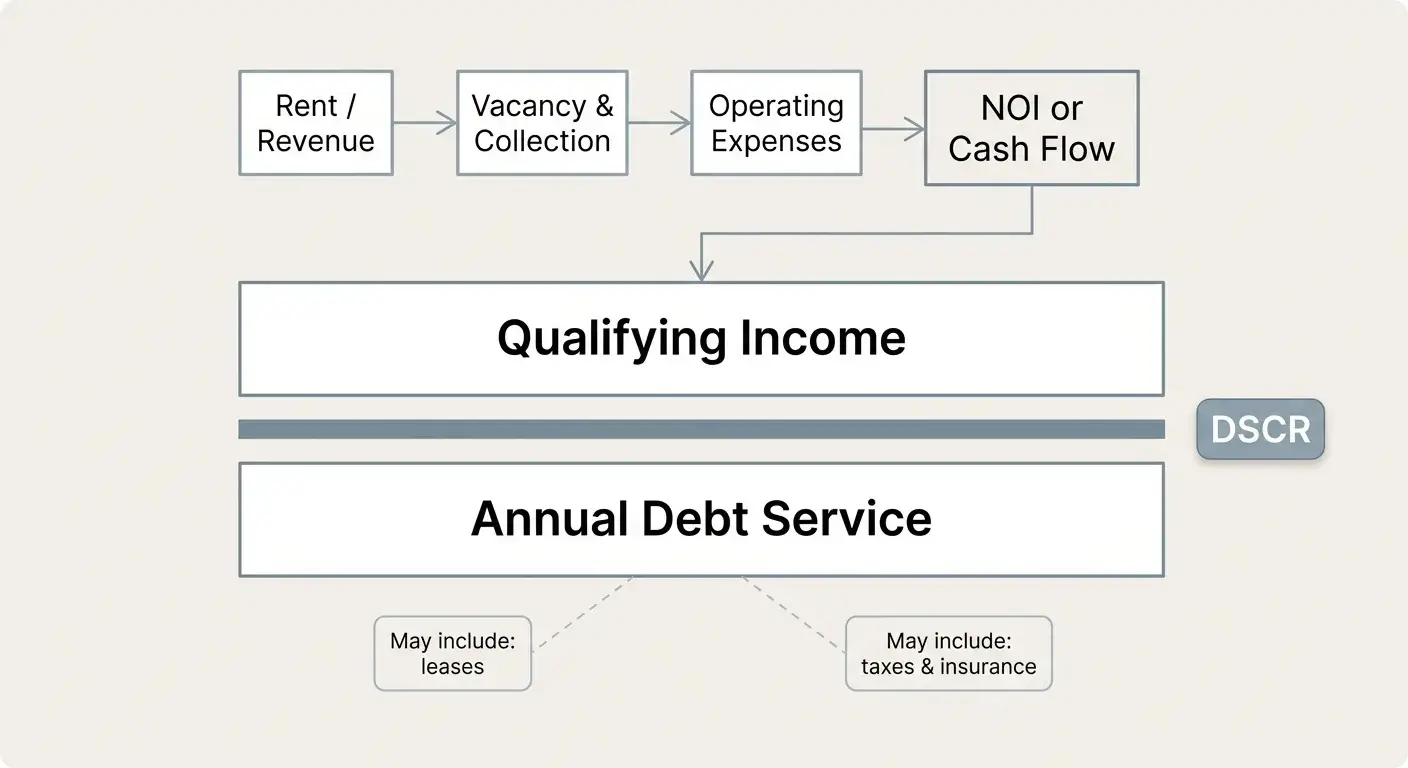
The formula is qualifying income divided by annual debt service. For a property, that is net operating income over twelve months of principal and interest. A shop with $120,000 of cash flow against $100,000 of annual loan payments covers its debt 1.2 times over.
Two rules keep the numerator honest. Property NOI runs gross scheduled rent, less vacancy and collection loss, less operating expenses such as taxes, insurance, utilities, repairs, management and a replacement reserve. It never includes principal, interest, depreciation or capital expenditures. Business cash flow starts from adjusted EBITDA, then loses cash taxes, unfinanced capital spending, and sometimes owner distributions.
The denominator is where people get surprised. Some loan agreements count principal and interest only. Others add capital lease payments, ground rent, other contractual debt, or the full monthly housing payment. One sentence in the definitions section of your loan document decides which version applies, and that sentence beats any formula published anywhere.
What a good debt service coverage ratio looks like
Four numbers carry most of the meaning. At 1.00x income exactly equals the payment, so one vacancy or one insurance renewal puts the loan underwater. At 1.20x the cushion is 20%, the tightest most banks will write. At 1.25x the cushion is 25%, the figure quoted most often as a good debt service coverage ratio. At 1.50x income is half again the payment.
There is no universal good number. Anyone quoting one without naming the property type is guessing. According to The Credit People, a conventional commercial mortgage usually requires a DSCR of 1.20 to 1.35. Property type sets the starting point.
| Property type | Typical underwritten DSCR | What drives it |
|---|---|---|
| Multifamily, stabilized | 1.20x to 1.25x | Short leases, deep tenant demand, agency programs |
| Industrial and single-tenant net lease | 1.20x to 1.30x | Long lease term, low operating expense load |
| Office | 1.30x to 1.40x | Rollover risk, tenant improvement and leasing cost |
| Retail | 1.25x to 1.40x | Tenant credit, co-tenancy clauses, rollover timing |
| Self-storage | 1.30x to 1.40x | Month-to-month leases, fast rate resets |
| Hotel | 1.40x and up | Income reprices nightly, high operating leverage |
Lev reports that office properties are generally underwritten to a DSCR of 1.30 to 1.40 in 2026. From there the requirement moves with risk rather than convention. Floating-rate debt needs more cushion than fixed. A 30-year amortization schedule produces a higher ratio than a 20-year schedule at the same loan amount and rate. Guarantor liquidity can buy tolerance the ratio alone would not earn.
One point worth holding onto: a high ratio is not automatically a good outcome. A 2.00x property is often an under-borrowed property. The equity parked in it earns the property’s return rather than the return you could earn elsewhere. Coverage is a safety measure, not a scoreboard.
How lenders calculate DSCR differently
Your lender’s number differs from yours because the lender restates the income and sometimes redefines the payment. Three definitions are in use, all of them legitimate: gross rent, vacancy-adjusted net operating income, and the full PITI housing payment. Run all three on the same eight-unit property with $180,000 of gross scheduled rent and $96,000 of annual principal and interest. The worksheet below shows exactly where the answers separate.
| Line item | Owner version | Lender underwritten version | PITI version |
|---|---|---|---|
| Rental income used | $175,000 (actually collected) | $180,000 (gross scheduled) | $180,000 (lease rent) |
| Vacancy and collection loss | not applied | $9,000 (5% of scheduled) | not applied |
| Effective gross income | $175,000 | $171,000 | $180,000 |
| Property taxes | $22,000 (current bill) | $26,000 (reassessed at sale) | in the payment below |
| Insurance | $7,000 (expiring policy) | $11,000 (renewal quote) | in the payment below |
| Repairs and maintenance | $12,000 | $12,000 | not applied |
| Utilities | $8,000 | $8,000 | not applied |
| Management fee | $0 (self-managed) | $6,840 (4% of EGI) | not applied |
| Replacement reserves | $0 | $2,000 ($250 per unit) | not applied |
| Capital expenditures | $0 (HVAC paid from cash) | excluded from NOI, priced through the reserve | not applied |
| Net operating income | $126,000 | $105,160 | n/a |
| Annual debt service | $96,000 (P&I) | $96,000 (P&I) | $133,000 (P&I plus taxes, insurance and any HOA dues) |
| Gap, owner to lender | – | $20,840 of NOI: $4,000 vacancy, $4,000 tax reassessment, $4,000 insurance renewal, $6,840 management fee, $2,000 reserves | – |
| DSCR | 1.31x | 1.10x | 1.35x |
Short answer to the question behind all of this: rent over PITI is the rental-program method and flatters the asset because no operating expense ever leaves the rent. NOI over principal and interest is the conventional commercial method and carries the vacancy factor, imputed management fee and reserve. True NOI is whatever the definition section of the loan document says it is. Capital spending sits outside all three, so a $40,000 HVAC replacement in an apartment building never reduces NOI. The replacement reserve is the only place a lender prices it in.
Rent is underwritten, not reported. Executed leases count at face value, contracted escalations count once the lease is signed, and pro forma or market rent takes a haircut. That is why a building full of month-to-month tenants underwrites lower than the same building on two-year leases.
Get three definitions in writing before you run a number:
- Which income figure applies: trailing twelve months, in-place annualized, or stabilized pro forma.
- Whether management fees, replacement reserves, and a vacancy factor are imputed even when you self-manage and the building is full.
- Whether annual debt service means principal and interest only, or principal, interest, taxes, insurance, HOA dues, ground rent, and other debt.
Two DSCR answers can both be correct. Only one of them is the one being underwritten. If you want a second set of eyes on the restated version before you submit, a 15-minute call is usually enough to tell whether the gap is a definition problem or an income problem.
How lenders use thresholds, and why there is no universal minimum
Bank commercial loans commonly land in the 1.20x to 1.30x range. Agency multifamily programs sit near the low end of that band. SBA-related underwriting is often described around 1.15x to 1.25x. Most multifamily lenders look for a DSCR of 1.20 to 1.25 for stabilized assets in 2026. Treat every published figure as a starting benchmark, not a commitment.
| Lender or program type | Typical minimum DSCR | What moves it |
|---|---|---|
| Bank or credit union, stabilized commercial | 1.20x to 1.30x | LTV, tenant concentration, guarantor liquidity |
| Agency multifamily | 1.20x to 1.25x | Market tier, loan size, interest-only period |
| SBA 7(a) lenders commonly underwrite small business loans to a minimum debt service coverage ratio that is often around 1.15x on a global basis. | ||
| CMBS and conduit | 1.25x and up | Property type, lease rollover, submarket vacancy |
| Rental-property DSCR programs | 1.00x to 1.25x, some below | Credit score, down payment, cash reserves |
| Bridge and private debt | varies, sometimes below 1.00x | Business plan, interest reserve, sponsor strength |
The spread from 0.75x at one lender to 1.30x at the next is not sloppiness. Five inputs set where a lender lands: LTV, cash reserves, credit score, property type, and the cash you are willing to put in at closing. A rental program may take 0.75x at 60% LTV from a borrower with a 740 score and twelve months of payments sitting in a funded reserve, then require 1.20x from that same borrower at 80% LTV on a short-term rental. Reserve requirements on those programs commonly run six months to a year of debt service, funded at closing.
Cash contribution settles most of the rest. A property with $84,000 of NOI pencils at 0.99x against a $1,000,000 request at 7% over 25 years, because annual debt service is about $84,800. Hold the rate and term, apply a 1.20x minimum, and maximum annual debt service drops to $70,000, which supports roughly $825,000. The borrower closes that gap with $175,000 more equity, not with a better argument.
The ratio also never operates alone. It gets read next to loan-to-value, debt yield, lease rollover schedules, and guarantor liquidity. A 1.25x deal still gets declined when one of those fails. Programs that accept coverage below 1.00x exist, and they buy the risk back with higher pricing, more equity, funded interest reserves, stronger guarantees, or all four. That is a structure decision, not a loophole.
How to calculate maximum loan amount from DSCR
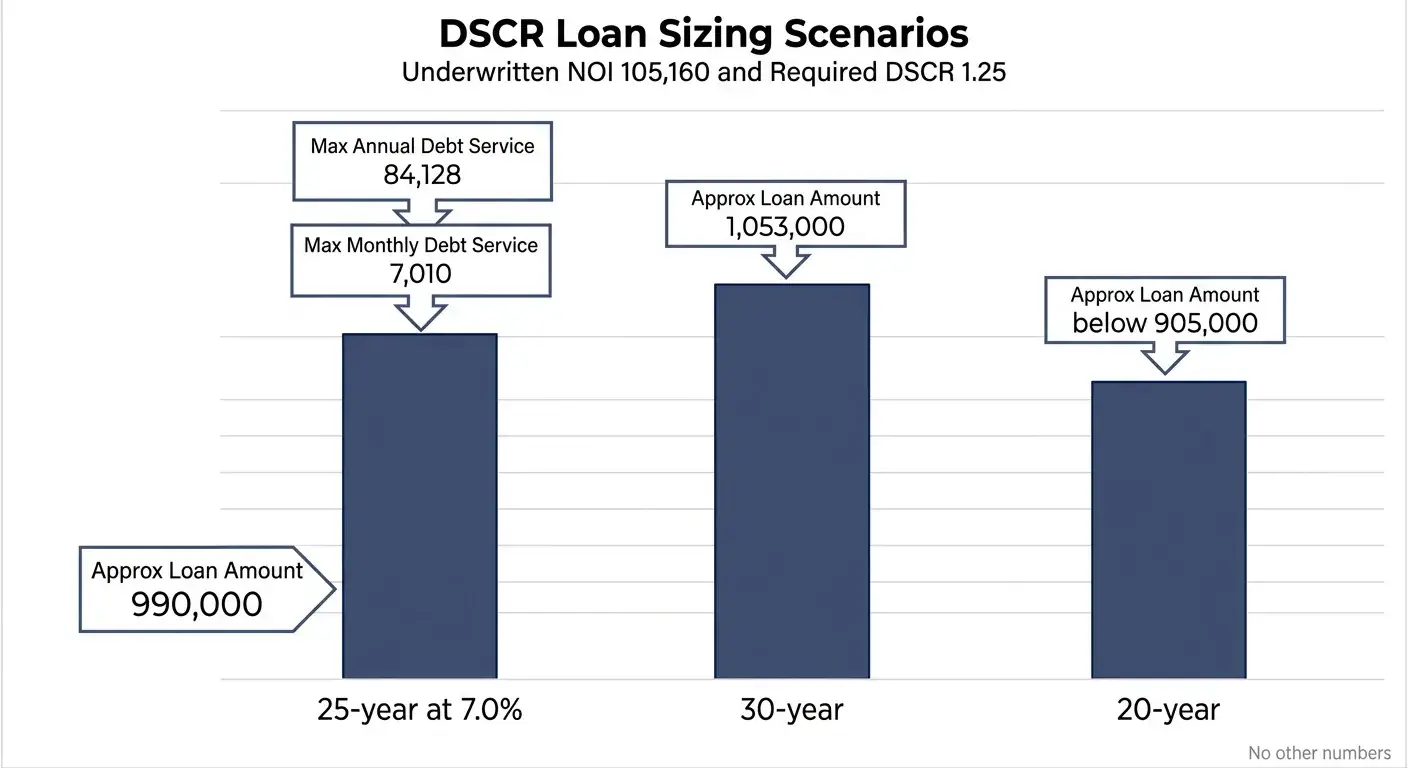
Reverse the formula. Maximum annual debt service equals NOI divided by the required DSCR. With the $105,160 of underwritten NOI from the worksheet above and a 1.25x requirement, maximum annual debt service is $84,128. That is $7,010 a month. At 7.0% over a 25-year schedule that payment supports roughly $990,000 of loan.
Loan size is a function of three variables, and only one of them is your income. Stretch amortization to 30 years and the same payment supports about $1,053,000. Shorten it to 20 and proceeds fall below $905,000. A quarter-point on the rate or a 0.05x move in the required ratio each swing proceeds by tens of thousands on a million-dollar loan, so model rate, term and ratio together before you accept the first term sheet.
Worked DSCR examples for a business and a property
A ratio means something once you convert it into dollars.
SaaS company, business DSCR. A software company does $12.4M in revenue with $2.1M of adjusted EBITDA. Step one is making the EBITDA defensible. When I was CFO at CertiPay, a platform modernization cut labor cost 17% and produced the company’s first customer-profitability reporting. Recurring cost removed that way sits in the numerator every year after, which does more for coverage than a one-time revenue spike ever will. Step two is the lender’s deductions, here $250,000 of cash taxes and $400,000 of capitalized development spend treated as unfinanced capital expenditure, leaving $1,450,000 of cash flow available for debt service. Step three is the denominator: $780,000 on the term loan plus $120,000 of equipment lease payments, so $900,000 in total. That is 1.61x, which clears almost any bank test.
Then the credit officer deducts the $400,000 of owner distributions the company has paid every year for four years, on the theory that they will continue. Cash flow available for debt service drops to $1,050,000 and the ratio falls to 1.17x. The deal moves from comfortable to conditional. The condition will be a distribution limit written into the loan agreement. Nothing about the business changed. One assumption did.
Office property, property DSCR. A multi-tenant office building produces $420,000 of underwritten NOI against $320,000 of annual debt service, so 1.31x and $100,000 of annual cushion, about $8,333 a month before any capital spending. Refinance the same balance 50 basis points higher and annual debt service rises to roughly $334,000, which takes coverage to 1.26x with no change in the rent roll at all. The property keeps paying its mortgage either way. Whether it still satisfies a 1.20x covenant is a separate test, and that one runs for the life of the loan.
How to improve a low DSCR before you apply or refinance
Five levers move the ratio, and four of them work faster than growing income. Pick based on what you are willing to give up.
- Borrow less. Reducing proceeds reduces the payment one for one. A property at 0.90x on $96,000 of annual debt service is short $9,600 a year. Getting to 1.00x means cutting proceeds about 10%, which is roughly $100,000 more cash at closing on a $1,000,000 loan, or funding a reserve account holding six months to a year of debt service instead.
- Lengthen amortization. Moving from 20 years to 25 or 30 cuts scheduled principal and raises coverage immediately. The cost is a larger balloon and more total interest.
- Fix the rate or buy a cap. Floating-rate debt makes the denominator a moving target. A rate cap turns an unknowable future payment into a known one, which some lenders will credit in the stress case.
- Clean up the income statement. Remove one-time revenue you cannot defend, document add-backs with support, and move personal expenses out of the operating entity before the lender finds them.
- Trim or retire small debt. Equipment notes and capital leases sit in the denominator of a global calculation. Paying off a $4,000 monthly obligation adds $48,000 of annual coverage room.
Two cautions. Interest-only structures raise the ratio on paper by removing principal from the denominator. The number collapses when amortization starts or the loan resets. Run the post-reset coverage before you accept the structure. And a ratio improved by under-funding reserves is borrowed from the roof, the parking lot, or the HVAC system. That bill arrives in a year when it is least convenient.
Summary: amortization and loan size move the ratio fastest. Income quality moves it most permanently. Anything that moves it by deferring a real cost is a timing trick. Underwriters recognize it.

What debt service coverage ratio means after approval
Clearing the underwriting test is a one-time event. The covenant is permanent. Most commercial loan agreements require a minimum DSCR tested quarterly or annually on a trailing twelve-month basis. Falling below it is a default under the agreement even when every payment has been made on time. Federal rules treat the measure as a live figure rather than a closing-day snapshot: for a multifamily mortgage exposure, debt service coverage ratio means the acquisition ratio when the loan is less than six months old and the mark-to-market ratio after that.
Can the lender call the loan when coverage falls below the covenant? Legally yes. A breach is an event of default and acceleration is on the list of remedies. On a loan that is still paying, the lender works a shorter list first: written notice with a cure period of 30 to 90 days, a waiver for a fee with the covenant reset at a lower level for a period, an equity cure where you deposit cash and the lender counts it as income for the test, a cash sweep that traps excess cash in a lender-controlled account, or a demand for a principal paydown and a funded reserve. Acceleration shows up when the breach runs for several test periods, the borrower stops communicating, or another default sits alongside it.
A professional earns the fee when the calculation involves multiple entities, affiliated-company cash flows, owner-occupied property, variable-rate debt, complex leases, unusual reserves, or two lenders using conflicting definitions. Ask any candidate which income basis they will use, whether they will build the covenant worksheet from the definition section of the loan document, and what the stress cases will be. A screening calculation on a clean single property with known rent and a quoted payment is fine to do yourself.
| What you are buying | Typical range | What it covers |
|---|---|---|
| Your own screening calculation | No direct cost | In-place income, quoted payment, feasibility only |
| Basic third-party review of a single property or loan | Several hundred dollars | Restated NOI, one debt scenario, sanity check |
| Full debt-capacity model, business or property | Several thousand dollars and up | Multi-entity cash flow, stress cases, loan sizing |
| CFO Decision Diagnostic | $3,000 to $5,000 planning range, confirmed after a fit and scope call | 10 business days, 13-week cash and working-capital view, margin and profitability map, prioritized 90-day action plan |
| Ongoing fractional CFO leadership | $3,000 to $10,000 a month | Depends on plan, scope and the condition of the finance function; every plan carries at least $50,000 in profit opportunities in the first 30 days or the work is free |
If you are sizing a loan, preparing a lender package, or watching a covenant drift toward its minimum, start with a 15-minute call and describe the decision in front of you. I work with founder-led and CEO-led companies between $5 million and $50 million in revenue that have usable books and no full-time CFO. The first thing we will do is build the version of the ratio your lender is using.
Frequently Asked Questions
What is the difference between DSCR and DSR?
Debt service coverage ratio measures income against debt payments for a business or property. A result above 1.00x means coverage. Debt service ratio is generally used in consumer and sovereign contexts to express debt payments as a percentage of income, so lower is better there. The two run in opposite directions, which makes mixing them up expensive in a conversation with a credit officer.
Why would someone get a DSCR loan?
Rental-property DSCR programs qualify the borrower on the property’s income rather than personal tax returns, which suits investors with heavy write-offs, self-employment income, or more properties than conventional guidelines allow. The tradeoff is pricing and structure: higher rates, larger down payments, and reserve requirements that often run six months of payments. The property still has to hit the program’s minimum, which typically falls between 1.00x and 1.25x.
What is the difference between DSCR and debt yield?
DSCR divides income by the debt payment, so it moves whenever the rate or amortization changes. Debt yield divides net operating income by the loan amount, which strips out both variables and gives the lender a measure that does not improve just because the loan was stretched to 30 years. A 10% debt yield means the lender recovers its loan amount in ten years of NOI at current performance.
What are the 5 key financial ratios?
Most credit reviews run five: coverage (DSCR), leverage (debt to equity or debt to EBITDA), liquidity (the current ratio), profitability (gross or contribution margin), and efficiency (days sales outstanding or asset turnover). DSCR usually decides whether the loan gets made and how large it is. The other four set pricing, covenants and reporting requirements. A borrower who can produce all five straight out of the monthly close, with the same numbers twice in a row, reads as lower risk before anyone looks at the results.
Is DSCR based on actual income, trailing-twelve-month income, or projected stabilized NOI?
Most banks underwrite trailing twelve months and then sanity-check it against in-place rent roll annualized. Stabilized pro forma NOI gets used on acquisitions and lease-up deals, but only when the assumptions can be supported by executed leases, market rent comparables, and a credible expense build. Ask which basis applies before you submit, because a property that passes on in-place income can fail on trailing twelve months after one vacant quarter.
What documents will a lender ask for to run DSCR?
For a property: a current rent roll with lease start and end dates, trailing twelve months of operating statements, the latest tax bill, a bound insurance quote, and a debt schedule showing rate, payment, maturity and collateral for every note. For an operating business, add two years of returns, interim financials, and written support for each add-back you expect the lender to accept. Underwriters haircut anything they cannot tie to a document. The quality of that package moves the ratio more than the arithmetic does.
Does an interest-only loan automatically improve DSCR?
It raises the stated ratio because the denominator drops to interest only. On a $1,000,000 loan at 7%, interest-only debt service is $70,000 against roughly $84,800 fully amortizing over 25 years, which is a 0.17x swing at a $105,000 NOI. Run the coverage at the post-interest-only payment before signing. That is the number you will be tested on later.
How do lenders calculate DSCR for short-term rentals or vacant units?
Short-term rental income usually requires twelve to twenty-four months of platform history. Many lenders haircut it or use the appraiser’s long-term market rent instead. Vacant units are typically underwritten at appraised market rent with a vacancy factor applied. Some lenders exclude units vacant longer than 60 days entirely. Signed leases always carry more weight than projections.
What is a good debt-to-income ratio?
Debt-to-income is a personal underwriting test, personal income against personal debt payments. Most consumer lenders want it at or below about 43%. It is a different measure from DSCR, which tests a property or an operating business, so the same borrower can pass one and fail the other on the same deal. When the lender is asking about capital structure rather than coverage, the ratio in question is usually debt to equity, and the full walkthrough is in “debt to equity ratio”.