
Most owners don’t discover a finance problem in a report. They discover it when payroll week feels tight, or when a lender asks for a covenant calculation nobody owns. This checklist is how I evaluate CFO services for small business owners, and it’s the same sequence I run when I step into a company: 12 checks, in order, with the pass signal, the fail signal, and what to do when an item fails.

Who this checklist is for
A CFO for a small business owns the forward-looking layer: cash timing, margin by customer, the forecast, the lender and investor conversation, capital and exit planning, risk review, and the controls that keep money from leaking. The contrast with the roles you already pay for is clean: the bookkeeper records transactions, the controller reports what already happened, the CPA handles tax compliance, and the CFO owns the model, the forecast and the decision that comes out of them.
Use this list two ways. Treat it as a 20-minute self-assessment of your own setup, or run it against an outsourced or fractional CFO relationship you already pay for and see which items come back clean. Work through it in order. The early checks are prerequisites. No strategic work is trustworthy until they pass. As Phoenix Strategy Group notes, the model has become common among businesses under $20M in revenue, which is exactly the band where complexity outruns a bookkeeper and a tax CPA.
1. Monthly close and statement accuracy
CFO services start with financials you can act on, so the first two checks are the close and the variance review. Skip them and everything downstream inherits the error.
- Close calendar. Check that the prior month closes on a fixed day, every month, with bank, credit card, payroll and merchant accounts reconciled.
– Pass: statements land by the same date each month and reconciliations are signed off.
– Fail: late closes, or an unexplained balance swing nobody can source. On a fail: put a date on the close and assign one person to reconciliations before anything else gets built on top. - Budget versus actual variance. Check that actuals are compared to plan by department and by major line, with a written explanation for anything material.
– Pass: variances above 10% are named, explained within a week of close, and rolled into an updated forecast.
– Fail: a static budget written in January and abandoned by February, or the same unexplained 15% swing three months running. On a fail: convert the static budget to a rolling forecast and set a standing variance review.
3. Rolling cash forecast and runway check
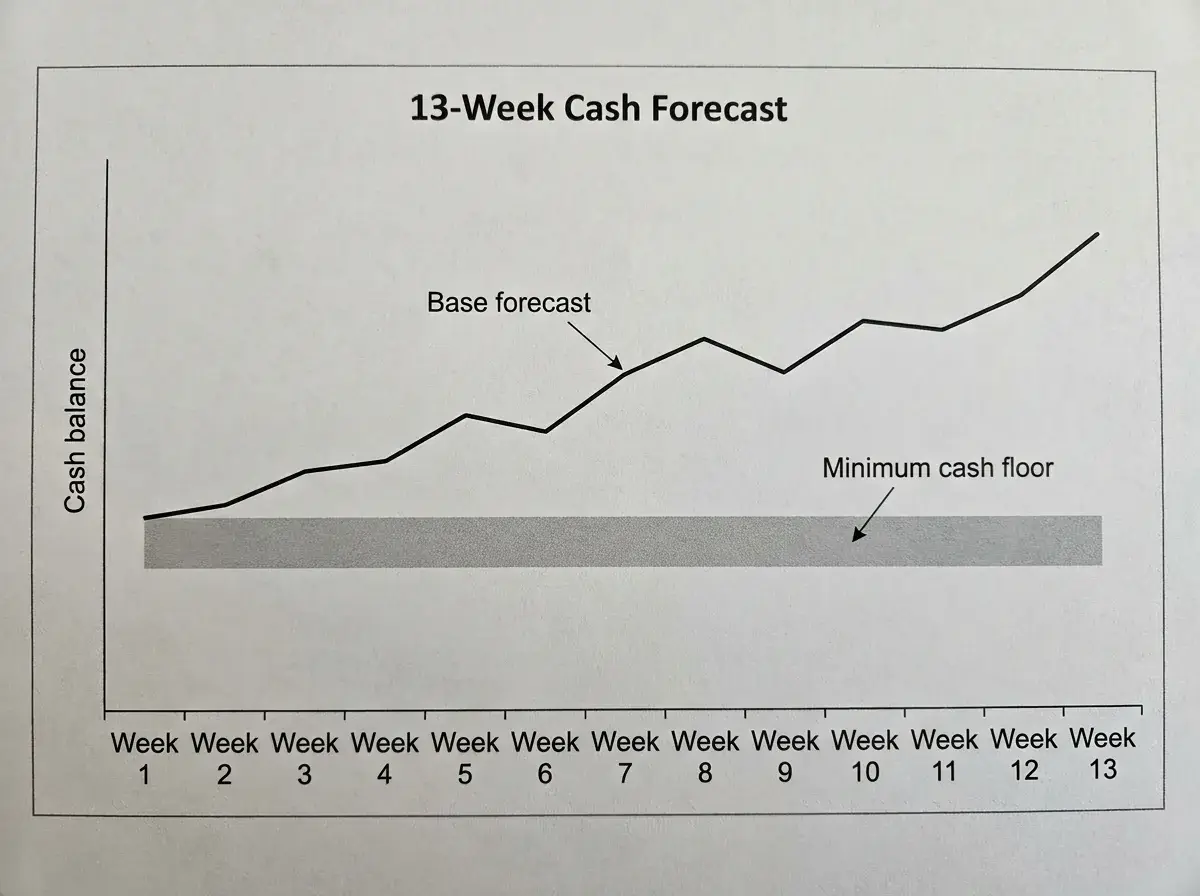
A 13-week cash view is a rolling picture of money in and out, week by week, updated weekly. Once someone owns it, an owner answers “what does cash look like in 90 days?” in about 30 seconds. That’s the line between CFO work and bookkeeping. The books tell you what happened and the 13-week view tells you what’s about to happen.
- 13-week cash view and runway. Check that someone owns it, updates it weekly, and compares last week’s forecast to what actually cleared.
– Pass: the forecast is current, forecast error is narrowing, runway is stated in months at current burn, and the view survives a stress test.
– Fail: decisions made off the bank balance, or repeated cash surprises in a business with stable operations. On a fail: build the 13-week view first, before any hiring, pricing or expansion decision.
Run the stress test with three shocks in the same 13 weeks. Your largest customer, say 22% of revenue, pays 30 days late. A planned facility draw or raise slips one quarter. One major expense line runs 15% over plan. Look at the lowest week in the view. If that week sits under your minimum cash floor or trips a covenant test, you have a problem you can see 60 days out instead of on a Friday payroll run.
4. Collections, DSO, and pipeline warning signs
Receivables and revenue timing are where cash crises are born, so this check tracks collections speed and pipeline quality together. Both feed the 13-week view. Both deteriorate quietly.
- DSO trend and pipeline health. Check DSO monthly, trend it, and segment it by your largest customers. Then check the pipeline for timing risk.
– Pass: DSO stable or improving against stated terms, no single customer dragging the average, and revenue arriving through the month rather than in a month-end pile.
– Fail: DSO rising more than 10% month over month for two consecutive periods, which can be a standard trigger for immediate investigation. Also failing: declining conversion rates, lengthening sales cycles, deeper discounting to close, or revenue concentrated in the last five days of the month. On a fail: pull an aged receivable list by customer that week, call the top three balances yourself, and reprice or retime terms for the customer creating the drag.
If two or more of the checks above are already failing, a focused diagnostic beats another month of guessing. That is the work I do in a short, scoped engagement before any ongoing commitment.
5. KPI, margin, and unit economics check
This is where CFO services turn reporting into decisions. The check is narrow on purpose: five to eight metrics tied to choices you actually make, plus margin visibility at the level where the money is won or lost.
- Margin and unit economics by segment. Check that you can see gross or contribution margin by customer, program, plan or SKU, and that customer acquisition cost and payback are known where you spend to acquire.
– Pass: margin by customer exists, CAC and payback are tracked, and burn is tied to a growth number rather than reported alone.
– Fail: one blended gross margin for the whole company, unknown CAC, or a KPI deck with 30 metrics and no decision attached to any of them. On a fail: pick the segmentation that matches how you sell and rebuild one month of margin at that level. That single exercise usually finds the profit leak. Judge whether the metrics earn their keep by the measurable outcome they produce, such as two to four points of gross margin recovered on the thinnest segment or three to six months of added runway, inside two quarters.
Worked example. A marketing and media agency at $9M in revenue picks six metrics: gross margin by client after delivery labor, billable utilization by team, realization against quoted scope, revenue per delivery employee, DSO by client, and the 13-week cash view. Each one carries a decision. Which clients get a rate increase or a scope reset at renewal. Whether the next senior hire is affordable this quarter. Which retainers get handed back. Failure looks like a dashboard reporting agency-wide gross margin at 52% while the two largest retainers run near 28% once the unlogged delivery hours land on them. A call center or BPO runs the same test at the program level, where margin per seat and per program decides whether a program gets renewed at the current rate.
| Business type | Margin cut that matters | Fail signal |
|---|---|---|
| Marketing or media agency | Gross margin by client after delivery labor | Largest client is also the thinnest, and nobody knows it |
| SaaS | Contribution margin by plan, CAC and payback | Spend rising while payback lengthens |
| Call center or BPO | Margin per seat and per program | Headcount grows, program margin does not |
| Distribution or wholesale | Margin by SKU and by customer after freight and terms | Revenue up, gross profit dollars flat |
| E-commerce | Contribution margin after ads, shipping, returns and processing | Refunds and chargebacks with no owner |
On the e-commerce side, one payments job makes the point. Baywalk held processing cost below 4% of gross, refunds below 15% and chargebacks below 3% at $60M annual capacity for five straight years. Those three numbers were reviewed monthly by name, which is why they stayed inside their bands.
6. Controls, reporting, and lender or investor cadence
CFO services also include the plumbing: who can approve what, what the outside reporting package contains, and when it goes out. The monthly order is fixed: close the books, build the reporting package, run the variance review, update the 13-week cash forecast, then deliver to the lender, board or investors on the agreed date. Run the checks below against that sequence. They’re the ones most often assumed rather than verified.
- Approval rules. Check that spending thresholds and approvers are written down. Fail: verbal rules. On a fail: document three thresholds and who signs at each.
- Segregation of duties. Check that no single person can create a vendor, enter an invoice and release the payment. Fail: one person holds all three. On a fail: split the payment release, even if the second pair of eyes is yours.
- Reporting package contents and model ownership. Check for P&L, balance sheet, cash flow, budget versus actual, KPIs and a short written commentary. According to Mercury, a standard outside package also includes a 13-week cash flow model, a board reporting pack, a budget with variance targets and a fundraise-ready model. Name the owner of the board pack and the owner of the financial model. Both are deliverables in their own right, not by-products of the close. Fail: numbers with no narrative, or a model nobody will put their name on. On a fail: add one page of commentary with action items and put one name against the model.
- Cadence. Check that lenders, investors or the board receive the package on an agreed date. Fail: reporting that arrives when asked for. On a fail: publish the calendar and hold it for three cycles.
- Covenant monitoring. Check that every covenant is calculated monthly, not at the bank’s request. Fail: nobody can name the current coverage ratio. On a fail: build the calculation into the close and forecast it forward.
- Coordination with bookkeeper and tax CPA. Check that accounting, tax planning and lender reporting agree. Fail: year-end tax surprises. On a fail: put all three on one call before the fourth quarter.
- CFO performance review. Check forecast accuracy, cadence adherence and how fast open variances close. Fail: the same three items are still open after 90 days. On a fail: name the deliverables and dates in writing, then review in 30 days.

Red flags that stop the job
Some failures mean you stop running the rest of the list and get senior help now. Run the full list once a quarter and CFO services for small business stop being a leap of faith. These are the ones I treat as escalations rather than improvement items:
- Financials arrive more than 30 days after month-end, two months running. Nobody is steering, including you.
- The P&L shows profit and the bank balance keeps falling. Accrual and cash have diverged, and the reason is unknown.
- Operating cash flow is negative and no one can say why. This precedes most emergency decisions I get called into.
- A covenant test is at risk inside two quarters, or the lender has asked a question the current reporting cannot answer.
- DSO deterioration with no explanation while sales reports look healthy.
- One person controls vendors, invoices and payments with no documented approvals. That’s a fraud exposure, not a workflow preference.
- Forecast error stops narrowing after 60 to 90 days. That’s the clearest sign an outsourced CFO is underperforming. The forecast is the one deliverable that should improve every week.
- Your current CFO support cannot answer the 90-day cash question without a week of preparation.
Any two of these together means near-term cash risk. Treat that as a fire, not a project. Two service-side signals belong in the same escalation set: open variances sitting unexplained past 90 days, and a monthly package that still arrives without commentary or a recommendation. Write them into the engagement and review them on a fixed date.
What to do with the results
Your next step depends on how many items failed, where they failed, and how complex the business behind them is. Outsourced CFO help tends to be relevant for businesses roughly between $500K and $10M in annual revenue. The need sharpens as complexity grows rather than as revenue alone grows.
- Zero to two fails, all in close and reporting, or revenue under about $1M with simple books: stay with bookkeeping and controller support and fix the close first. That’s an accounting problem rather than a strategy problem. Paying CFO rates to clear reconciliations is poor value.
- Three to five fails, including cash, margin or covenant items, or revenue between about $1M and $10M, or a raise or bank facility inside two quarters: this is fractional CFO territory. The forward-looking layer has no owner. That’s the gap the role fills. I work with founder-led companies between $5 million and $50 million that have usable books and no full-time CFO, alongside the bookkeeper, controller, CPA and leadership team rather than in place of them.
- Six or more fails, multi-entity operations, or CFO work that fills most of a week every week: you’re at the crossover. Model a full-time hire next to the fractional option before you renew anything.
Ongoing work runs in three plans, CFO Foundation, CFO Leadership and CFO Strategic Partner. Clients move up or down anytime as the failing item list shortens. What each plan runs per month, and what hours and deliverables sit inside it, is laid out in “Fractional CFO for Startups Cost Guide.”
Judgment matters more than the tier. Mine comes from 30-plus years in the CFO seat and more than 20 M&A and exit events, across founder-led, PE-backed and NASDAQ-listed companies.
Whichever band you land in, sequence the work. In my first 90 days, weeks 1 and 2 review cash, reporting and processes. Weeks 3 to 6 build the forward plan. Weeks 7 to 12 fix the top profit or cash leak and set the review rhythm.
If three or more items on this list came back failing, bring me the list and we’ll walk it in a 15-minute call. You will leave knowing which item to fix first and what it is costing you to leave it alone.
Frequently Asked Questions
How often should a 13-week cash forecast be updated, and how accurate should it be?
Weekly. The value comes from comparing last week’s forecast to what actually cleared, then correcting the assumptions that missed. Accuracy in week one should be tight within a few percent. The useful test is whether forecast error narrows over the first 60 to 90 days rather than hitting a fixed target.
What are the minimum internal controls a small business finance function needs?
Three: written spending thresholds with named approvers, separation between whoever creates a vendor and whoever releases payment, and a monthly review of new vendors added. Those three fit a two-person accounting team and close the most common leakage path. Bank and credit card reconciliations signed off monthly make the fourth.
How do I avoid buying CFO services when what I really need is better bookkeeping?
Run checks 1 and 2 first. If your only failures are late closes, unreconciled accounts and missing accruals, that’s an accounting hygiene problem. A good bookkeeper or controller solves it at a fraction of senior rates. CFO work pays off once the books are usable and the open questions are about cash timing, margin and capital.
At what revenue level do I need outsourced CFO services instead of just a bookkeeper and tax CPA?
Read the checklist before the revenue line. Most owners cross over somewhere between $1M and $10M. The real trigger is three or more fails in the cash, margin and covenant checks rather than a number on the top line. Under about $1M with clean books and two or fewer fails, a bookkeeper plus a tax CPA still covers it. A raise, a new bank facility or a first covenant package moves the date forward at any revenue level.
How much of my own time do CFO services give back?
Owners typically hand off 10 to 20 hours a month of reporting, cash chasing and spreadsheet work. You still own the operational assumptions: pipeline confidence, hiring intent, pricing decisions and approving the plan. The trade is that your remaining finance time moves from assembling numbers to deciding with them.
Can I get CFO help as a one-time project instead of a monthly retainer?
Yes. A scoped diagnostic works well when you have a single decision in front of you. Mine runs as a 10-business-day engagement producing a 13-week cash and working-capital view, a margin and profitability map, and a prioritized 90-day action plan. A one-time project answers a question. Ongoing work is what changes the numbers month after month.