
Most owners ask this question while staring at a bank balance they can’t explain. The honest answer depends less on revenue than on the kind of finance problem sitting in front of you. This guide lays out when outsourced CFO services pay for themselves, when they don’t, and the test you can run today to tell the difference.

The short answer: it depends on whether your finance problem is strategic or just operational
Outsourced CFO services are worth it when your finance problem is forward-looking. You can’t see cash 90 days out. You don’t know which customers or projects carry acceptable margin. A lender, investor or buyer is about to ask questions your current reporting can’t answer. If your problem is that the books are late, messy or wrong, that’s an operational gap. A bookkeeper or controller fixes it faster and cheaper.
The distinction matters because the two problems look identical from the owner’s chair. Late reports feel like a reporting problem. Sometimes they are. Other times the reports arrive on time and still don’t tell you whether you can afford the next hire, which is a judgment problem no amount of clean data solves by itself.
When outsourced CFO services are worth it
An outsourced CFO earns the fee when decisions are getting made on instinct because nobody owns the forward view. Before a raise or a bank conversation, that role builds the forecast, the 13-week cash view and the margin story that turn a vague pitch into something a lender can underwrite. The revenue band where this usually starts making sense runs roughly $2M to $50M. Complexity moves that line more than revenue does.
The situations where the answer is clearly yes:
- Cash is a guess. You can’t answer “what does cash look like in 90 days?” without an afternoon of spreadsheet work. A 13-week cash view is a rolling picture of money in and out. Once someone owns it, that question gets answered in about 30 seconds.
- A financing or lender event is coming. A covenant test, a line renewal, a raise or a diligence request. These have deadlines. Unprepared companies either miss the window or accept worse terms.
- Margin is unclear at the customer or product level. You know gross margin in total. You don’t know which accounts subsidize which.
- Complexity outgrew the stack. Multiple entities, a new pricing model, an acquisition, a system migration. Your controller is looking backward, correctly, and your CPA is handling tax. Nobody owns the forward layer.
- Two or more of the above are true at once. That combination is the practical threshold where the fee usually pays for itself.
A controller closes the month and protects accuracy. An outsourced CFO uses the closed month to decide what happens next. Pricing, hiring, debt, capital allocation. Both matter. Only one of them is looking through the windshield.
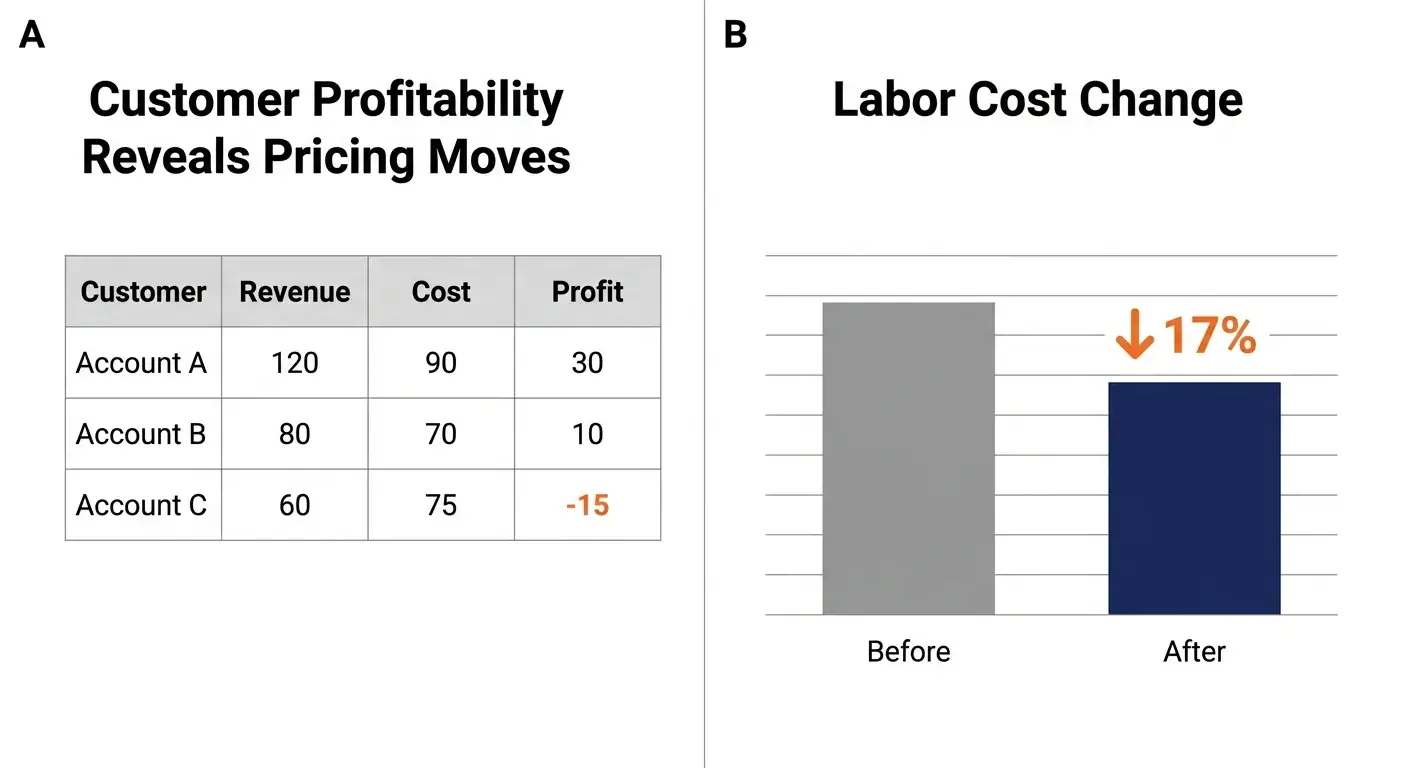
A worked example. In SaaS and software, a platform modernization at CertiPay cut labor cost 17% and produced its first customer-profitability reporting. The reporting mattered as much as the savings. Before that, pricing conversations were guesswork across the customer base. After it, the leadership team could see which accounts earned their keep and which ones needed a price change or a graceful exit.
When outsourced CFO services are not worth it
If the honest answer to “what’s broken?” is that the books are behind, the chart of accounts is a mess, or you need a tax return filed, CFO-level help is the wrong purchase. You’d be paying senior judgment to wait on data that doesn’t exist yet. Fix the foundation first. Then decide.
Skip the outsourced CFO, for now, when:
- The books aren’t usable. No CFO can forecast off a general ledger nobody trusts. Get a bookkeeper or a cleanup engagement done first.
- Your only real question is tax. That’s a CPA conversation.
- Decision volume is low. One product, one channel, one bank, predictable seasonality, no financing event on the horizon. Senior finance capacity sits idle. You resent the invoice by month four.
- You need throughput, not judgment. More invoices processed, faster collections, cleaner AP. That’s staff or systems work.
- You want advisory only. If your controller is strong and your books close on time, a periodic strategic review may be all you need. Embedded leadership is a different purchase at a different price.
What to do instead: stabilize the close, get reporting inside a predictable window, then reassess in two quarters. For the fuller comparison of bookkeeper versus controller versus CFO and how the roles stack, the breakdown lives in “Fractional CFO Guide: Costs, Options and When to Hire.”
The tradeoff: DIY finance, in-house hire, or outsourced CFO
Three paths. Each one costs something different. The cost is rarely just money.
| Option | What you pay | What you get | Where it breaks |
|---|---|---|---|
| DIY (owner plus bookkeeper) | Your nights and weekends, decision latency measured in weeks | Clean-ish books, tax compliance, historical reporting | No forward view. Financing windows close before you’re ready. Pricing and hiring calls made on feel |
| Full-time CFO hire | Base salary plus bonus, benefits and equity, 60 to 120 days to recruit, real risk of a bad fit at that level | Full-time senior capacity, deep internal ownership, succession | Under roughly $50M in revenue, the seat is often underused and the fully loaded cost outruns the value |
| Outsourced CFO | A monthly retainer, ongoing engagements commonly run $3,000 to $10,000 a month depending on plan, scope and the condition of the finance function, part-time attention | Forecast, 13-week cash view, margin analysis, lender and investor readiness, decision support | Weak fit if the books are bad, if scope isn’t defined, or if the provider is a controller wearing a CFO title |
Keep pricing in perspective. Don’t shop on rate alone. Full stage-by-stage cost detail, including what moves a quote up or down, is in “Fractional CFO for Startups Cost Guide.”
The risk nobody prices is scope creep. Diligence, a fundraise or a system conversion will expand the work. That expansion should be pre-approved in writing before it starts, not discovered in an invoice. Ask at signing what triggers extra hours and what the cap is.
If you want a low-commitment way to test the fit, a 15-minute call is usually enough to tell whether your problem is strategic or operational.

A rule of thumb for deciding today
Here is the test. Write down every finance question you couldn’t answer in under a minute last month. If two or more of them would change a decision worth more than one month’s retainer, you’ve crossed the threshold. If you can’t name two, you’re shopping too early.
Most articles quote ROI as “2x to 9x” and leave it there. Useless when you’re deciding in March whether to spend money in April. Here’s a more honest timeline:
- Weeks 1 to 2: review of cash, reporting and processes. You should learn something uncomfortable about your own numbers in this window.
- Weeks 3 to 6: the forward plan gets built. This is when the forecast and the cash view start answering questions instead of raising them.
- Weeks 7 to 12: the top profit or cash leak gets fixed and a review rhythm gets set.
That’s the shape of a working first 90 days. Measure results against specifics: cash visibility extended to a rolling 13 weeks, margin identified by customer, one pricing or cost decision made with better data, one financing conversation entered prepared. If none of those has moved by day 90, the engagement isn’t working. Say so.
Key takeaway: Two or more unanswerable finance questions plus one upcoming money event (a raise, a renewal, a covenant test or a sale conversation) means the answer is yes. One question and no event on the calendar means wait.
At Morgan Fractional CFO, the ongoing engagements carry a $50,000 guarantee. Profit opportunities found in the first 30 days, or the work is free. That’s one way to make the ROI question concrete instead of theoretical.
What the risks look like when you choose wrong
Choosing wrong rarely announces itself. It shows up as a decision you delayed, a term sheet you accepted because you had no alternative, or twelve months of advice that could have applied to any company.
The failure patterns worth naming:
Waiting too long. The most expensive version. A lender asks for a rolling forecast and three years of clean margin data with two weeks’ notice. You produce a spreadsheet nobody believes. Rates go up or the facility shrinks. Cash decisions made without visibility compound quietly. Overhiring in a soft quarter, underinvesting in a strong one, missing a financing window that was open for six weeks.
Buying a controller with a CFO title. A recurring complaint in owner forums, where people estimate a large share of the market is elevated bookkeeping. The screen is simple. Ask what the candidate changed at a prior client, what the number was before, and what it was after. Ask about a covenant they renegotiated or a diligence process they ran. Vague answers are the answer. The full interview checklist is in “How to Choose Fractional CFO Services: What to Look For.”
Generic advice and thin availability. The second most common source of buyer’s remorse. Every business gets the same dashboard template and the same three recommendations. Prevent it by defining deliverables and meeting cadence in the engagement letter.
Scope creep during a transaction. Diligence expands work dramatically. It always arrives faster than expected. Agree in advance on what counts as in-scope and what gets quoted separately.
Overbuying. Paying for capacity you never use. This one is easy to spot after the fact. If you can’t name a decision the engagement changed, you bought too much too soon.
The independence question matters too. A provider who oversees their own bookkeeping is grading their own homework. A provider earning a commission on your banking or insurance placement isn’t giving you neutral advice. Ask directly.
If you’re weighing whether senior finance support fits your situation, the CFO Decision Diagnostic is a defined 10-business-day engagement that produces a 13-week cash and working-capital view, a margin and profitability map, and a prioritized 90-day action plan. Start with a fit and scope call and get a clear answer instead of a guess.
Frequently Asked Questions
What are the risks of hiring a fractional CFO?
The three that surface most often are generic advice, limited availability when something urgent hits, and scope creep during a fundraise or system change. All three are contract problems before they’re performance problems. Define deliverables, meeting cadence and a pre-approval trigger for extra hours before you sign.
How much does an outsourced CFO cost?
Ongoing engagements commonly run $3,000 to $10,000 a month depending on plan, scope and the condition of your finance function. Lighter advisory falls below that and transaction-heavy work runs above. The full breakdown by stage and scope is in “Fractional CFO for Startups Cost Guide.”
What revenue level justifies an outsourced CFO?
Roughly $2M to $50M is the common fit band, and $5M to $50M is where founder-led companies most often have the complexity to use the role fully. Revenue is the weaker signal though. A $6M company with three entities and a bank covenant needs CFO help more than a $20M company with one product and no debt.
What is the difference between a controller and an outsourced CFO?
A controller owns accuracy and the close, looking at what already happened. A CFO owns the forward layer: forecast, 13-week cash view, margin by customer, capital structure, and the decisions that follow. Many companies need both. The controller’s work has to be solid for the CFO’s work to mean anything.
How many hours per month does a fractional CFO usually work?
Engagements typically range from about 10 hours a month at the light end to 30 or 40 at the heavy end. Driven by meeting cadence and whether a transaction is underway. Ask for the expected hours in writing and what happens when a month runs over.
When is advisory-only CFO support enough?
When your books close reliably, your controller is strong, and your open questions are strategic rather than structural. A monthly or quarterly review covering forecast variance, cash and one or two decisions can be sufficient. The moment a financing event appears on the calendar, advisory-only usually stops being enough.
What financial problems does an outsourced CFO solve before fundraising?
The forecast that survives questioning, a margin story tied to real customer data, a clean 13-week cash and working-capital view, and a data room that doesn’t fall apart in diligence. Start six months before you plan to raise. Reconstructing three years of defensible numbers under deadline is where deals slip.
What ROI metrics justify paying for outsourced CFO services?
Track four: cash visibility measured in weeks of reliable forward view, margin identified at the customer or product level, cost of capital on your next financing, and one operating decision per quarter made with better data. If none of those moved in 90 days, raise it directly with your provider.