
Most startups pay $2,500 to $15,000 a month for a fractional CFO in 2026. What moves that number most is stage plus scope intensity: a pre-seed company buying a monthly cash view sits near the floor, and a Series B company running board reporting, diligence and a live raise sits near the ceiling. As Fiscallion notes, one honest market survey puts the range at $3,000 to $15,000 a month, with most early-to-growth startups landing between $4,000 and $10,000.
Take a VC-backed SaaS company. At seed, with one product and 12 employees, the work is a 13-week cash view, burn discipline and unit economics, maybe 10 hours a month. Eighteen months later the same company preparing a Series A needs a defensible model, a data room, a board pack and scenario analysis. Same CFO, same hourly value, roughly double the hours and double the invoice.

Cost by Startup Stage
Here is what startups actually pay by round. Seed engagements cluster at $2,500 to $6,000 a month, Series A at $5,000 to $10,000, and Series B at $8,000 to $15,000. According to Adlega, across small-to-mid companies generally, $5,000 to $7,000 is the most common band.
| Stage | Monthly range | Implied hours | What is included |
|---|---|---|---|
| Pre-seed (pre-revenue) | $2,000 – $4,000 | 8 – 12 | 13-week cash view, burn tracking, simple operating model, pricing sanity check |
| Seed (under $1M ARR) | $2,500 – $6,000 | 10 – 15 | Monthly reporting package, runway scenarios, CAC and payback, investor updates |
| Series A ($1M – $5M ARR) | $5,000 – $10,000 | 15 – 25 | Board pack, driver-based forecast, margin by customer, hiring plan, raise support including model and data room |
| Series B ($5M+ARR) | $8,000 – $15,000 | 20 – 40 | Multi-entity close oversight, covenant tracking, diligence readiness, capital strategy, cap table and dilution scenarios |
Stage and scope intensity move the price more than any other variable. A seed company buys cash discipline and unit economics for $2,500 to $6,000 a month, while a Series B company with covenants, a board and live diligence buys two to three times as much senior time for $8,000 to $15,000.
My own ongoing engagements run $3,000 to $10,000 a month depending on plan, scope and the condition of the finance function. That last item moves the price more than founders expect. Clean books with a reliable close cost less to sit on top of than a general ledger nobody trusts.
Cost by Scope and Hours
The real choice is light advisory versus embedded support. Light advisory means I answer the questions you bring me. Embedded support means I sit in the operating cadence and find the questions you have not asked yet. Dividing the monthly fee by the hours band gives the effective rate you are actually paying. Kruze Consulting reports that startup-focused fractional CFOs commonly charge $250 to $500 per hour, with monthly costs of $8,000 to $16,000 in the heavier engagements.
| Hours/month | Typical fee | What the hours buy | What it will not cover |
|---|---|---|---|
| 5 | $1,600 – $2,500 | Runway planning only: one review call, a cash forecast refresh, ad hoc questions | Board reporting, fundraising, diligence, systems work |
| 10 | $2,500 – $4,500 | Runway planning plus KPI tracking: close review, 13-week cash view, margin analysis, investor update draft | A live raise, diligence responses |
| 15 | $4,500 – $7,500 | Board reporting: board pack, driver-based forecast, weekly finance meeting, pitch deck financials, lender conversations | Two workstreams at once, such as a raise plus a system migration |
| 20+ | $8,000 – $15,000+ | Fundraising and diligence: capital plan, data room, diligence responses, term sheet scenarios, leadership meetings | Bookkeeping production |
Read the table by the obligation you owe someone outside the company. A cash question you answer yourself needs the bottom band. A board that reads a monthly pack needs the 15-hour band. A raise or lender diligence needs the embedded band for the months it runs, then you step back down.
What you buy at every band is senior time, priced as an ongoing subscription to judgment. Some providers bundle a controller, an analyst and bookkeeping production into the fee, which raises the monthly number and lowers the cost per service. On my engagements the CFO hours sit on top of the bookkeeper, controller, CPA and leadership team you already have.
At 800 Travel Systems, a call center business, we ran daily KPIs on staffing versus schedule, call-abandon, conversion and gross profit by agent. Adding travel insurance to every ticket lifted close rates from 10% to 12%. That KPI work needs a seat in the weekly operating rhythm, which is the top band, not the bottom one.

Cost by Pricing Model: Hourly, Retainer, or Project
Retainers win for ongoing work and projects win for one-time events. Hourly is the model that looks cheapest and often is not, because you pay ramp-up time repeatedly and you get help only when you remember to ask. Hourly rates in 2026 run $150 to $250 for entry level, $250 to $350 mid-tier, and $350 to $500 for senior or specialized practitioners. Marketplace hourly work usually runs about $100 to $300+ per hour.
| Model | Typical band | What is included | Where it costs more than founders expect |
|---|---|---|---|
| Hourly | $150 – $500/hr | Time only, no standing deliverables | Repeated context rebuild, no cadence, surprise months during a raise |
| Monthly retainer | $2,500 – $15,000/mo | Defined scope, hours band, meeting cadence, named deliverables | Overage rates during fundraising, minimum term you did not read |
| Project fee | $8,000 – $40,000 per project | Model build, diligence prep, system implementation, cleanup | Scope drift, anything outside the statement of work is a change order |
A useful test: if the engagement has a calendar in it, buy a retainer. If it has a finish line, buy a project.
What Adds to the Bill
The model, board pack and cash forecast belong in the base retainer. The extras below are where a diligence-prep quote blows past the number founders had in their head, so ask for each one to be priced before you sign.
- Onboarding or setup fee. $1,500 to $5,000 in many quotes, covering chart of accounts review, KPI definitions and the first model build.
- Access to financial systems. Getting access to the general ledger, payroll, billing and banking, then configuring reporting inside them, takes real hours in week one. Some quotes bill that inside onboarding and others bill it against the hours band, so ask which.
- Software and tools. FP&A platforms, dashboards and data room tooling are usually pass-through, not included.
- Extra meetings. Weekly leadership meetings, lender calls and investor Q&A beyond the agreed cadence draw down the hours band.
- Fundraising rush work. Expect a 1.5x to 2x month during an active round, or a fixed project fee on top of the retainer, covering the model, the deck financials, the data room and diligence responses.
- Event work quoted as projects. Audit prep, venture debt support, cap table and dilution scenarios, and M&A or exit readiness are scoped and priced separately from the monthly fee.
- Repairs found during diligence. Revenue recognition errors, unreconciled deferred revenue and missing contracts. These are the true budget breakers.
- Minimum charges. Many providers set a floor around $1,500 to $3,000 a month and a three to six month minimum term.
- Excluded work. Bookkeeping cleanup is priced separately, often by the month being fixed, and tax returns stay with your CPA. I don’t provide stand-alone bookkeeping or tax-return preparation, so both get scoped outside the retainer.
Checklist for a fundraising or diligence quote
Before you sign anything with a round in front of you, get these six numbers in writing:
- The setup or onboarding fee, and whether week-one system access is billed inside it or against the hours band.
- The hours band for the raise months, plus the rush multiplier or fixed project fee that applies on top.
- The overage trigger hour and the overage rate.
- The minimum term and the notice period.
- The pass-through list: FP&A tools, dashboards, data room tooling.
- The written exclusion list, so cleanup, tax returns, audit assurance and investment-banking work are priced elsewhere or not at all.
Unstated setup fees and unstated overage rates are the two gaps that turn a $6,000 quote into a $14,000 month. Settle both before diligence starts, not during it.
How to Pay Less Without Regret
The savings that hold up come from narrowing scope, not from buying a cheaper person.
Savings that hold up:
- Start with a defined diagnostic instead of an open retainer. My CFO Decision Diagnostic is a 10-business-day engagement in a $3,000 to $5,000 planning range, and it delivers a 13-week cash and working-capital view, a margin and profitability map and a prioritized 90-day CFO action plan. If an ongoing engagement starts within 14 days of the readout, some or all of that fee can be credited to the first month.
- Match the engagement size to the finance gap. If the gap is a forecast and a cash view, buy the middle band. If the gap is a raise or a covenant problem, buy the embedded band for the months it lasts and step back down after.
- Buy hours in the cadence you will use. A 15-hour band you fill beats a 25-hour band you waste.
- Put overage rules in writing so a fundraising month is a known cost instead of a negotiation.
- Ask for the term you want now. A six-month minimum that converts to month to month with 30 days notice costs less than a 12-month lock you try to exit early.
Savings that backfire:
- The $75 to $150 per hour ‘CFO.’ That price buys controller-level work with a CFO title, and it shows up in the first diligence call, where a model nobody can defend costs valuation.
- Underbuying strategy to protect this quarter’s cash. A missed runway signal or a late pricing decision costs multiples of the fee, because the decision gets made without the numbers.
- Stacking two cheap providers so nobody owns the forecast and nobody owns the cash view.
Which layer of finance work belongs at CFO rates and which belongs with a controller or bookkeeper is its own question, and the answer sets the band you buy. The full role and pricing comparison is in “Fractional CFO Guide: Costs, Options and When to Hire.”
Every plan I offer carries the same promise: at least $50,000 in profit opportunities found in the first 30 days of an ongoing engagement, or the work is free. If you want to test that against your own numbers, a 15-minute call is enough to scope it.
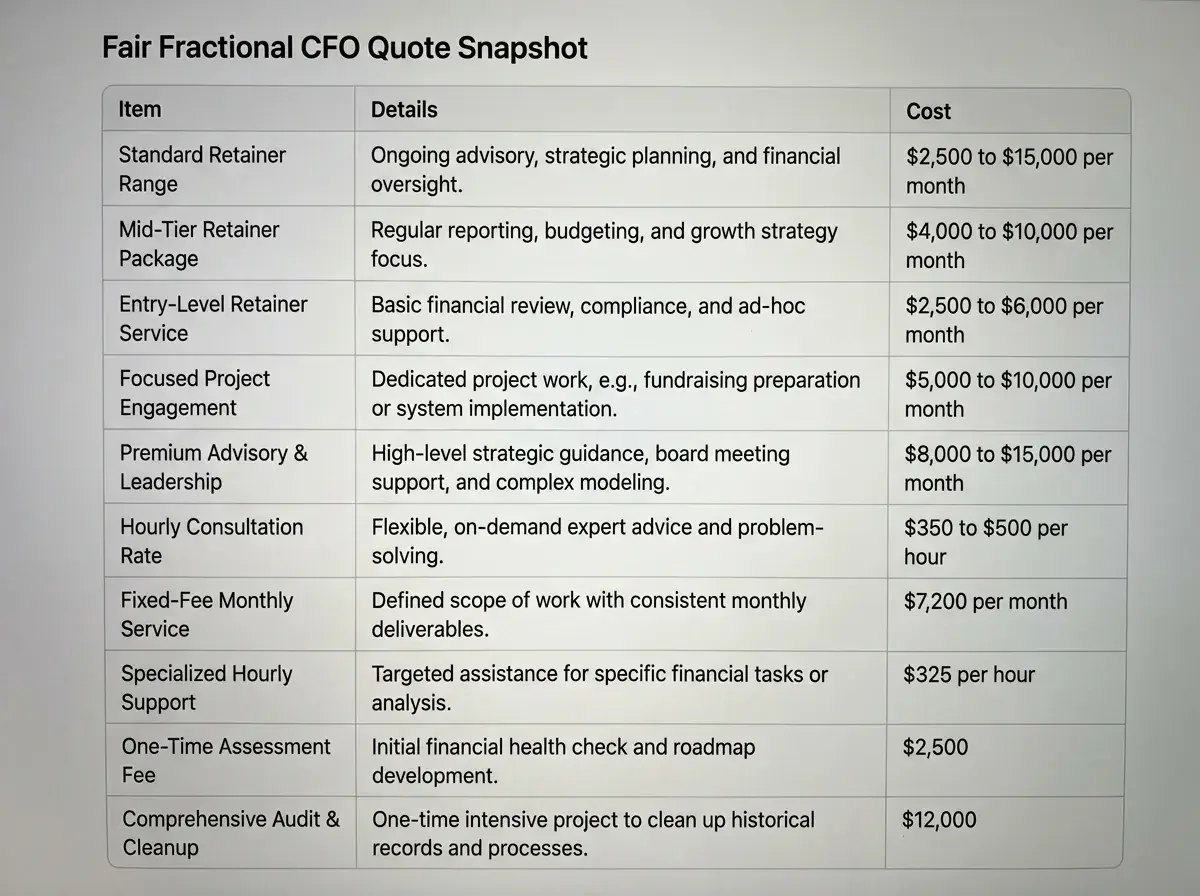
What a Fair Quote Looks Like
A fair quote tells you what you get, how much of it, how often and what happens when you need more. Compare quotes on these six elements side by side and the cheap one often stops looking cheap.
| Element | What to compare |
|---|---|
| Scope | Named workstreams, plus a written exclusion list |
| Hours | A stated monthly band and a named person, not ‘our team’ |
| Cadence | Meeting frequency and who attends |
| Deliverables | Each output with a due date, such as board pack by day 15 |
| Overage rules | The trigger hour, the rate and whether you get warned first |
| Term | Minimum months, renewal and notice period |
Quote example: Series A SaaS company, $3.2M ARR
| Line item | Detail | Fee |
|---|---|---|
| CFO leadership | 18 hours/month, named CFO, no substitutions | $7,200/mo |
| Deliverables | Monthly board pack by day 15, 13-week cash view refreshed weekly, driver-based forecast, margin by customer | Included |
| Cadence | Weekly 45-minute leadership call, monthly board prep, quarterly plan reset | Included |
| Onboarding | Chart of accounts review, model build, KPI definitions, weeks 1 – 3 | $2,500 one-time |
| Overage | Hours above 18/month | $325/hr |
| Raise support | Data room, diligence responses, investor Q&A | $12,000 project fee |
| Term | 6 months, then month to month with 30 days notice | – |
| Excluded | Bookkeeping production, tax returns, audit, legal and investment-banking services | – |
Run the math before you line proposals up: $7,200 divided by the 18-hour band is a $400 effective rate, and the $325 overage rate sits below it, so extra hours during a raise cost less than the base band. If a proposal carries a monthly number and a paragraph of adjectives, you have nothing to compare it against.
When DIY or a Cheaper Option Costs More
Three risks show up by stage. Hiring too early: under $1M in revenue, with no board and a clean spreadsheet, a founder can run finance alone for a while. Confusing the roles: a controller is the right first hire when the problem is a slow, messy close rather than a missing forecast, and paying CFO rates for close work is the most common overspend I see. Waiting too long: a model without cohort logic, a burn number that moves between two decks or a revenue schedule that disagrees with the contracts costs valuation or a term sheet once investors, lenders and board members start grading your numbers. For scale, earlier-stage companies spend $250,000 to $400,000 all in for a full-time CFO, plus 0.6% to 1.25% equity.
If uncertain cash, unclear margins or late reporting is shaping decisions in your business right now, start with the CFO Decision Diagnostic and get a 90-day action plan before you commit to a retainer.
Frequently Asked Questions
What services does a fractional CFO offer?
Strategic planning, cash and capital management, fundraising support and board reporting, plus performance and profitability work, banking and insurance guidance, and transaction or growth readiness. In practice that is a 13-week cash view, a driver-based forecast, margin by customer, a monthly board pack, and the model and data room a raise needs. I work alongside your bookkeeper, controller, CPA and leadership team, and I don’t provide stand-alone bookkeeping, tax-return preparation or investment-banking services.
How much does a CFO at a startup make?
Earlier-stage companies spend between $250,000 and $400,000 all in for a full-time CFO, plus 0.6% to 1.25% equity in the company. That all-in figure is the right comparison for a retainer, since a $6,000 a month engagement annualizes to $72,000 with no equity. The gap is why founders usually buy fractional hours first and hire full time once the work outgrows the band.
How do fractional CFOs handle overage hours beyond the retainer’s included time?
Most bill overage at an incremental hourly rate close to the retainer’s effective rate, often $250 to $400 per hour. Get the trigger in writing: whether overage starts at hour 19 or after a 10% buffer, and whether you get notified before the clock runs. Fundraising months are where unspoken overage rules turn into a surprise invoice.
Are offshore fractional CFO services at $75 to $150 per hour suitable for investor-facing work?
Use them for controller-level tasks: reconciliations, schedule preparation, reporting production. At that price you are buying execution, not judgment, and investor-facing work needs someone who can defend the model live in a diligence call. Mispriced metrics in a data room cost far more than the hourly savings.
When does it make more financial sense to switch to a full-time CFO?
The switch usually makes sense when the work exceeds roughly 30 to 40 hours a month for two consecutive quarters, or when a transaction, a major system build and a raise are running at the same time. Compare the annualized retainer against total loaded cost including benefits and equity, then ask whether the role needs presence or judgment. Presence-heavy roles belong in-house.
Do fractional CFO engagements require a minimum contract length?
Most retainers ask for three to six months, because the first month is onboarding and the second is when the forecast starts earning its keep. Look for month-to-month after the minimum with 30 days notice. My plans let clients move up or down at any time.
How fast should value show up after onboarding?
Expect a working 13-week cash view inside the first three weeks and a board-ready reporting package by the end of month two. In my ongoing engagements, at least $50,000 in profit opportunities surfaces in the first 30 days of the engagement, or the work is free. If nothing actionable has appeared by day 45, either the scope or the data is wrong, and that is a conversation to have before month three.
What is the difference between a $3,000 a month retainer and a $10,000 a month embedded engagement?
At the entry tier, roughly $3,000 to $5,000 a month, you get a standing review of the numbers and answers to the questions you bring. Mid-range work at $5,000 to $10,000 buys the reporting rhythm a board can read: a driver-based forecast, a monthly board pack and a weekly finance meeting. At $10,000 and above the engagement is embedded, which means a seat in leadership meetings, ownership of the capital plan, and running a raise or lender diligence end to end.
What should be included in a startup due diligence quote?
Ask for the diligence request list, the supporting schedules, a revenue recognition review, a refreshed 13-week cash view and the data room build, each with a named owner and a due date. Bookkeeping cleanup sits outside that scope. I don’t provide stand-alone bookkeeping, so it gets scoped with your bookkeeper or CPA and priced by the month being fixed. Expect a fixed project fee rather than open hours, and get the change-order rule in writing before diligence starts.