
This page is the map of the topic: what a fractional CFO actually does, how to tell the role apart from a controller or bookkeeper, what the work costs, how many hours you get at each retainer level, and how to judge whether the person you hired is moving the numbers. Where a subtopic deserves its own full treatment, I point you to the article in this cluster that handles it. Think of it as a curated list of the decisions, with the detail one click away.
On this page
- What a fractional CFO is and who needs one
- How to decide whether you need a fractional CFO, controller, or bookkeeper
- If you need cash flow and margin visibility
- If you need help preparing for fundraising or a transaction
- If you mainly need ongoing CFO leadership for a smaller business
- How much a fractional CFO costs
- What the work usually looks like month to month
- When a fractional CFO is worth the hire
- How to judge whether your fractional CFO is actually helping
- Frequently asked questions

What a fractional CFO is and who needs one
A fractional CFO is a senior finance executive who works part time, on a retainer or a defined project, and carries the same responsibilities a full-time CFO would: forecasting, cash and capital, margin by customer, banking relationships, board and investor reporting, and readiness for a transaction. Tipalti reports that the role is bought as a contract engagement rather than a payroll hire.
Four situations bring owners to it. Growth that outruns the finance function. Cash that behaves in ways the P&L doesn’t explain. Investors or lenders asking questions the current reporting can’t answer. A deal on the horizon, in either direction.
A worked example from software. At CertiPay, a $285M PEO, ASO and B2B payroll software business where I served as CFO from 2017 to 2023, a platform modernization cut labor cost 17% and produced the company’s first customer-profitability reporting. Before that reporting existed, every pricing conversation was a guess dressed up as a policy. After it, the sales team knew which accounts earned their keep. That’s the shape of the work whether the retainer is $4,000 a month or the seat is full time: build the view, then use it to change a decision.
How to decide whether you need a fractional CFO, controller, or bookkeeper
If your books are late or wrong, hire bookkeeping or controller help first. If your books are clean and you still can’t answer what cash looks like in 90 days, which customers earn margin, or whether you can afford the next hire, you need a CFO. As Paro notes, one common recommendation puts the trigger for CFO-level help at $1M to $10M in revenue or whenever a fundraise is coming.
The three roles do different jobs, and paying for the wrong one is the most common waste I see.
- Bookkeeper. Records transactions, runs AP and AR, reconciles accounts. Looks at yesterday. Usually enough on its own below roughly $1M in revenue with a single entity and simple billing.
- Controller. Owns the close, the chart of accounts, revenue recognition mechanics, and accurate monthly statements. Looks at last month. The right hire when the close takes three weeks or the numbers move after you’ve already reported them.
- Fractional CFO. Owns the forward view: the 13-week cash view, the forecast, contribution margin by customer or project, covenant headroom, pricing, capital structure, and diligence readiness. Looks at the next four quarters.
Decision guide: pick your path
- Books late, wrong, or unreviewed, revenue under $2M: controller or bookkeeping first. A CFO built on bad data produces confident nonsense.
- Books usable, revenue $2M to $10M, cash surprises or unclear margins: fractional CFO on an ongoing retainer. This is the band where the model earns the most per dollar.
- According to Ambition CFO, revenue $10M to $50M, multi-entity, multiple revenue lines, lender covenants: fractional CFO with a controller underneath. One source argues the optimal window to hire a fractional CFO is when annual revenue sits between $10 million and $30 million, which reads as a caution against buying the role before the complexity exists.
- One event driving the need (raise, sale, refinance, audit prep): project engagement, not a permanent retainer.
- Revenue above roughly $50M, or finance headcount you need to manage daily: start scoping the full-time seat.
The tradeoff is simple to state. Accounting support buys accuracy. CFO support buys judgment about the future. Most founder-led companies between $5 million and $50 million need both, in that order.
Quick summary
- Fix the data before you buy the judgment.
- Controller work is backward looking by design, which is fine.
- The forward-looking layer usually has no owner, which is the actual gap.
- A single upcoming event calls for a project, not a retainer.
The buyer-side questions, what to look for in a provider and how to compare proposals, are handled in “fractional cfo services.”
If you need cash flow and margin visibility
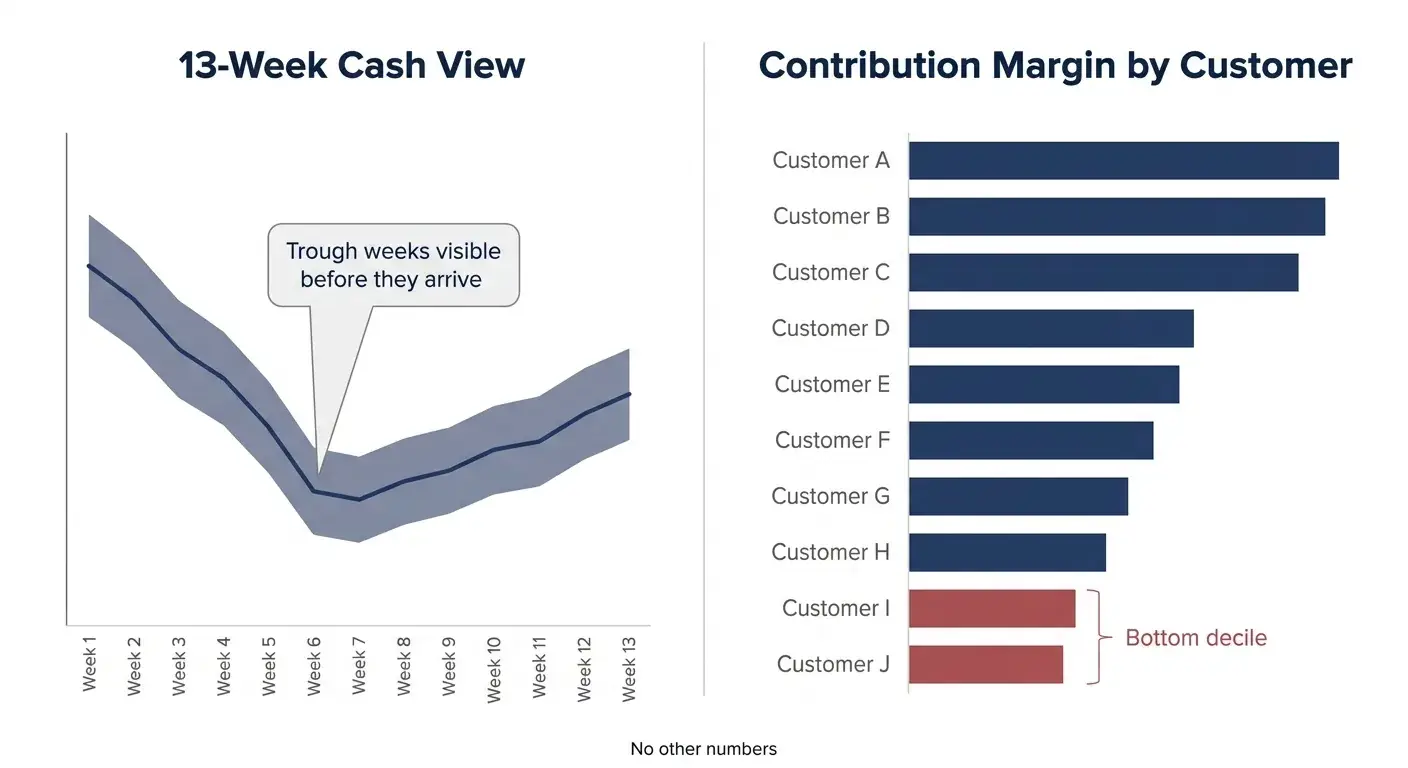
This is the most common reason owners call. A fractional CFO builds three things here: a rolling 13-week cash view that shows the trough weeks before it arrives, a forecast tied to the operating plan rather than to last year plus ten percent, and a margin map that shows contribution margin by customer, project, product, or location.
The margin work is where the money usually is. In a marketing agency, a $60,000 monthly retainer client can run below breakeven once you load senior time, pass-through media, and rework. Meanwhile a $18,000 client with tight scope carries the office. Until someone allocates labor to the job, both look like revenue. The same pattern shows up in a distributor whose freight and returns sit in one bucket, and in a call center where two queues share a floor and one of them destroys the blended rate.
Pricing follows from the map. So does working capital: payment terms, deposits, collection cadence, inventory turns, and the amount of cash growth will consume before it pays anything back. In my own diagnostic work, the three deliverables are a 13-week cash and working-capital view, a margin and profitability map, and a prioritized 90-day action plan, delivered in 10 business days after the complete data package arrives.
For the full breakdown of services, deliverables, and cadence, see “fractional cfo services.”
If you need help preparing for fundraising or a transaction
You can hire a fractional CFO for the event alone. Plenty of owners should. Fundraise prep, quality of earnings readiness, diligence support, and the model behind the raise all scope cleanly as projects with a start and an end.
The work has a standard shape. Rebuild the historical numbers so they survive a buyer’s or investor’s questions. Define the metrics the market expects for your model, whether that’s net revenue retention and CAC payback for SaaS or effective rate and retention for a workforce services firm. Produce the board-ready package: three-statement model, scenario cases, a cash bridge, and a clean data room. Then sit in the room when the questions come, because the person who built the model should be the one defending it.
Timing matters more than scope. For fundraising, six to twelve months of lead time lets you fix metric definitions and margin presentation before an investor sees them. For an exit, one source puts the optimal window at three to five years before a planned transition. That’s the gap between cleaning up numbers and actually changing them. I’ve been on that side of the table in more than 20 M&A and exit events, and the pattern holds: the seller who starts early negotiates from evidence, and the one who starts late negotiates from explanations.
Whether a project engagement or an ongoing relationship makes more sense for your situation is the decision guide in “outsourced cfo services.”
If you mainly need ongoing CFO leadership for a smaller business
If you get accurate reports and still can’t decide what to do with them, you need CFO leadership rather than more accounting. An accountant tells you what happened and files the return. A CFO takes a decision you’re facing, whether to add two salespeople, whether to extend terms to a large account, whether to take the equipment loan, and gives you the cash and margin consequences of each option.
Ongoing means embedded. A monthly rhythm with a forecast that gets updated, a cash view that gets re-run, and a short list of actions that gets closed out. It also means working alongside the people you already pay: bookkeeper, controller, CPA, and your leadership team. I don’t provide stand-alone bookkeeping, tax-return preparation, legal advice, or investment-banking services, and the engagements that work best are the ones where those roles stay where they belong.
The compact version: buy accounting when you need accuracy, buy CFO time when you need decisions, and expect to keep both. The full playbook for smaller founder-led companies, including the sequence of what to fix first, is in “cfo services for small business.”
How much a fractional CFO costs
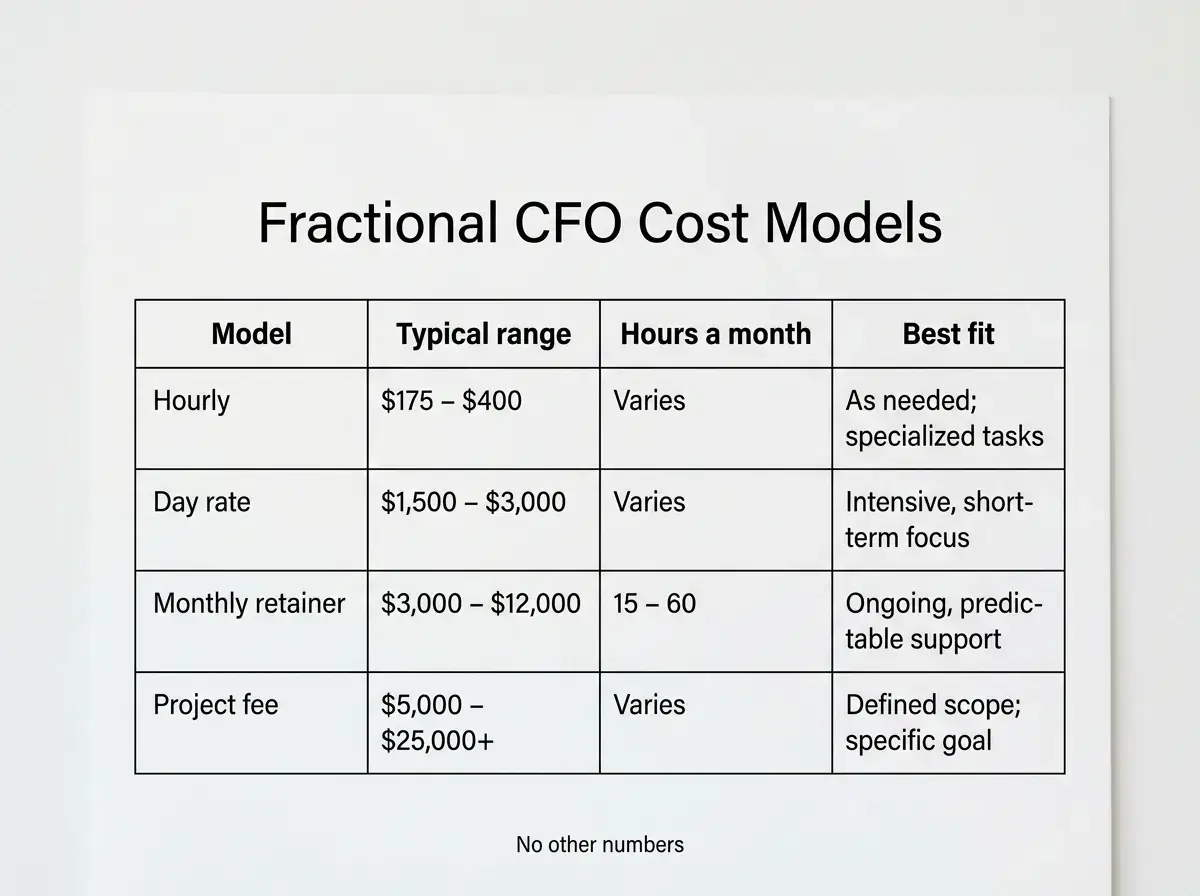
Monthly retainers commonly run $3,000 to $15,000, hourly work runs $150 to $500 an hour, and discrete projects run $10,000 to $35,000 and up. NerdWallet reports that the model exists because these companies either do not need or cannot carry a full-time CFO, so the work gets bought part time, on contract, or by the project.
| Model | Typical range | Hours a month | Best fit |
|---|---|---|---|
| Hourly | $150 to $500 an hour, senior operators $250 to $500 | As needed | Ad hoc questions, second opinions, short reviews |
| Day rate | $1,200 to $2,500 a day | 1 to 4 days | Planning sessions, diligence sprints, bank meetings |
| Monthly retainer | $3,000 to $15,000 a month | 8 to 40+ | Ongoing forecasting, cash, margin, board reporting |
| Project fee | $10,000 to $35,000+ | Scoped | Fundraise prep, diligence, model rebuild, audit prep |
Rough revenue-band view: pre-revenue to $1M tends to land at 4 to 8 hours a month; $1M to $5M at 8 to 15 hours; $5M to $15M at 15 to 25 hours; $15M to $50M at 25 to 40 hours, with fees rising through the retainer range as hours climb. A full-time CFO in the US can cost several hundred thousand dollars a year, including salary, benefits and incentives.
For my own work, ongoing engagements run $3,000 to $10,000 a month depending on plan, scope, and the condition of the finance function, across three plans that clients can move up or down anytime. The CFO Decision Diagnostic carries a planning range of $3,000 to $5,000, confirmed after a fit and scope call. If an ongoing engagement begins within 14 days of the readout, some or all of that fee may be credited to the first month.
Stage-by-stage pricing, what changes between bands, and how to read a proposal that quotes a fractional cfo hourly rate instead of a retainer are covered in detail in “fractional cfo for startups.”
What the work usually looks like month to month
Retainers translate into hours. The honest math is roughly 10 to 15 hours at $3,000, 20 to 25 hours at $7,000, and 40 or more hours at $15,000. What changes across tiers is cadence and depth, not the job title.
At about $3,000 a month, 10 to 15 hours. Monthly review of results, a maintained forecast, a 13-week cash view refreshed monthly, and one working session with you. Response inside a day or two on questions. One analysis project per quarter, not per month. This tier keeps the forward view alive and answers the decisions you bring.
At about $7,000 a month, 20 to 25 hours. Weekly cash cadence, monthly close review with the controller, margin by customer or project maintained rather than built once, a board or lender package, pricing and hiring models on request, and involvement in bank and insurance renewals. At this level I’m in your operating meetings and your KPIs get definitions that survive scrutiny.
At about $15,000 a month, 40+ hours. Effectively a part-time seat in the leadership team: multi-entity consolidation, system and reporting upgrades, managing the finance staff’s priorities, covenant tracking, and a live transaction or raise running alongside the monthly rhythm.
What sits outside almost every retainer: daily bookkeeping and reconciliations, running payroll, chasing AR invoices, closing the books, tax-return preparation, audit fieldwork, legal or securities opinions, and investment-banking services. Those belong to your bookkeeper, controller, CPA, auditor, attorney, and banker. A CFO who absorbs them stops doing the forward-looking work you actually bought.
Worth asking any candidate: how many clients do you carry, and what does week one of the month look like for you. The complaint that shows up in forum threads about fractional CFOs, including the long fractional cfo reddit discussions, is a provider spread across eight or ten companies with a few percent of attention each. Capacity is a scope question. Put it in the conversation early.
If you want to see what this rhythm would look like against your own numbers, start with a 15-minute call and describe the decision in front of you.
When a fractional CFO is worth the hire
It’s worth the hire when a decision larger than the fee depends on numbers you don’t trust. That’s the whole test. Below are the cases where I see it pay back fastest.
- Cash surprises in a profitable company. The P&L says yes and the bank account says no. Working capital is consuming the profit and nobody has modeled it week by week.
- Margins you can’t explain by customer, project, or channel. Blended gross margin is stable and the mix underneath it is rotting.
- Growth of 30% or more with no finance leadership. Headcount, terms, and inventory decisions are being made faster than the reporting can follow.
- A raise inside twelve months. Metric definitions, cohort data, and the financial narrative need time to become defensible.
- A sale, refinance, or acquisition. Diligence exposes every shortcut in the historicals.
- Lender or investor pressure. Covenant math, board packages, and forecast accuracy are now someone’s job by name.
- An expensive question you keep deferring. Whether to add the sales pod, open the second site, or fire the largest low-margin account.
What to ask in the first conversation: What decision are we trying to make, and by when. What does the first 30 days produce. Which deliverables arrive on a date, and which are best efforts. Who owns the close, and who owns the forecast. How do we measure whether this worked. How many other clients are you carrying this quarter.
Then choose the smallest next step that produces something you can act on. In my practice that step is the CFO Decision Diagnostic, a 10-business-day engagement that ends with a 13-week cash and working-capital view, a margin and profitability map, and a prioritized 90-day CFO action plan. Ongoing engagements carry a further commitment: at least $50,000 in profit opportunities found in the first 30 days, or the work is free. Every plan carries it.
Quick summary
- The fee should be small relative to the decision it informs.
- Growth, cash surprises, and deals are the three loudest triggers.
- Ask for dated deliverables, not a list of capabilities.
- Searching for a fractional cfo near me matters less than sector fit and available capacity.

How to judge whether your fractional CFO is actually helping
Judge on artifacts and decisions, not on meeting attendance or deck quality. If after three months you can’t name a decision that changed because of the work, the engagement is decorative. Here’s the scorecard I’d hold myself to.
First 30 days. A 13-week cash view you can read in about 30 seconds and answer what cash looks like in 90 days. A margin map showing contribution margin by customer, project, or SKU, with the bottom decile named. A written list of profit opportunities with dollar values and owners. A close calendar with dates. If month one produces only a narrative summary of your own financials, that’s the first warning sign.
Days 31 to 60. A forecast with at least two scenarios, tested against actuals. Working capital actions underway: terms, deposits, collections, or inventory. Pricing or mix changes proposed with the math attached. Covenant and banking position documented. Forecast variance on revenue and cash should be measurable now, even if it’s ugly.
Days 61 to 90. Monthly cash forecast variance inside roughly 10%, close completed within 10 business days, at least one margin or pricing change implemented with a dollar result attributed to it, and a board or lender package that gets fewer follow-up questions than the last one. In agency and BPO work, the tangible outcome usually looks like a dropped or repriced account and a labor-to-revenue ratio moving one or two points. In distribution it looks like turns improving and dead stock leaving.
Warning signs worth acting on: deliverables that slip twice, analysis that never converts into an action with an owner, reports that restate the accounting you already had, no point of view when you ask a direct question, and a provider who can’t tell you how many hours went where. A good CFO relationship produces uncomfortable recommendations, because the profit leaks are usually in a customer or a habit you like.
If you want a defined starting point with dated deliverables rather than an open retainer, tell me the decision you are facing and we can confirm scope on a short fit call.
Frequently Asked Questions
Does a fractional CFO need to be a CPA?
No. Many strong fractional CFOs come from operating and FP&A backgrounds without a CPA license, and the license says nothing about forecasting judgment. It does help when the work touches revenue recognition, audit readiness, or diligence. I hold an MBA and a CPA credential, Georgia State Board of Accountancy License #CPA012637, currently inactive, with an MBA in Marketing behind it.
What is a fractional CFO salary?
Fractional CFOs aren’t salaried by the client, so the comparable figure is annual engagement cost rather than compensation. At $3,000 to $15,000 a month, a client pays roughly $36,000 to $180,000 a year for the role. A provider’s own income depends on how many concurrent clients they carry, which is exactly why you should ask about client load before signing.
How can I become a fractional CFO?
The practical path is time in the seat: run FP&A, then a controller or CFO role, then a transaction or two. My own background covers CFO, COO, CTO, interim CEO, and co-founder roles across founder-led, PE-backed, and NASDAQ-listed companies over 30-plus years. Buyers between $5 million and $50 million are hiring judgment they can point at their own situation, so sector depth beats certification.
Does a fractional CFO replace my bookkeeper or CPA?
No, and an engagement that tries to usually fails. The bookkeeper records and reconciles, the controller owns the close, the CPA files the returns, and the CFO owns the forecast, the cash view, margin, and capital. I work alongside those roles and don’t take on stand-alone bookkeeping or tax-return preparation.
Can one fractional CFO handle multiple clients without my business getting ignored?
Yes, within limits. The limit is usually three to six concurrent retainer clients for one person carrying real ownership. Ask how many clients they hold this quarter, which days of the month are committed to you, and what the response standard is for an urgent question. If the answer is eight or ten clients, you’re buying attendance.
Why do some fractional CFOs charge $175 to $250 per hour while others charge $400 to $500?
The premium tracks three things: completed transactions, sector-specific depth, and willingness to own a number rather than advise around it. Someone who has run diligence on twenty deals prices differently from someone who has read about it. Stage-by-stage pricing and what scope changes between bands are covered in “fractional cfo for startups.”
Do I need a fractional CFO near me, or does remote work fine?
Remote works for most of the work, since the data, the meetings, and the models all travel. On-site time earns its keep for the first planning session, board meetings, lender or insurer meetings, and diligence. I’m based in the St-Petersburg, Florida region and work with founder-led companies across the country.
How long does a fractional CFO engagement usually last?
Project engagements run from 10 business days for a diagnostic up to several months for fundraise or diligence work. Ongoing retainers commonly last one to three years, until complexity or scale justifies a full-time seat. For most companies that arrives somewhere past $50M in revenue or with a finance team large enough to need daily management.
What should I ask in the first 30 days to prevent scope creep and surprise bills?
Ask for a written scope naming the recurring deliverables and their due dates, the hours or bandwidth included, the rate for work outside scope, and who approves it before it starts. Ask for a 90-day action plan with owners in the first month, so extra work is a deliberate decision. Ask how plan changes are handled; in my engagements clients can move up or down between plans anytime.