
A curated list of fractional CFO firms gets you a shortlist. It does not tell you which name on that list will still be useful in month six, when the forecast has to hold up in front of a lender and the margin report has to survive a customer-by-customer argument.
I have sat in the CFO seat for more than 30 years, and I have watched owners hire on rapport and regret it by the second quarter. The vetting work is not complicated. It comes down to a handful of criteria, six or seven questions with answers you can grade, and a short list of things that should end the conversation. Here is how I would run that process if I were the buyer.

What actually matters when choosing fractional CFO services
Five factors decide whether this works: stage and industry fit, hands-on capability, reporting speed and data integrity, who actually does the work, and whether the engagement is written down in measurable terms. Everything else is preference.
Stage and industry fit means the person has run finance at your size, not advised it from a distance. A $6M agency and a $40M distributor have almost nothing in common operationally. Hands-on capability means they build the model, own the close calendar, and go into the general ledger themselves. Reporting speed and data integrity are two halves of one thing: numbers that arrive late are useless, and numbers that arrive fast but do not reconcile are worse. Who does the work matters because the person selling is often not the person serving. A clear engagement turns a retainer into something you can grade at day 90.
Consider an e-commerce retailer at $12M. The owner needs to know how much cash the next inventory buy consumes, which acquisition cohorts pay back inside 90 days, and whether a credit line makes more sense than slowing growth. None of that comes out of clean bookkeeping. It comes from someone who can tie the marketing spend, the payback math, and the working capital cycle into one forward view and then defend it to a bank.
How do I know if a fractional CFO has the right industry and stage fit?
Ask for a named company at your revenue band in a business model like yours, the problem they were hired for, what changed, and how long it took. A strong answer is specific and slightly unflattering (it includes the part that took longer than planned). A weak answer stays at the category level, as in “I have worked with a lot of service businesses.”
Stage matters as much as sector. Bootstrapped and founder-led companies need cash discipline, pricing, and margin by customer. Sponsor-backed or investor-backed companies need covenant math, board packs, and diligence-ready records. A CFO fluent in one is not automatically fluent in the other, so ask which one they have done more of in the last three years.
Two examples of what fit sounds like in practice. A marketing agency should hear the candidate ask about utilization, scope creep on retainers, and gross margin by client before they ask about anything else. A SaaS company should hear questions about attach rate, CAC and payback, and whether revenue in the billing system reconciles to the general ledger. In SaaS and software, a platform modernization I led at CertiPay cut labor cost 17% and produced the company’s first customer-profitability reporting. That is the kind of outcome you should be able to hear described with a number attached.
One note on search habits. Typing “fractional cfo services near me” is a reasonable place to start, and there is value in a provider who can sit across your table. Proximity is a tiebreaker, not a criterion. Fit beats zip code every time.
What will you actually own week to week?
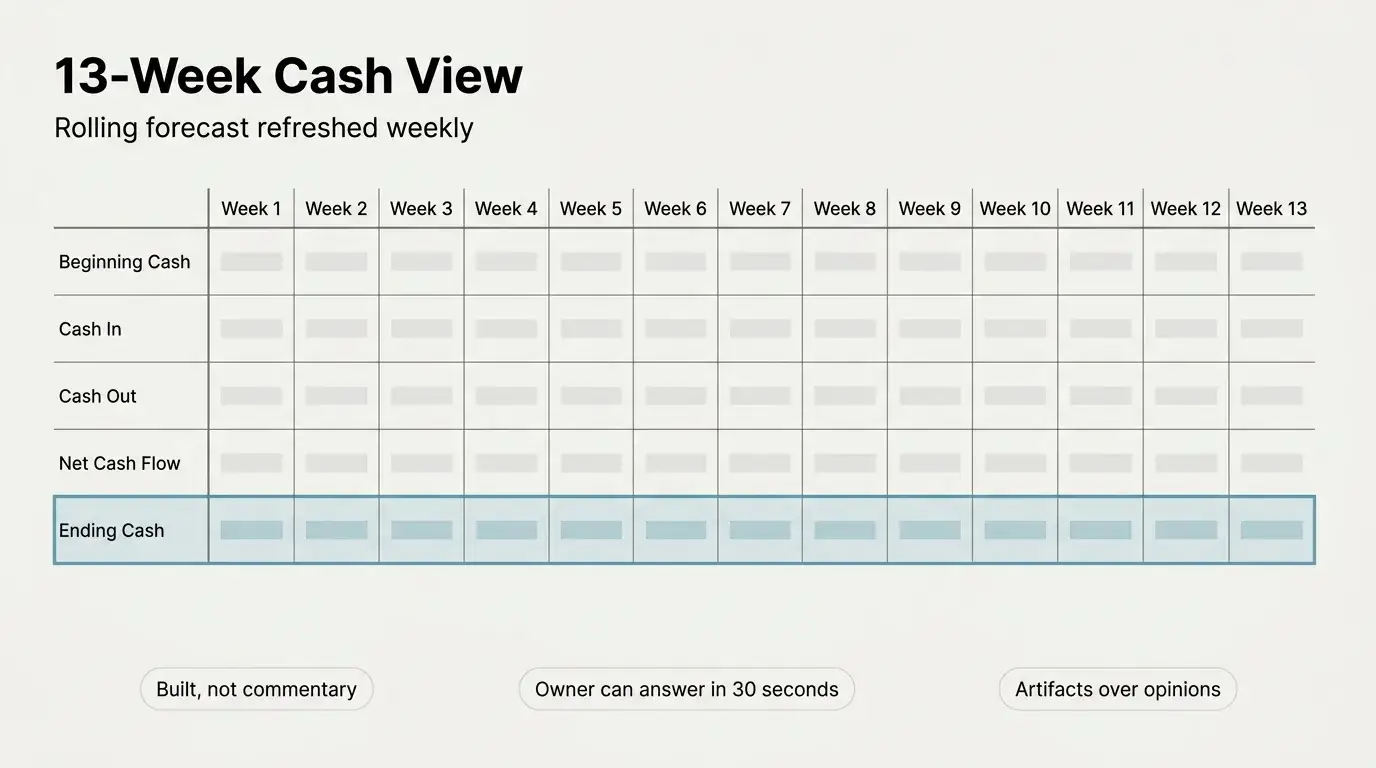
A good fractional CFO owns deliverables, not opinions. Week to week that means a rolling cash forecast, the close calendar and its accuracy, the forecast and its assumptions, pricing and margin analysis, lender and board materials, and the cleanup of whatever systems are producing bad data. According to CFO for My Business, the forecast should be forward-looking and built, not commentary on last quarter’s results.
Ask the candidate to walk you through their first 90 days as a list of artifacts. What will you hold in your hands at day 30, day 60, day 90? A strong answer names things: a 13-week cash view, a margin map by customer or project, a close that lands in days rather than weeks, and a prioritized action plan with owners. A weak answer describes meetings and “strategic support.”
The 13-week cash view is the single best test of whether someone will do real work. It is a rolling picture of money in and out. Once someone owns it, an owner can answer “what does cash look like in 90 days?” in about 30 seconds. If the candidate cannot describe how they build one, who feeds it, and how often it gets refreshed, they are advising, not operating.
Also ask what they will not touch. My own line is clear: no stand-alone bookkeeping, no tax-return preparation, no legal advice, no investment-banking services. A provider who claims all of it is either subcontracting quietly or overselling.
Who will do the work, and how many clients are they juggling?
Ask for the number. “How many active clients do you personally serve, and how many hours a month does my engagement get?” A candidate serving four to six companies with a named lead on each can give real attention. Founders in finance forums regularly complain about fractional CFOs carrying eight to ten clients and giving each a sliver of a week, which is exactly how reporting slips and model errors appear.
The honest answer includes a range and a cadence. Someone who will not disclose client load is telling you something. So is a firm that sends a partner to the sales call and an analyst to the work. Get the servicing lead’s name, background, and credentials in writing, and meet them before you sign.
| Scope level | Typical monthly time | What the lead should own | What to verify before signing |
|---|---|---|---|
| Light | Roughly 8 to 16 hours | 13-week cash view, monthly review, close oversight | Who refreshes cash weekly when the lead is with another client |
| Core | Roughly 20 to 30 hours | Above plus forecast, margin by customer, lender and board materials | Named lead, standing weekly slot, response time in writing |
| Deep | 40 hours and up | Above plus systems cleanup, pricing work, diligence or raise preparation | Bench depth, project plan with dates, who covers vacations |
Response time is worth pinning down separately from hours. CFO Advisors reports that one provider in this market publicly guarantees 24-hour turnaround on financial model updates, which shows the standard is achievable when a firm chooses to commit to it. Ask for the commitment in the agreement rather than the pitch.
If you want a low-pressure way to test any of this, a short 15-minute call about the actual decision in front of you will tell you more about a candidate than an hour of credentials talk.
What are the biggest red flags to walk away from?
The engagement letter is where good intentions go to die. Read it for what is missing.
Red flags: stop the process when you see these
- Deliverables described as “insights,” “strategic support,” or “access.” No artifact, no accountability.
- A 12-month minimum with no milestone exit. Long lock-ins move all the performance risk to you. Month-to-month forces the provider to earn the next month.
- Add-on fees for board decks, lender packages, or ad hoc analysis. Ask what triggers an extra invoice and get the answer in the document.
- No professional liability, or errors and omissions, coverage. Anyone touching your financial statements and lender materials should carry it and should tell you the limit without being pressed.
- They cannot name one client at your size in a comparable model. Or the references they offer are unreachable and generic.
- They plan to report around broken data forever. Ask what they do when revenue in the CRM does not tie to the general ledger. A good answer covers field design, mapping, and a reconciliation process. A bad answer adds a spreadsheet tab.
- A price far below everyone else. Under-market usually means under-qualified or a bench model where senior attention gets diluted.
- Slow, vague answers during the sales process. That is the best behavior you will ever see from them.
One more that gets missed: no handover terms. Ask who owns the models, the documentation, and the reporting templates when the engagement ends. If the answer is anything other than “you do,” fix it before signing.
What should a fair offer from fractional CFO services look like?
A fair offer is one page you could hand to your attorney and understand: named lead, listed deliverables with dates, meeting cadence, what is in scope and what is out, how scope changes get priced, response times, and 30-day exit terms on either side. It should also flex as you grow rather than resetting into a new negotiation the moment a lender or a buyer appears.
Structure matters more than the number. Most real engagements are monthly retainers tied to deliverables, so a published fractional CFO hourly rate tells you very little about what actually gets done. As Eightx notes, one ecommerce-focused firm reports monthly retainers of $4K to $12K as typical for brands with $5M to $50M in revenue. My own ongoing engagements run $3,000 to $10,000 a month depending on plan, scope and the condition of the finance function, and every plan carries the $50,000 guarantee: at least $50,000 in profit opportunities found in the first 30 days, or the work is free. Full pricing detail, including how hours convert to retainers, belongs in “fractional cfo for startups” rather than here.
Ask for a paid, scoped starting point instead of a long free discovery. Mine is a CFO Decision Diagnostic, a 10-business-day engagement in a $3,000 to $5,000 planning range that produces a 13-week cash and working-capital view, a margin and profitability map, and a prioritized 90-day action plan. A defined first step is a fair test of both sides.
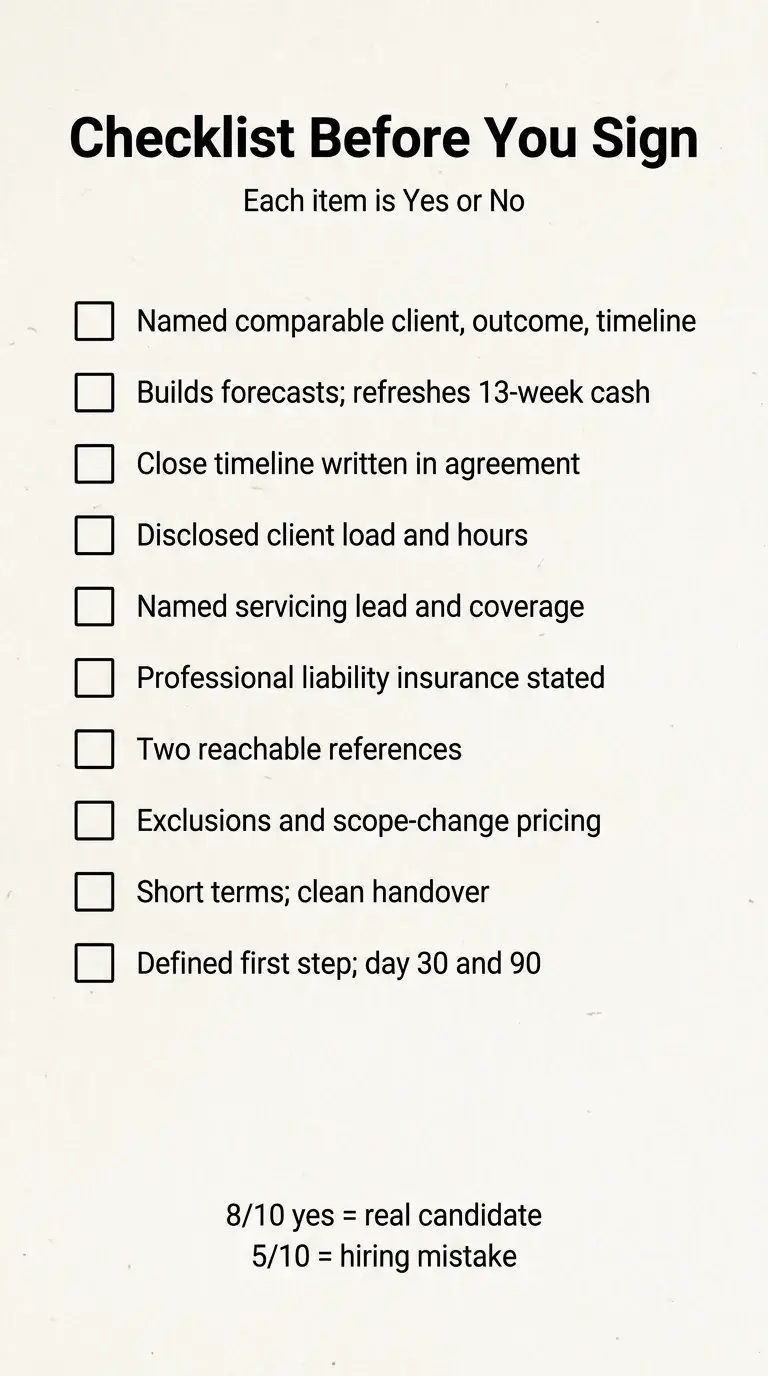
Checklist before you sign
Save this and run it against every provider on your shortlist. Every item is a yes or a no.
- Named a client at your revenue band in a comparable business model, with the outcome and the timeline.
- Builds models and forecasts personally, and can describe how a 13-week cash view gets refreshed.
- Commits to a reporting cadence and a close timeline in the agreement, not in conversation.
- Told you how many clients they serve and how many hours your engagement gets.
- Named the servicing lead you will actually work with, plus credentials and coverage during absences.
- Carries professional liability insurance and stated the limit.
- Gave you two reachable references at your size, ideally one who ended the engagement.
- Wrote down what is excluded and how scope changes are priced.
- Offers month-to-month or short terms with a clean handover of models and documentation.
- Has a defined first step with deliverables you can grade at day 30 and day 90.
Eight yeses out of ten is a real candidate. Five is a hiring mistake waiting to happen. If you want a second read on a shortlist you have already built, bring me the decision and the constraint and I will tell you plainly whether the work you need is CFO work or something cheaper.
Frequently Asked Questions
Is hiring a fractional CFO worth it?
It depends on whether your open questions are backward-looking or forward-looking. If you need clean history and a tax return, a controller and a CPA cover it. If you cannot answer what cash looks like in 90 days or which customers carry acceptable margin, the forward-looking layer has no owner. That is the gap this role fills. The full worth-it analysis, including where it does not pay off, is in “outsourced cfo services.”
How much does a fractional CFO charge?
Most charge a monthly retainer tied to deliverables rather than hours, with scope and the condition of your finance function driving the number more than your revenue does. A defined paid starting point, such as a 10-business-day diagnostic, is usually a cheaper way to test fit than a long engagement. Ranges, pricing models and the hours-to-retainer math are covered in “fractional cfo for startups.”
What is a fractional CFO salary?
There is no salary, because the role is a contract engagement rather than a payroll position. That is the point for a company between $5 million and $50 million in revenue: you buy the judgment without the full-time compensation, benefits and recruiting cost. Compare the retainer against the all-in cost of a full-time hire, not against the base salary alone.
How long after month-end should reports arrive?
Board-ready reporting should land within days of month-end, not four to six weeks later. Late reporting costs you correction time, which means you are steering the current month using numbers you cannot see yet. Ask candidates for their actual close timeline on their current clients and make it a term in the agreement.
What level of professional liability insurance should a fractional CFO carry?
Any provider touching financial statements, lender packages or investor materials should carry professional liability (also called errors and omissions coverage) and should state the limit without hesitation. Ask for the certificate before you grant system access. A refusal or a vague answer is a reason to stop.
How do I verify a fractional CFO’s track record beyond testimonials?
Ask for two references you can call, at your revenue band, and include one former client rather than only current ones. Then ask the candidate for a specific transaction or turnaround with the number attached, such as the number of M&A and exit events they have worked and what their role was on each. Vague experience claims fall apart quickly when you ask for company, outcome and timeline.
Should I choose a provider that brings bookkeeping too, or a standalone CFO?
It depends on your internal finance maturity. If the books are unreliable, a bundled model can be simpler, though you lose the independent second set of eyes on the accounting. If you already have a working bookkeeper or controller, a standalone CFO who works alongside them and your CPA usually gets you further, faster, because the money buys forecasting and margin work rather than data entry.