
A complete set of financial statements is five reports: the income statement, the balance sheet, the cash-flow statement, the statement of changes in equity, and the notes. Together they show what a business earned, what it owns and owes, how cash moved, and how owner capital changed over a period. The reports are standard. What changes is who is asking, how far back they want to see, and how much assurance sits behind the numbers.

What financial statements are and who needs them
Five reports make up the set. The income statement, the balance sheet, the cash-flow statement, and the statement of changes in equity carry the numbers. The notes explain how those numbers were built.
They get used in six situations. The situation decides how formal the set has to be:
- Monthly management. Decisions on headcount, pricing, customer mix, and spending inside the quarter.
- Bank financing. New facilities, renewals, and covenant certificates.
- Investor diligence. Raises, recapitalizations, and board reporting.
- Tax support. Books that tie to the return your CPA files.
- A sale or acquisition. Quality of earnings work starts with your statements.
- Contractual or regulatory reporting. Bonding, franchise approval, grant compliance, merchant processing, commercial leases.
The four numbered statements only make sense read together. A distributor can look profitable on the income statement and still miss payroll. An agency can show a sound balance sheet while receivables age past 60 days. That’s why a lender or a buyer asks for the whole set and a comparative period rather than one page.
In short:
- A complete set is five reports, and the first four tie to each other.
- Internal use sets no outside standard. An outside reader sets the standard for you.
- The notes and the accountant’s report tell a reader how much work stands behind the numbers.
How to decide which financial statements you need
Which statements you need, for how many periods, and with what level of accountant involvement is decided by the party asking, not by you. That single point saves more money than any other in this topic. Paying for an audit when the lender accepts a compilation is a five-figure mistake. Find your situation in the table, then match the period coverage and the assurance level before you buy anything.
| Your situation | Periods usually requested | Assurance level usually accepted |
|---|---|---|
| Internal management | Monthly statements for the current year, with budget versus actual | None. Internally prepared statements are the norm |
| Bank lender | Two to three years of comparative annual statements, current interim statements, and a debt schedule | Often internally prepared or compiled below a loan size threshold, review or audit above it |
| Outside investor | Three years where they exist, plus monthly detail for the trailing 12 months | Review at a minimum, audit once the round or the board calls for it |
| Sale or acquisition | Three years plus trial balances and transaction-level detail for a quality of earnings review | The buyer’s accountants test rather than accept. Audited years shorten diligence |
| Tax support | The full year that matches the return, reconciled to the general ledger | None required. The CPA works from your records |
| Contract or regulatory compliance | Whatever the agreement names, usually annual and on a fixed date | Named in the agreement, frequently review or audit |
Two practical notes. According to the Washington State Auditor, comparative statements mean two complete sets of statements, one for each comparative year, so a request for comparatives is a request for twice the work, not for one extra column. And before you compare quotes from accountants, fix the accounting framework in writing: US GAAP, IFRS, tax basis, cash basis, or another special-purpose basis. Quotes built on different frameworks are not comparable.
The income statement and how it differs from profit
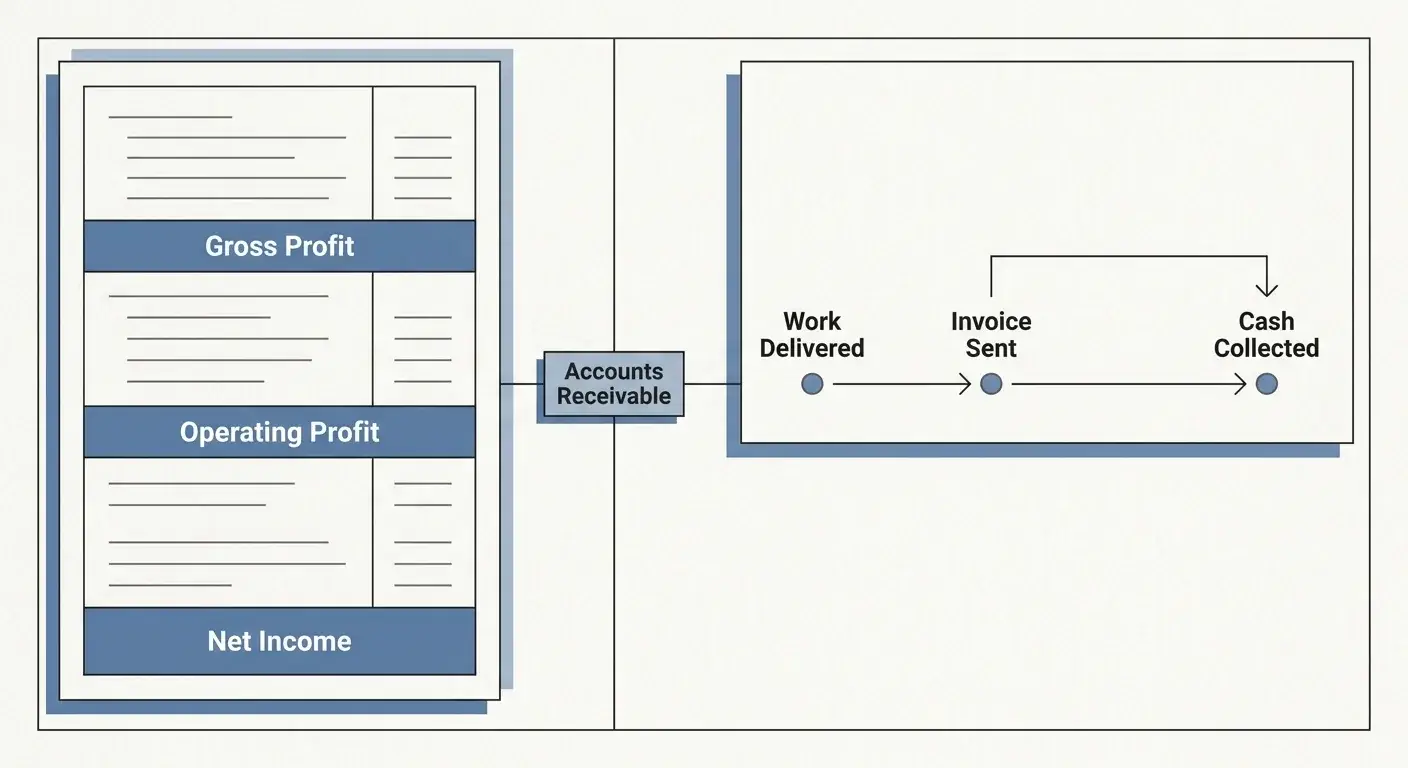
The income statement reports revenue and expenses over a period and ends in net income. It answers one question: did the business make a profit in that period. The balance sheet reports position on a single date, and the cash-flow statement explains the movement of cash between two balance sheet dates. Revenue lands on the income statement when it’s earned, not when the customer pays. That’s where most misreadings start.
Three profit lines sit inside it. Gross profit is revenue less cost of sales, and it tells you whether the delivery model works. Operating profit subtracts overhead, and it tells you whether the company works at its current size. Net income subtracts interest, taxes, and non-operating items such as a gain on the sale of equipment. Which is why “revenue minus expenses” and “revenues plus gains minus expenses plus losses” give different answers the moment a one-time item appears. Both describe the same statement. Only the second one holds up over a real year.
For the line-by-line walkthrough, a filled-in example, and the formats a bank expects to see, the full answer is in “profit and loss statement.”
The balance sheet and what it says about financial strength
Assets equal liabilities plus equity in every balance sheet ever produced, including the ones belonging to companies three weeks from insolvency. The equation balancing proves the bookkeeping is internally consistent. Strength shows up in four places, and you can read all four in about five minutes.
Liquidity. Current ratio under 1.0 means current obligations exceed the assets expected to cover them in the next year. Between 1.0 and 1.5 is workable for a service business with fast collections and thin inventory. A distributor with 90 days of stock on the floor needs more. Strip inventory out and look at the quick ratio too. A current ratio of 1.8 made of slow inventory and aging receivables is weaker than a current ratio of 1.2 made of cash.
Leverage. Debt to equity above 3.0 narrows your options fast, and most commercial loan agreements set a tighter limit than you would set yourself. Read the funded debt number, not total liabilities, and then check fixed charge coverage against the covenant in the agreement rather than against a textbook benchmark.
Working capital movement. Working capital is a dollar figure, not a ratio. The direction matters more than the level. Receivables growing faster than revenue means collections are slipping. Inventory growing faster than cost of sales means cash is going into the warehouse. An agency with days sales outstanding drifting from 42 to 61 over two quarters has funded a client’s cash flow with its own line of credit, whether or not anyone decided to.
Maturity and timing. Look at what comes due in the next 12 months: the current portion of term debt, a balloon, a line that resets, deferred revenue that has to be delivered. Cash runway is the honest version of this test. Cash on hand divided by average monthly net burn, with the next debt maturity marked on the same calendar.
Two warning signs worth naming. A balance sheet that hasn’t been reconciled to the bank and the loan statements is a draft, not a statement. And an “Ask My Accountant” or suspense balance carrying a real number means the income statement above it is also wrong.
The cash-flow statement and why profitable companies can still run out of cash
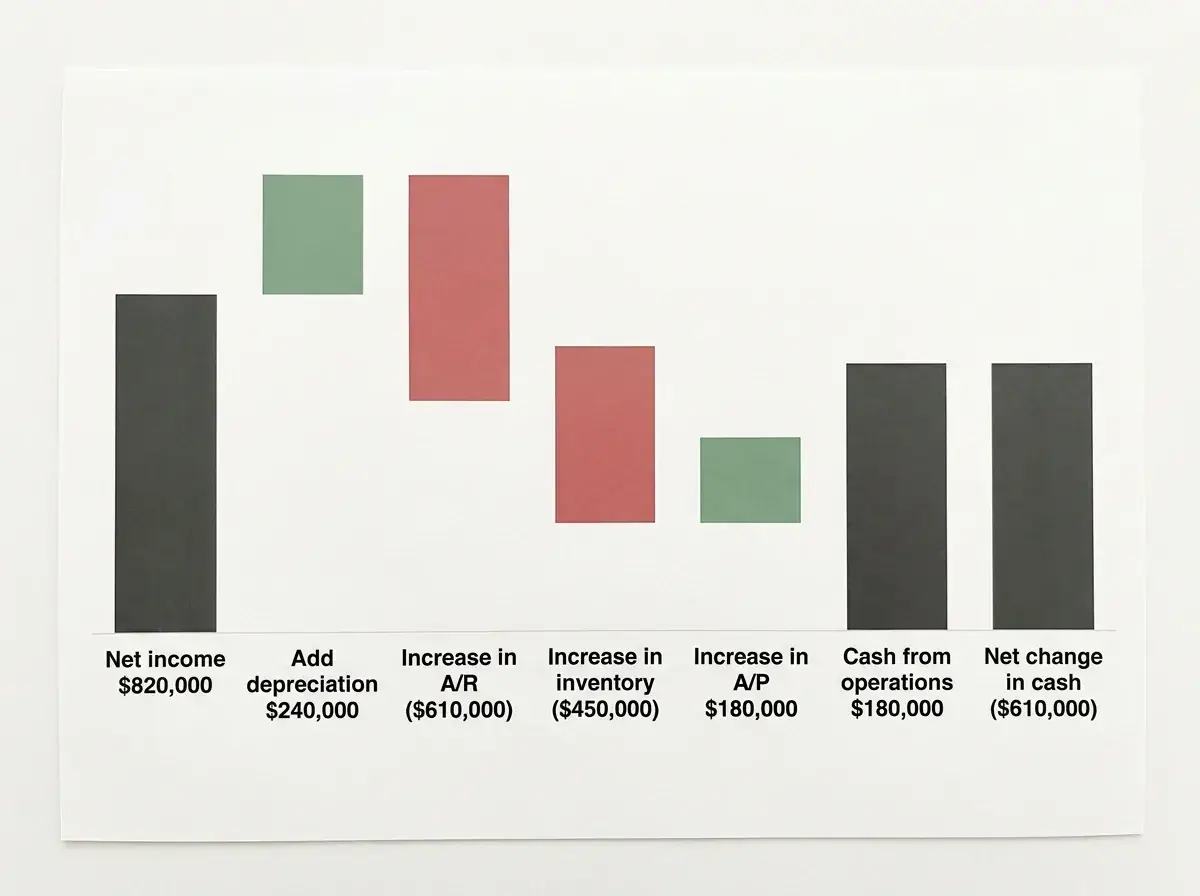
Profit and cash separate for five reasons, and the cash-flow statement is where each one gets a dollar amount: receivables, inventory, payables, non-cash charges such as depreciation, and anything that moves cash without touching the income statement at all. Loan principal, capital expenditures, and owner distributions belong in that last group. That’s why the bank balance can fall in a month the income statement calls the best of the year.
Worked example: a distributor with $14M in revenue and a cash problem
| Line | Amount |
|---|---|
| Net income | $820,000 |
| Add depreciation (non-cash) | $240,000 |
| Increase in accounts receivable | ($610,000) |
| Increase in inventory | ($450,000) |
| Increase in accounts payable | $180,000 |
| Cash from operations | $180,000 |
| Equipment and warehouse racking | ($300,000) |
| Term loan principal payments | ($240,000) |
| Owner distributions | ($250,000) |
| Net change in cash | ($610,000) |
The company earned $820,000 and ended the year with $610,000 less cash. Nothing went wrong in the accounting. Growth consumed $880,000 in receivables and inventory net of payables, and the three items below the operating line never appear on the income statement at all. Principal repayment, capital spending, and distributions aren’t expenses. This is the single most common reason a founder tells me the numbers feel wrong. The numbers are fine. The income statement was answering a question the founder wasn’t asking.
A 13-week cash view is the forward-looking version of this same bridge. It’s the layer most companies in the $5M to $50M range have nobody assigned to. The controller looks backward. The CPA handles the return. If you want that gap closed before the next covenant test, a short conversation about your numbers is a reasonable first step.
Statement of changes in equity and retained earnings
The statement of changes in equity is the roll-forward behind the equity section of the balance sheet: opening balance, plus net income, plus owner or shareholder contributions, less distributions or dividends, plus stock issued, less stock repurchased, plus or minus other movements such as stock compensation. Ask most people to name the main financial statements and they stop at three and leave this one out.
It’s short. In a closely held company it carries information the other statements don’t. Retained earnings that climb while cash doesn’t say earnings went into working capital or fixed assets. Distributions that exceed net income year after year tell a lender the owner is drawing the balance sheet down. A buyout of a departing partner, a second class of stock, or a note receivable from an owner all land here first.
For an owner it answers the one question the other three statements avoid: what happened to my capital. For a buyer or an investor it sets the baseline for the ownership math.
Notes to financial statements and what they change
The notes can move a headline number by a wide margin, and in diligence they usually do. They set the accounting policies that produced the revenue figure, disclose debt terms and covenants, quantify lease obligations, flag contingencies that aren’t yet liabilities, and name related-party transactions that may not be arm’s length. A clean-looking income statement with a revenue recognition policy that front-loads multi-year contracts is a different business than it appears.
Read them in this order:
- Basis of accounting and revenue recognition. Everything downstream depends on these two. A change in policy between periods makes comparisons meaningless until you normalize.
- Debt and covenants. Rates, maturities, financial covenants, cross-default language, personal guarantees. This is where a current liability hides as long-term, or the reverse.
- Leases and commitments. Operating leases and purchase commitments are real obligations with real cash requirements.
- Contingencies and subsequent events. Litigation, tax exposure, a customer lost after year end. A subsequent event can change a valuation more than the prior 12 months of results.
- Related-party transactions. Rent paid to an entity the owner controls, below-market compensation, intercompany balances. Every one of these gets normalized in a quality of earnings analysis.
- Estimates and concentrations. Allowance for doubtful accounts, inventory reserves, and any customer above roughly 10 percent of revenue.
If the statements are unaudited (the normal case in this revenue range), the notes plus the accountant’s report are the only disclosure of how much work stands behind the numbers. Read the report first. It states whether the accountant performed a preparation, a compilation, a review, or an audit, and whether they’re independent.
How financial statements are prepared from bookkeeping records
Preparation runs from source records to a finished statement set in a fixed sequence. Skipping a step upstream corrupts everything after it. the IRS reports that Publication 583, revised December 2024, tells businesses to prepare financial statements as part of ordinary recordkeeping, supported by records that substantiate what gets reported.
The workflow, in order:
- Collect source records. Bank and card statements, loan statements, payroll registers, merchant processor settlements, invoices, bills, inventory counts.
- Reconcile. Every bank account, every credit card, every loan balance to the lender’s statement. Unreconciled accounts make every later step guesswork.
- Post and correct. Classify transactions against the chart of accounts, fix misclassifications, clear suspense and undeposited funds.
- Review the balance sheet accounts. Receivables aging, payables aging, inventory, prepaid expenses, fixed assets and accumulated depreciation, accrued liabilities, payroll and sales tax, deferred revenue, debt, equity.
- Record adjusting entries. Depreciation, accruals, prepaid amortization, revenue cutoff, inventory adjustments, owner transactions coded correctly as distributions rather than expenses.
- Produce a trial balance, then generate the statements and run them against prior periods for anomalies.
- Add disclosures when the engagement or the framework calls for them.
Double-entry bookkeeping is the floor for any of this to hold together. Every transaction lands as a debit and a credit and the system flags itself when it doesn’t. Software will produce a statement on demand whether or not steps 2 through 5 happened. That’s the trap. A report pulled from accounting software on the 3rd of the month is a draft of the data. Treating it as a closed month is how companies end up presenting numbers to a bank they later have to walk back.
What financial statements cost
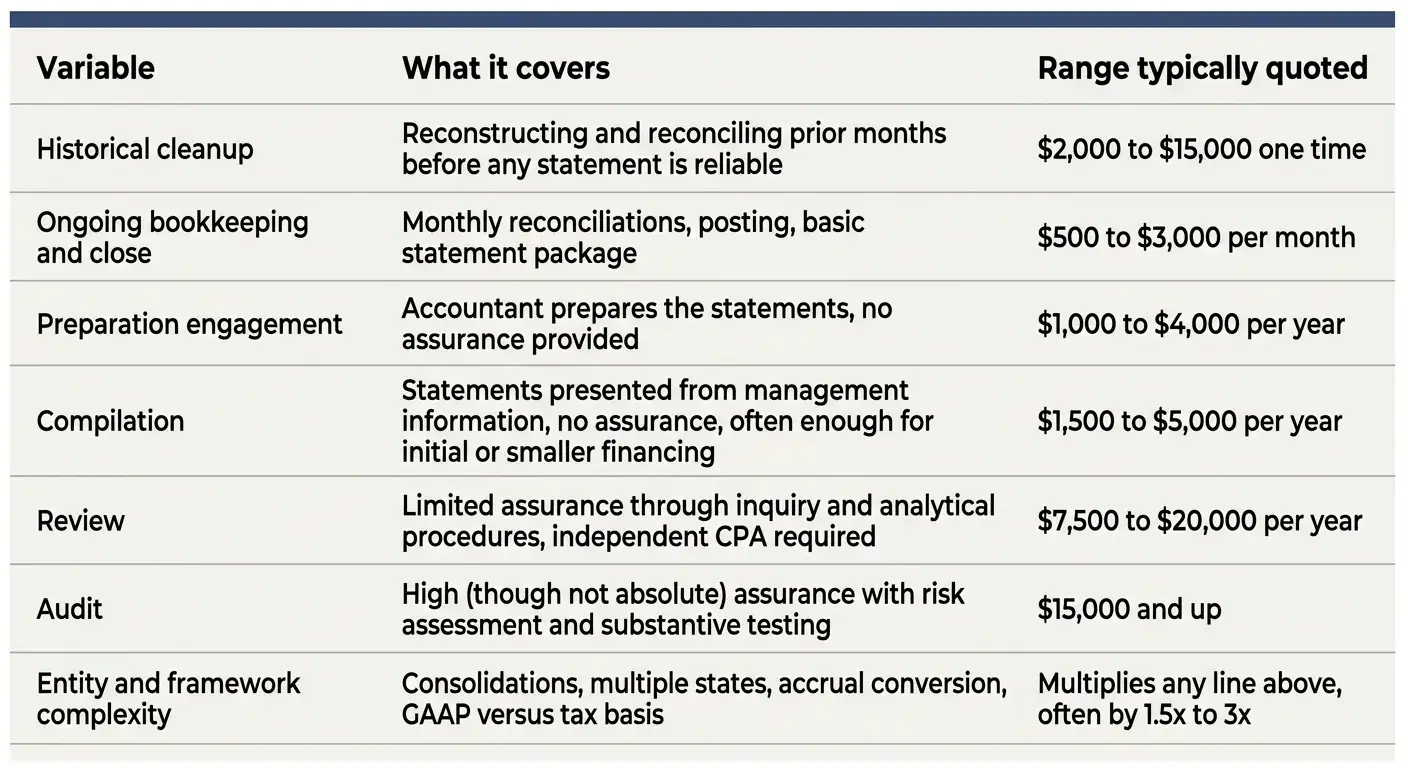
Cost tracks five variables: the condition of the books going in, the complexity of the entity, the accounting framework, how often statements are produced, and whether an accountant is preparing them or attesting to them. Accountant hourly rates commonly run from about $100 to more than $200 per hour, depending on experience and location.
| Variable | What it covers | Range typically quoted |
|---|---|---|
| Historical cleanup | Reconstructing and reconciling prior months before any statement is reliable | $2,000 to $15,000 one time, driven by months open and transaction volume |
| Ongoing bookkeeping and close | Monthly reconciliations, posting, basic statement package | $500 to $3,000 per month by volume and entity count |
| Preparation engagement | Accountant prepares the statements, no assurance provided | $1,000 to $4,000 per year |
| Compilation | Statements presented from management information, no assurance, often enough for initial or smaller financing | $1,500 to $5,000 per year |
| Review | Limited assurance through inquiry and analytical procedures, independent CPA required | $7,500 to $20,000 per year |
| Audit | High (though not absolute) assurance with risk assessment and substantive testing | $15,000 and up, rising sharply with inventory, multiple entities, or revenue recognition complexity |
| Entity and framework complexity | Consolidations, multiple states, accrual conversion, GAAP versus tax basis | Multiplies any line above, often by 1.5x to 3x |
One cost trap worth naming. Buying monthly reporting before the historical cleanup is done means paying twice for the same months.
When to hire a pro for financial statements
A bank loan doesn’t automatically require a CPA. It requires whatever the bank’s credit policy names, and below certain loan sizes many lenders accept internally prepared or compiled statements. Ask the lender in writing which level they accept before you spend anything. What does require professional help is the list below, where the cost of getting it wrong is larger than the fee.
- A fixed outside deadline. A loan closing, a renewal, a grant cycle, or a diligence request with a date on it.
- Books that don’t hold. The balance sheet doesn’t reconcile, opening balances are wrong, or a prior period was closed improperly.
- Profit without cash, or a bank balance that never matches what the software reports as profit.
- Complex revenue or inventory. Deferred revenue, multi-year contracts, percentage of completion, customer deposits, landed cost.
- A transaction in sight. A sale, a merger, an acquisition, or an outside investor, where three clean years matter more than this month’s margin.
- A compilation, review, or audit named specifically in an agreement you’ve already signed.
- A growth decision you can’t price. Which customers produce acceptable margin, what the next hire costs in cash, how much working capital the next year of growth will absorb.
What to ask any provider before you engage them:
- Which accounting framework will the statements be prepared under?
- Is this a preparation, compilation, review, or audit engagement, and are you independent?
- What’s included for cleanup, and what’s billed separately?
- What’s the turnaround after you receive complete data?
- Who will do the work, and what happens when the lender asks a follow-up question?
Two answers I’d want before engaging anyone, including me: how long the first piece of work takes and what happens if it finds nothing. My own entry point is a CFO Decision Diagnostic, a 10-business-day engagement, and on ongoing engagements I find at least $50,000 in profit opportunities in the first 30 days or the work is free. If your statements are accurate and you still cannot answer what cash looks like in 90 days, book a 15-minute call and describe the decision you are facing.
In short:
- The requesting party sets the level of assurance, so get it in writing before buying a service.
- Deadlines, broken books, complex revenue, and transactions are the triggers that justify paying for help.
- Settle the framework and the scope of cleanup in the engagement letter, not after the first invoice.
Frequently Asked Questions
Can I prepare financial statements myself using QuickBooks or Excel?
Yes, and most companies under $5M do. The software will generate an income statement, balance sheet, and cash-flow statement in seconds. What it won’t do is reconcile your loan balances, record depreciation, cut off revenue at period end, or stop you from coding an owner draw as an expense. Run the seven-step close described above before you call the output a statement.
What is the difference between preparation, compilation, review, and audit?
Preparation and compilation provide no assurance. In a preparation engagement the accountant builds the statements without being engaged to audit, review, or compile them. A compilation presents management’s information using the accountant’s reporting expertise, with no verification. A review provides limited assurance through inquiry and analytical procedures and requires independence. Under AICPA standards, different engagements provide different levels of assurance, and some provide no assurance at all.
When does a lender require reviewed or audited financial statements?
It varies by institution and loan size. Smaller facilities and initial financing often move on internally prepared or compiled statements. Reviews and audits tend to appear as loan size, collateral complexity, or covenant structure increases, and they become standard when outside investors or a bonding company are involved. Get the requirement in writing from the lender before buying a service.
Should my small business use cash-basis or accrual-basis financial statements?
If you carry inventory, bill in advance, or hold meaningful receivables, accrual is the only basis that shows what the business actually earned in a period. Cash basis can work for a small service firm collecting on delivery. Your recordkeeping method still has to clearly show income for your tax year, and many companies run accrual for management and lenders while filing on a tax basis.
Why doesn’t my accounting software profit match my bank balance?
Five usual suspects: loan principal payments, owner draws and distributions, capital expenditures, sales tax and payroll liabilities collected but not yet remitted, and unreconciled or duplicate transactions. The first four are real cash movements that never touch the income statement. Reconcile every bank, card, and loan account to the statement balance before chasing anything else.
Which financial statement should I read first?
Read the cash-flow statement first if cash is tight, the income statement first if you’re deciding on spending or pricing, and the balance sheet first if a bank or buyer is involved. Then connect them: a credit sale raises revenue and receivables but not cash, collection moves receivables to cash with no income statement effect, and a loan payment splits between interest on the income statement and principal on the balance sheet.
Where can I find financial statements examples to copy?
Use a format that matches your framework and the audience asking, since financial statements format differs between a lender package and a tax-basis year-end set. For a filled-in income statement with every line explained, see “profit and loss statement.”
Do financial statements have to follow GAAP?
Not always. A private company can report under US GAAP, IFRS, tax basis, cash basis, or another special-purpose framework. The reporting requirements follow the framework selected rather than any assurance standard. Lenders, investors, and contracts are what force GAAP, and governmental entities report under their own standard, GASB Codification Section 2200 for the annual comprehensive financial report.
How do I compare two companies that classify expenses differently?
Convert both to common-size statements, stating every line as a percentage of revenue, then align fiscal years and normalize for policy differences such as capitalization thresholds, inventory method, and whether delivery labor sits in cost of sales or operating expenses. Add back owner compensation above or below market and related-party rent. Without that normalization, a gross margin comparison between two companies in the same industry can be off by 10 points or more for purely presentational reasons.
How long should a monthly close take?
For a company in the $5M to $50M range with clean books, 5 to 10 business days after month end is a reasonable target. Reporting that lands later than that stops being useful for decisions inside the current month. If your close runs past 20 days, the constraint is usually unreconciled accounts or a single person holding every approval, not the volume of transactions.