
Selling your business includes finding the right buyer at the right price, and most importantly, answering the right questions before they’re asked. Every M&A deal lives or dies on financial clarity, and the sellers who walk away with top dollar are those who eliminate surprises before the first Letter of Intent lands on the table.
Most business owners assume their accountant has everything buttoned up. But tax-optimized books and buyer-ready financials are two different animals. Buyers don’t care what you reported to the IRS. They care about sustainable cash flow, defensible margins, and whether your numbers will hold up under scrutiny from their forensic accountants and lenders.
Research shows that roughly 60% of deals fall apart during due diligence. The culprit is almost always a financial surprise (an unsubstantiated add-back, a working capital dispute, or a gap between what the seller claimed and what the books actually show). The difference between a clean exit and a re-traded nightmare comes down to one thing: preparation.
This guide walks you through the exact financial questions buyers will ask, the timeline for getting your answers ready, and the checkpoints where most sellers either earn their premium or leave money on the table. Whether you’re 18 months out or already fielding offers, consider this your roadmap to a faster close and a higher valuation.

Why Financial Questions Determine Your Valuation
Here’s what buyers won’t tell you upfront: they start discounting your asking price the moment they see inconsistency, ambiguity, or missing documentation. Every unanswered question is a perceived risk. Risk kills multiples.
When a buyer’s analyst opens your financial data room, they’re not just checking boxes. They’re forming a thesis about whether your business can operate without you, whether your margins are real or artificially inflated, and whether the cash flow will cover the debt they’re about to take on. If your EBITDA relies on a single customer or your working capital swings wildly month to month, that thesis turns negative fast.
The businesses that command premium multiples share one trait: they make it easy for buyers to say yes. Clean financials, defensible add-backs, consistent month-over-month trends, and transparent reconciliations between tax returns and management accounts build trust. Trust translates directly into valuation.
Sellers who can’t explain a sudden margin spike, who scramble to produce AR aging reports, or who present EBITDA add-backs without supporting invoices end up in protracted negotiations. Buyers either walk or demand earnouts, seller notes, and heavy reps and warranties to offset their risk. The math is brutal. A 0.5x to 1.0x EBITDA haircut on a $5 million EBITDA business is $2.5 million to $5 million left on the table.
Financial due diligence isn’t about compliance. It’s about proving to a skeptical buyer that your numbers are real, repeatable, and won’t blow up three months after they wire the funds. The more questions you answer proactively, the faster your deal closes and the higher your exit value.
The 18 to 24 Month Pre-Sale Financial Readiness Timeline
Exit preparation should start long before you engage a buyer. The sellers who maximize value treat financial readiness as a strategic project rather than a last-minute cleanup.
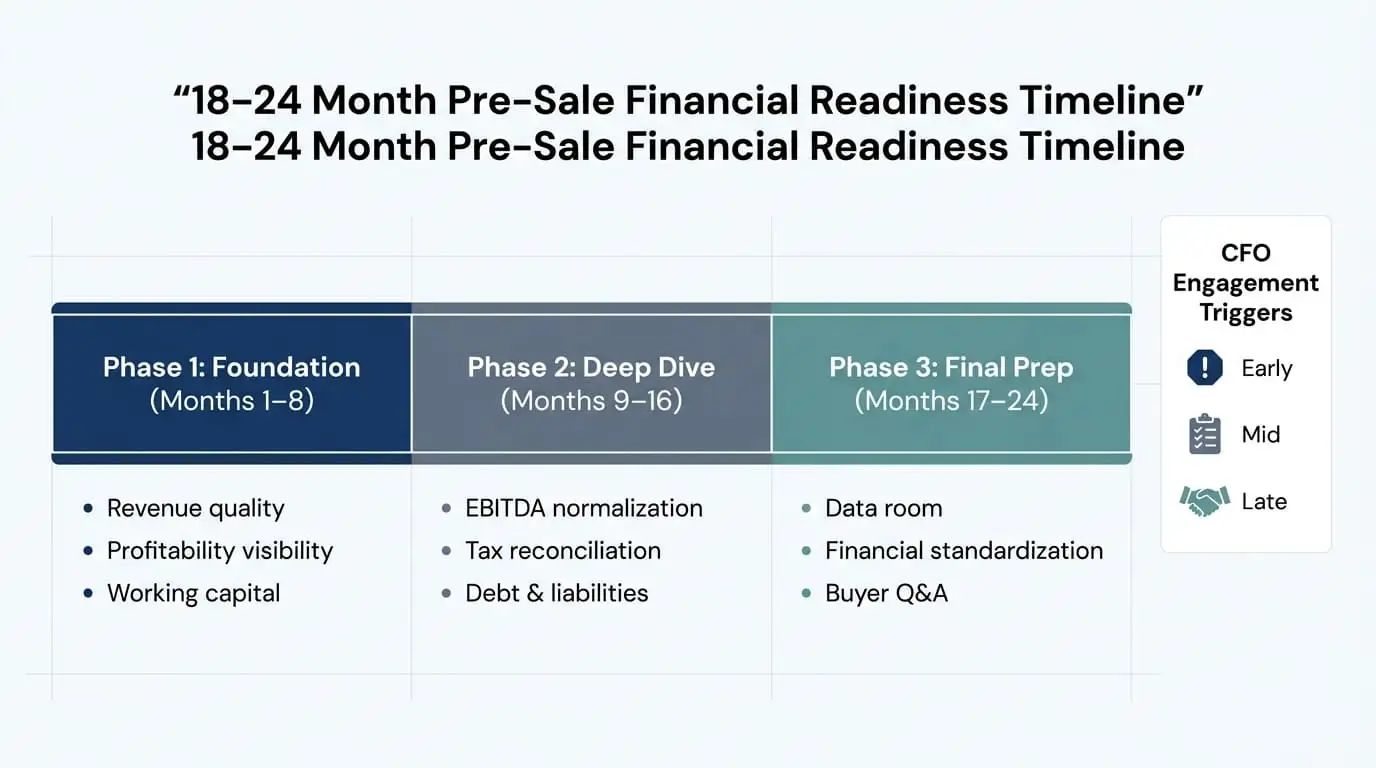
Most fractional CFOs recommend an 18 to 24 month runway, divided into three distinct phases: Foundation, Deep Dive, and Final Prep. Each phase targets specific buyer concerns and builds the financial infrastructure that supports a clean Quality of Earnings report and a fast close.
Phase 1: Foundation (Months 1 to 8)
This is the “establish trust” stage. You’re proving to buyers that your business runs on reliable systems. The focus is on revenue quality, profitability visibility, and working capital structure. Many sellers can handle this phase internally, though early complexity signals (customer concentration above 20% or inconsistent monthly closes) often warrant fractional CFO engagement.
Phase 2: Deep Dive (Months 9 to 16)
Buyers now look under the hood. This phase tackles EBITDA adjustments, tax compliance, debt structure, and owner discretion items. Expect to normalize earnings, reconcile tax returns to internal books, and document every add-back with third-party evidence. Fractional CFO involvement becomes standard here, not because sellers can’t do the work, but because buyers expect a professional counterpart to field their analysts’ questions.
Phase 3: Final Prep (Months 17 to 24)
The transition from internal review to buyer-facing documentation. You’re building a data room, standardizing financial statements, and preparing answers to the 50 or more questions buyers will ask in the first week of diligence. This phase is about reducing friction and demonstrating confidence through transparency.
| Phase | Timeline | Priority Categories | When to Engage a Fractional CFO |
|---|---|---|---|
| Foundation | Months 1 to 8 | Revenue quality, profitability visibility, working capital structure | If customer concentration is over 20%, inconsistent monthly closes, or unclear margin drivers |
| Deep Dive | Months 9 to 16 | EBITDA normalization, tax compliance, debt and liabilities, owner discretion | Standard engagement for businesses with over $2M EBITDA or complex add-backs |
| Final Prep | Months 17 to 24 | Data room, financial reconciliation, buyer Q&A preparation | If preparing for institutional buyers or seeking over 4x EBITDA multiple |
Buyers expect to see 12 to 18 months of “clean” financials (consistent accounting policies, normalized margins, and no sudden swings in key metrics). If you start six months before going to market, you’ll lock in your existing weaknesses and leave no room to tune performance or address red flags.
Phase 1: Foundation (Months 1 to 8)
The first phase is about proving reliability. Buyers want to see that your business generates predictable cash flow from stable customers, that your margins are real and not inflated by one-time events, and that your working capital doesn’t require constant cash injections to stay afloat.
This is the phase where many sellers discover gaps they didn’t know existed. Revenue that looks strong on a P&L can reveal concentration risk when analyzed by customer. Margins that seem healthy can disappear when owner perks and personal expenses are stripped out. Working capital that “just works” can turn into a $50,000 dispute at closing if receivables are aging poorly or inventory is obsolete.
Most of this work can be done internally, especially if you have a competent bookkeeper and a disciplined close process. However, if your monthly financials aren’t ready by the 10th of the following month, if you can’t break revenue down by customer or product line, or if you’re unsure what your true working capital position is, you’re not ready for serious buyer conversations.
Revenue Quality and Customer Concentration
Buyers care less about your top line and more about where it comes from. A $10 million business with 100 customers paying an average of $100,000 each is infinitely more attractive than a $10 million business with one customer paying $6 million and 40 others making up the rest.
Revenue quality starts with customer diversification. If your top customer represents more than 10% of revenue, buyers will discount your valuation to reflect churn risk. If your top three customers represent more than 30%, expect heavy scrutiny and possibly an earnout tied to retention.
The next layer is revenue type. Recurring revenue under contract is worth more than transactional revenue that resets to zero every year. Subscription models, retainer agreements, and multi-year contracts with auto-renewal clauses signal stability. One-time project revenue or seasonal spikes signal volatility.
Revenue Quality Checklist:
- Customer concentration: Do your top 10 customers represent more than 30% of total revenue?
- Recurring vs. transactional: What percentage of revenue is under contract or recurring?
- Contract terms: What is the average contract length, and do contracts auto-renew?
- Customer churn: What is your annual customer retention rate?
- Revenue trajectory: Is revenue growing, flat, or declining over the past 36 months?
- Revenue recognition: Are you using accrual accounting and recognizing revenue in the period earned?
If you can’t answer these questions with data, not anecdotes, you’re not ready for due diligence. Buyers will ask for a revenue breakdown by customer, by month, for the past three years. They’ll compare your largest customers’ contract terms to your overall revenue trends. They’ll model what happens if your top customer leaves. If the numbers don’t add up, they’ll walk or price in the risk.
Profitability and Cost Structure Clarity
Revenue is vanity. Profit is sanity. Buyers care about sustainable operating profit, not accounting tricks or founder discretion.
The first question buyers ask: what is your true EBITDA? Not the number on your tax return, and not the number inflated by aggressive add-backs. They want to see a clean P&L where revenue, cost of goods sold, and operating expenses are classified correctly and consistently over time.
The second question: what drives your margins? If gross margin is 60% this year but was 45% last year, buyers want to know why. Did you raise prices? Cut COGS? Shift your product mix? If you can’t explain the change with specific operational decisions, buyers will assume the spike is temporary and model downward.
Common Mistake: Conflating Revenue Growth with Margin Improvement
Many sellers celebrate top-line growth without tracking whether that growth is profitable. A 30% revenue increase that comes from low-margin customers or discounted contracts can actually compress EBITDA. Buyers model profitability per customer, per product line, and per channel. If your fastest-growing segment is your least profitable, expect questions.
The third layer is operating leverage. Buyers want to see that your cost structure scales. If you have to add a full-time employee for every $500,000 in new revenue, you’re not scalable. If your variable costs grow faster than revenue, your margins will shrink under new ownership.
You’ll hear the term Adjusted EBITDA repeatedly. This is your reported EBITDA plus add-backs for non-recurring, non-operating, and owner-specific expenses. We’ll go deep into EBITDA adjustments in Phase 2. For now, understand that buyers accept far fewer add-backs than sellers propose. If your Adjusted EBITDA is 40% higher than your reported EBITDA, expect a fight.
Working Capital: The Often-Overlooked Question
Here’s a scenario that plays out in nearly every small business sale. The seller and buyer agree on a $5 million purchase price based on a 5x EBITDA multiple. The deal reaches closing, and the buyer’s accountant calculates normalized working capital at $300,000. The seller’s books show only $250,000 in current assets minus current liabilities. Result: the seller owes the buyer $50,000 at close, or the purchase price is reduced accordingly.
Working capital disputes are the second most common reason deals blow up or get re-traded. The first is EBITDA adjustments.
Working capital is the cash tied up in your business to keep operations running: accounts receivable, inventory, and prepaid expenses, minus accounts payable and accrued liabilities. Buyers care because they need to inject cash on day one to fund receivables and inventory. If your AR is aging poorly or your inventory includes obsolete stock, buyers will either discount the purchase price or demand that you clean it up before closing.
The key metric is normalized working capital (the average working capital level needed to support your revenue over the past 12 to 24 months). Buyers calculate this average and set a “working capital peg” at closing. If actual working capital is below the peg, you owe the difference. If it’s above, the buyer owes you. The math is simple. The disputes are brutal.
When Working Capital Complexity Triggers the Need for Fractional CFO Input:
- DSO (Days Sales Outstanding) exceeds 60 days, or receivables show more than 10% over 90 days
- Inventory turnover is unclear, or a significant portion of inventory hasn’t moved in 12 or more months
- You can’t produce a clean AR aging report by customer and invoice date
- Your AP aging shows overdue balances, suggesting cash flow stress
- Working capital swings more than 20% month-to-month without seasonal explanation
If any of these apply, bring in a fractional CFO now. The cost of fixing working capital issues before going to market is a fraction of the cost of a post-LOI dispute or a reduced purchase price.

Phase 2: Deep Dive (Months 9 to 16)
This is where buyers get serious. They’ve moved past high-level financials and now want to see the footnotes, the tax returns, the debt agreements, and the rationale for every EBITDA add-back you’re claiming.
Phase 2 is also where fractional CFO engagement becomes the norm, not the exception. Buyers expect to negotiate with a financial professional who can model scenarios, defend adjustments, and answer technical questions without putting the owner in the hot seat. If you’re still handling due diligence solo at this stage, you’re signaling either that your business is too small to warrant professional support or that you’re not serious about maximizing value. Neither is a good look.
The work in this phase is technical, time-consuming, and high-stakes. Missteps here (unsupported add-backs, inconsistent tax filings, or undisclosed liabilities) will either kill your deal or compress your multiple by 1.0x or more.
EBITDA Adjustments: What Buyers Really Scrutinize
This is the most contentious area in any business sale. Sellers want to maximize Adjusted EBITDA to drive up valuation. Buyers want to minimize it to avoid paying for earnings that won’t recur under new ownership. The gap between these two positions is where deals get re-traded or fall apart.
Not all add-backs are created equal. Buyers will accept certain categories without much pushback (owner salary above market rate, one-time legal settlements, and non-recurring capital expenditures). But they’ll challenge others aggressively, especially discretionary expenses that blur the line between personal and business (country club memberships, family travel, and related-party rent above market rate).
The table below shows which adjustments buyers typically accept, which they scrutinize, and how to document each:
| Adjustment Category | Buyer Acceptance Likelihood | How to Document |
|---|---|---|
| Owner salary above market | High | Third-party salary surveys for comparable roles in your industry and region |
| One-time legal or consulting fees | High | Invoices, engagement letters, and proof the issue is resolved |
| Non-recurring capital expenses | Medium | Invoices, proof the asset is now in service, and explanation of why it won’t recur |
| Related-party rent above market | Medium | Independent appraisal or comparable lease data for similar space |
| Personal expenses (travel, meals, auto) | Low | Rarely accepted unless clearly personal and supported by credit card statements |
| “One-time” marketing or R&D | Low | Buyers assume these are ongoing unless you prove otherwise with a multi-year spend history |
Pro-Tip: EBITDA Add-Back Documentation
For every add-back over $25,000, prepare a one-page memo with: the expense category, the amount by year for the past three years, the rationale for adding it back, and supporting documentation (invoices, contracts, or third-party benchmarks). Buyers won’t accept verbal explanations. They need evidence that holds up when their lender or investor reviews the Quality of Earnings report.
The biggest mistake sellers make is inflating Adjusted EBITDA with aggressive add-backs and assuming buyers will accept them. In reality, buyers hire forensic accountants to challenge every line item. If your add-backs represent more than 20% of reported EBITDA, expect heavy scrutiny and a possible valuation haircut.
Tax Compliance and Historical Accuracy
Buyers will request five years of tax returns: corporate, sales tax, payroll tax, and any other filings relevant to your business. They’ll compare these returns to your internal financials and reconcile every material difference. If your tax return shows $1 million in revenue but your P&L shows $1.2 million, you’ll need to explain the gap with documentation, not a story.
Tax compliance is about accuracy, but also about proving to buyers and lenders that your business won’t inherit regulatory risk or undisclosed liabilities. Buyers often hire third-party tax advisors to review historical filings and flag issues (unpaid taxes, aggressive positions, or pending audits).
Tax Compliance Checklist:
- Corporate income tax returns for the past five years, filed and paid on time
- Sales tax filings for all applicable states, with no outstanding balances
- Payroll tax filings (federal and state) for the past five years, including 941s and W-2s
- Reconciliation memo explaining material differences between tax returns and internal financials
- Any tax audits or disputes in the past seven years, including resolution status
- Proof of estimated tax payments or tax reserves on the balance sheet
- Employment tax compliance, including 1099s for contractors and classification accuracy
- State and local business licenses, tax registrations, and permits, all current
If you’ve been aggressive on tax deductions, underreported revenue, or misclassified employees as contractors, deal with it now. Buyers will discover these issues during diligence, and the cost of fixing them under time pressure is far higher than addressing them proactively.
Debt, Liabilities, and Off-Balance-Sheet Obligations
Buyers care deeply about what they’re inheriting. Every dollar of debt on your balance sheet is a dollar they’ll either assume or deduct from the purchase price. Every contingent liability (pending litigation, warranty claims, or vendor disputes) is a potential post-close surprise that erodes value.
The most common mistake sellers make is assuming that “normal” business obligations don’t need to be disclosed. Buyers disagree. They want to see loan agreements, capital leases, equipment financing, lines of credit, and any personal guarantees the owner has provided. They’ll model debt pay-down and assess whether the business can service existing obligations plus new acquisition debt.
Specific Questions Buyers Will Ask:
- What is the current debt balance, and what are the terms (interest rate, maturity, covenants)?
- Are there any personal guarantees, and can they be released at closing?
- Are there any off-balance-sheet obligations (operating leases, earn-outs from prior acquisitions, or deferred compensation agreements)?
- Are there any pending or threatened lawsuits, regulatory actions, or warranty claims?
- Are there any vendor disputes or unpaid invoices over 90 days old?
- Are there any change-of-control provisions in customer or supplier contracts that could be triggered by the sale?
Decision-Trigger: If you have any of the following, consider engaging a fractional CFO to model debt pay-down strategies and structure a clean balance sheet before going to market:
- Debt exceeding 2x EBITDA
- Personal guarantees that can’t be released without full pay-down
- Off-balance-sheet liabilities exceeding $50,000
- Pending litigation or regulatory disputes
Buyers won’t walk away from a business with debt or liabilities, but they’ll price in the risk. A clean balance sheet with well-documented obligations signals professionalism and reduces friction during diligence.
Owner Discretion Items and Personal Expenses
Let’s be honest: many small businesses carry owner-funded expenses that won’t survive a sale. The company car, the country club membership, the family member on payroll who doesn’t actually work, the “business trips” that are 80% vacation. These are real, and buyers expect them.
The question isn’t whether you have discretionary expenses. It’s how you frame them. If you treat every personal expense as a legitimate add-back to EBITDA, buyers will push back hard. If you acknowledge the reality, separate personal from business, and present defensible add-backs with evidence, you’ll preserve credibility and value.
Mini-FAQ: Owner Discretion Items
Q: Can I add back my entire salary if I plan to leave the business after the sale?
A: Only the portion above market rate. Buyers will benchmark your role against salary surveys and accept the delta. If you’re paying yourself $300,000 but a comparable CFO would cost $150,000, you can add back $150,000, not $300,000.
Q: Can I add back family members on payroll?
A: Only if you can prove they don’t perform work that will need to be replaced. If your spouse handles bookkeeping, the buyer will need to hire a bookkeeper, so that salary stays in.
Q: Can I add back the cost of my company car?
A: Only the personal-use portion. If the car is 50% business use, you can add back the other 50%, supported by mileage logs.
Q: Can I add back related-party rent if I own the building?
A: Yes, but only the amount above market rate. Get an independent appraisal or comparable lease data to support the adjustment.
The golden rule: never add back an expense unless you can support it with third-party evidence and prove the new owner won’t incur it. Buyers won’t accept handwaving.
Phase 3: Final Prep (Months 17 to 24)
You’ve spent months cleaning your financials, normalizing EBITDA, and reconciling tax returns. Now it’s time to package everything for buyers in a way that builds confidence and accelerates decisions.
This phase is about reducing friction. The easier you make it for buyers to find answers, the faster your deal moves and the fewer opportunities they have to question your credibility. A well-organized data room, clean financial statements, and prepared answers to common questions signal that you’re serious, professional, and ready to close.
Data Room Organization and Document Standardization
Buyers expect a virtual data room organized by category, with clear folder structures, consistent file naming, and version control. A chaotic data room full of duplicate files, unclear labels, and missing documents is a red flag that suggests poor internal controls and increases buyer skepticism.
Data Room Folder Structure (by category and priority):
- 01: Executive Summary and Overview
Business overview memo, org chart, key metrics dashboard - 02: Financial Statements (CRITICAL)
3 to 5 years audited or reviewed financials, monthly P&L, balance sheet, cash flow for past 24 months, TTM financials - 03: Tax Returns (CRITICAL)
5 years corporate, payroll, and sales tax returns, reconciliation memo to internal financials - 04: EBITDA Adjustments and Add-Backs
Normalized EBITDA schedule, add-back memos with supporting invoices - 05: Working Capital and Balance Sheet Detail
AR aging, AP aging, inventory valuation, bank reconciliations - 06: Debt and Liabilities
Loan agreements, capital leases, debt schedules, personal guarantee status - 07: Customer Contracts and Revenue
Top 20 customer contracts, revenue by customer for 36 months - 08: Legal and Compliance
Corporate documents, permits, licenses, litigation history - 09: HR and Payroll
Org chart, employment agreements, benefit plans, payroll registers
Use consistent file naming: “2024-12-31_Balance_Sheet.pdf” not “BS Dec 31.pdf.” Version every document and purge duplicates. Buyers will log every file they open and every question they ask. A clean data room cuts diligence time by weeks.
Financial Statement Reconciliation and Audit-Readiness
Buyers will reconcile your internal P&L to your tax returns, your tax returns to your bank statements, and your bank statements to your balance sheet. If cash doesn’t match, they’ll assume fraud, sloppy accounting, or both.
The most common reconciliation issue is timing (revenue recognized in one period but deposited in another, or expenses paid in one month but recorded in the next). If you’re on cash-basis accounting, convert to accrual now. Buyers won’t accept cash-basis financials for anything larger than a lifestyle business.
Pro-Tip: Materiality Thresholds
If your QuickBooks cash account doesn’t match your bank statements by more than 1%, hire an accountant to reconcile it. Buyers will assume every discrepancy is material until proven otherwise. Small mismatches suggest weak controls. Large mismatches suggest bigger problems.
The second layer is audit-readiness. Most small businesses don’t have audited financials, but buyers expect the next best thing: reviewed financials or compilation-level statements prepared by a CPA with clean footnotes and consistent policies.
If you’ve never had a financial review, engage a CPA 12 months before going to market. The review process will surface inconsistencies, misclassifications, and missing documentation. Fix these issues now, not during buyer diligence.
Preparing Answers for Buyer Due-Diligence Questions
Buyers won’t wait for you to scramble for answers. They’ll send a request list with 50 to 100 questions in the first week of diligence. Your response time and accuracy set the tone for the entire negotiation.
The best defense is preparation. Build a Q&A document that anticipates the most common buyer questions and provides answers with supporting data. Update it monthly so it’s always current.
Mini-FAQ: Common Buyer Questions
Q: What is your trailing-twelve-month (TTM) revenue and EBITDA, and how does it compare to the prior year?
A: Provide TTM financials and a variance memo explaining any material changes.
Q: What is your customer concentration, and what percentage of revenue comes from your top 10 customers?
A: Provide a revenue-by-customer table for the past 36 months.
Q: What is your gross margin by product or service line, and how has it trended over the past three years?
A: Provide a margin analysis by segment, with explanations for any changes over 5%.
Q: What is your normalized working capital, and how do you calculate it?
A: Provide a 24-month working capital table, calculate the average, and explain any seasonal adjustments.
Q: What EBITDA add-backs are you claiming, and what documentation supports each?
A: Provide the normalized EBITDA schedule with memos and invoices for every add-back over $10,000.
Q: Are there any contingent liabilities, pending litigation, or off-balance-sheet obligations?
A: Provide a liabilities schedule and legal memo confirming status.
The faster you respond, the more confidence you build. Slow, incomplete, or inconsistent answers raise red flags and invite deeper scrutiny.
If you’re preparing for institutional buyers or targeting a multiple above 4x EBITDA, consider engaging a fractional CFO to serve as your “deal counsel.” They’ll field buyer questions, prepare responses, and keep you out of the weeds so you can focus on running the business. For more on how fractional CFO support can streamline your exit, visit morganfractionalcfo.com.
When to Engage a Fractional CFO: Decision Triggers
Fractional CFO engagement isn’t overhead. It’s insurance against deal risk and a multiplier on exit value. The question isn’t whether to engage a fractional CFO. It’s when.
Here’s a three-tier decision framework based on business complexity and deal stage:
Early Engagement (Months 1 to 8):
- Customer concentration exceeds 20% of total revenue
- Monthly financials aren’t ready by the 10th of the following month
- Gross margin or EBITDA swings more than 10% month-to-month without clear seasonal patterns
- You can’t produce a clean AR aging or AP aging report
- You’ve never reconciled your internal P&L to your tax returns
Mid-Stage Engagement (Months 9 to 16):
- You’re targeting institutional buyers or a multiple above 4x EBITDA
- Your Adjusted EBITDA includes add-backs exceeding 20% of reported EBITDA
- You have debt exceeding 2x EBITDA or off-balance-sheet obligations
- You’ve never prepared normalized working capital or a Quality of Earnings schedule
- You’re fielding buyer questions and struggling to keep up with data requests
Late-Stage Engagement (Months 17 to 24):
- You’ve received an LOI and due diligence has started
- Buyers are challenging your EBITDA add-backs or working capital peg
- You’re spending more than 10 hours per week answering buyer questions
- You lack a professional counterpart to negotiate with the buyer’s CFO or accountant
Quick-Win: ROI of Early Fractional CFO Engagement
A business selling for $10 million where better-prepared EBITDA add-backs and margin improvements increase Adjusted EBITDA by 10% can yield $500,000 to $1 million in incremental proceeds at a 5x to 10x multiple. Fractional CFO fees for exit prep typically range from $25,000 to $75,000 over 6 to 12 months. The ROI is often 10x to 40x the cost.
Engaging a fractional CFO isn’t a sign of weakness. It’s a signal to buyers that you’re serious about maximizing value and that you have the infrastructure to support a professional transaction.

The 10 Questions Every Business Seller Must Answer
Before you engage a buyer, answer these 10 questions with data, not assumptions:
- Revenue Quality: What percentage of your revenue is recurring or under contract, and what is your customer concentration (top 10 customers as % of revenue)?
- Revenue Trajectory: What is your 36-month revenue trend, and can you explain any material changes (over 10%) with specific operational decisions?
- Profitability: What is your gross margin, operating margin, and EBITDA margin for each of the past three years, and how have they trended?
- Adjusted EBITDA: What add-backs are you claiming, and can you support each with third-party documentation (invoices, benchmarks, contracts)?
- Working Capital: What is your normalized working capital over the past 24 months, and are there any seasonal adjustments?
- Cash Flow: What is your operating cash flow vs. reported profit, and can you reconcile the difference?
- Debt and Liabilities: What is your total debt, and are there any off-balance-sheet obligations, contingent liabilities, or personal guarantees?
- Tax Compliance: Are all corporate, payroll, and sales tax returns filed and paid for the past five years, and can you reconcile tax returns to internal financials?
- Customer and Supplier Concentration: Do any contracts have change-of-control clauses, and are there any vendor disputes or overdue payables?
- Owner Dependency: Can the business operate without you for 90 days, and have you documented key processes and customer relationships?
If you can’t answer all 10 with confidence and supporting data, you’re not ready to go to market.
Final Checklist: 90 Days Before You Engage a Buyer
This is your final push. Everything before this was preparation. Now you’re building the package that buyers will judge you on.
Critical (Non-Negotiable):
- 36 months of monthly P&L, balance sheet, and cash flow statements, formatted consistently
- 5 years of tax returns (corporate, payroll, sales tax) with reconciliation memo to internal financials
- Normalized EBITDA schedule for past 3 years plus TTM, with add-back memos and supporting invoices
- Working capital analysis (24-month average) with AR aging, AP aging, and inventory valuation
- Customer revenue table (top 20 customers, % of revenue, contract terms) for past 36 months
- Debt schedule with loan agreements, maturity dates, interest rates, and covenant status
- Legal entity documents (articles of incorporation, bylaws, operating agreement, cap table)
- Org chart, employment agreements for key staff, and owner transition plan
High-Priority (Strongly Recommended):
- Data room organized by folder with consistent file naming and version control
- Q&A document with pre-written answers to the 50 most common buyer questions
- Bank reconciliation for past 24 months, showing cash balances match financial statements
- Quality of Earnings prep memo (if engaging sell-side QoE provider)
- Forward-looking 3-year projections with explicit assumptions tied to historical trends
- List of all business licenses, permits, and regulatory filings with expiration dates
- Summary of any pending litigation, disputes, or warranty claims with resolution status
Nice-to-Have (Differentiators):
- KPI dashboard showing monthly trends in key metrics (revenue per customer, churn, DSO, gross margin)
- Product or service-line P&L showing margin by segment
- Capex schedule for past 3 years, separating maintenance vs. growth capex
- Independent appraisal or valuation (if selling a capital-intensive business)
- Customer and employee satisfaction surveys (if retention risk is a concern)
If you’ve completed the critical and high-priority items, you’re ahead of 80% of sellers. Buyers will notice, and it will show up in your valuation and close timeline.
Conclusion: Financial Clarity Accelerates Exit Value
Financial preparation isn’t about hiding problems. It’s about de-risking the buyer’s perspective and proving that your numbers are real, repeatable, and won’t blow up after closing.
The sellers who walk away with top dollar are those who answer questions before they’re asked, who provide documentation without being prompted, and who treat due diligence as an opportunity to build confidence, not a gauntlet to survive.
Every question you answer early, every add-back you document, and every reconciliation you complete is a signal to buyers that your business is worth the premium you’re asking. The more transparency you provide, the faster your deal closes and the fewer opportunities buyers have to re-trade.
Exit preparation is a long game, but the payoff is measured in millions. If you’re 18 to 24 months out, start now. If you’re closer, engage professional support and prioritize the financial questions that matter most to buyers: EBITDA quality, working capital, customer concentration, and cash flow sustainability.
The financial questions you answer today will determine the valuation you achieve tomorrow. Make sure you’re ready.
Frequently Asked Questions
What is the most important financial metric buyers focus on during due diligence?
Adjusted EBITDA is the single most scrutinized metric. Buyers use it to calculate valuation multiples and assess sustainable earnings. They won’t accept your claimed EBITDA without verification. They’ll review add-backs, reconcile to tax returns, and often commission a Quality of Earnings report to validate your numbers.
How far in advance should I start preparing my financials before selling my business?
Most fractional CFOs recommend 18 to 24 months. This gives you time to clean up accounting inconsistencies, normalize margins, implement monthly close processes, and generate 12 to 18 months of “clean” financials that buyers expect to see. Starting six months out locks in existing weaknesses and leaves no room to improve valuation.
What EBITDA add-backs will buyers accept, and which will they reject?
Buyers typically accept owner salary above market rate, one-time legal or consulting fees, and non-recurring capital expenses, provided you document each with third-party evidence. They’ll reject or heavily discount personal expenses like travel and meals, discretionary perks, and “one-time” items that recur year after year. Any add-back over $25,000 should come with a supporting memo and invoices.
How does customer concentration affect my business valuation?
If your top customer represents more than 10% of revenue, buyers will discount your valuation to reflect churn risk. If your top three customers exceed 30%, expect heavy scrutiny and possibly an earnout tied to retention. Recurring revenue under contract partially offsets this risk, but concentration above 20% will almost always compress your multiple.
What is normalized working capital, and why does it matter at closing?
Normalized working capital is the average level of working capital (current assets minus current liabilities) your business needs to operate over the past 12 to 24 months. Buyers set a “working capital peg” at this level. If actual working capital at closing is below the peg, you owe the difference. If it’s above, the buyer owes you. Poor AR or inventory management can cost you $50,000 or more at closing.
How much does it cost to hire a fractional CFO for exit preparation?
In the US, fractional CFO retainers typically range from $3,000 to $12,000 per month. Exit preparation packages over six to twelve months often run $25,000 to $75,000 total, including financial cleanup, EBITDA normalization, data room preparation, and buyer Q&A support. Given that better-prepared financials can increase exit value by 10% to 20% or more, the ROI is often 10x to 40x the cost.
Do I need audited financial statements to sell my business?
Not always, but institutional buyers and lenders often require at least reviewed financials. If you’ve never had a financial review or audit, engage a CPA 12 months before going to market. The review will surface inconsistencies and give you time to fix them. Unaudited, unreviewed financials signal weak internal controls and reduce buyer confidence.
What happens if my tax returns don’t match my internal financials?
Buyers will ask for a reconciliation memo explaining every material difference. Small timing differences (revenue recognized in one period, cash received in another) are normal if you’re on accrual accounting. Large, unexplained gaps raise red flags and can kill deals. If your tax returns underreport revenue or overstate expenses for tax purposes, deal with it now. Buyers will discover the discrepancy during diligence, and the cost of fixing it under time pressure is far higher than addressing it proactively.